
Silver prices have surged past $100 per ounce in January 2026, triggering a cascade of 15-20% price increases across the automotive resistor supply chain. For Tier 1 and Tier 2 automotive electronics procurement managers, EMS factory supply chain leaders, and electronic design engineers, this "Silver Storm" represents the most significant cost pressure event since the 2017-2018 passive component shortage. The window to secure automotive grade resistors at current pricing is closing rapidly, with major manufacturers including Yageo and Walsin Technology implementing price hikes effective February 1, 2026. This comprehensive guide provides actionable intelligence on market dynamics, AEC-Q200 certified component sourcing, and strategic stocking recommendations to protect your production lines from supply disruptions.
What Is the 2026 "Silver Storm" and Why Should You Care?
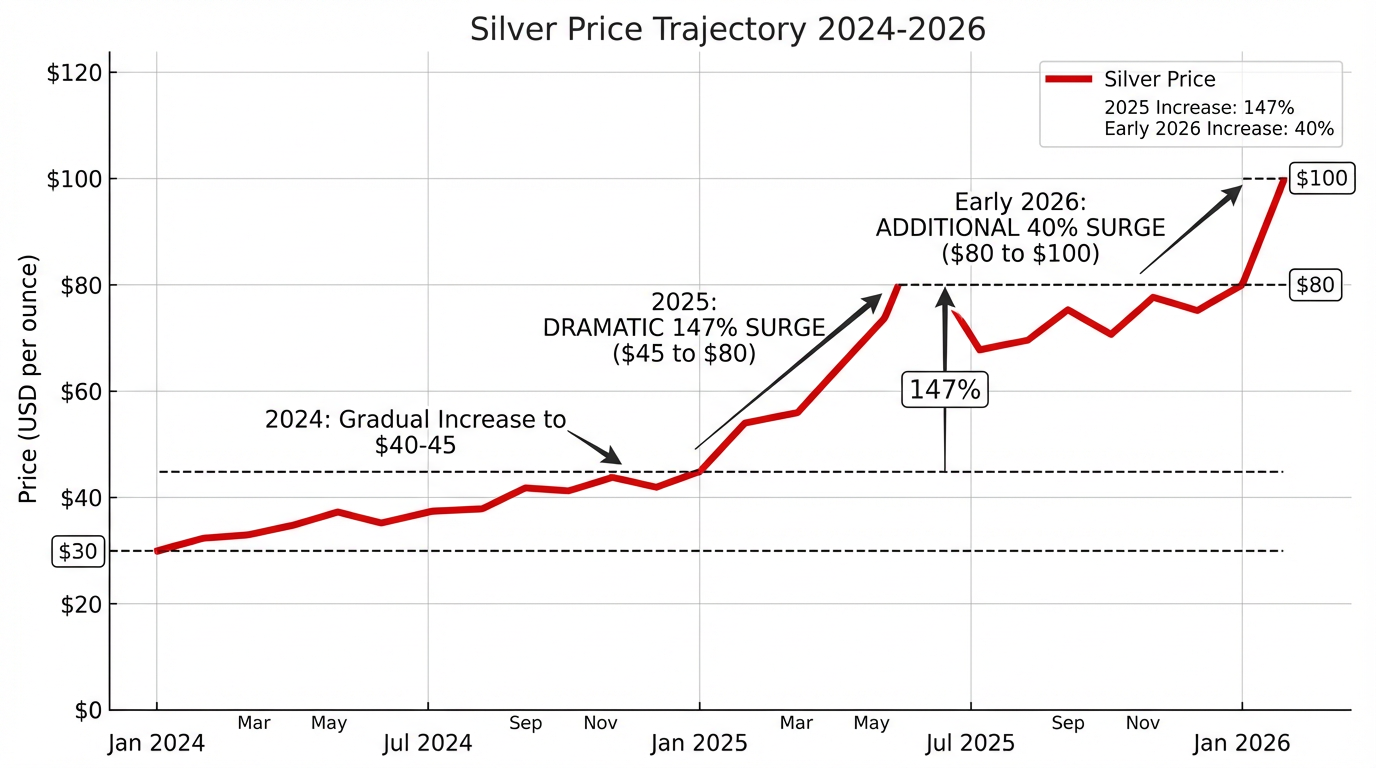
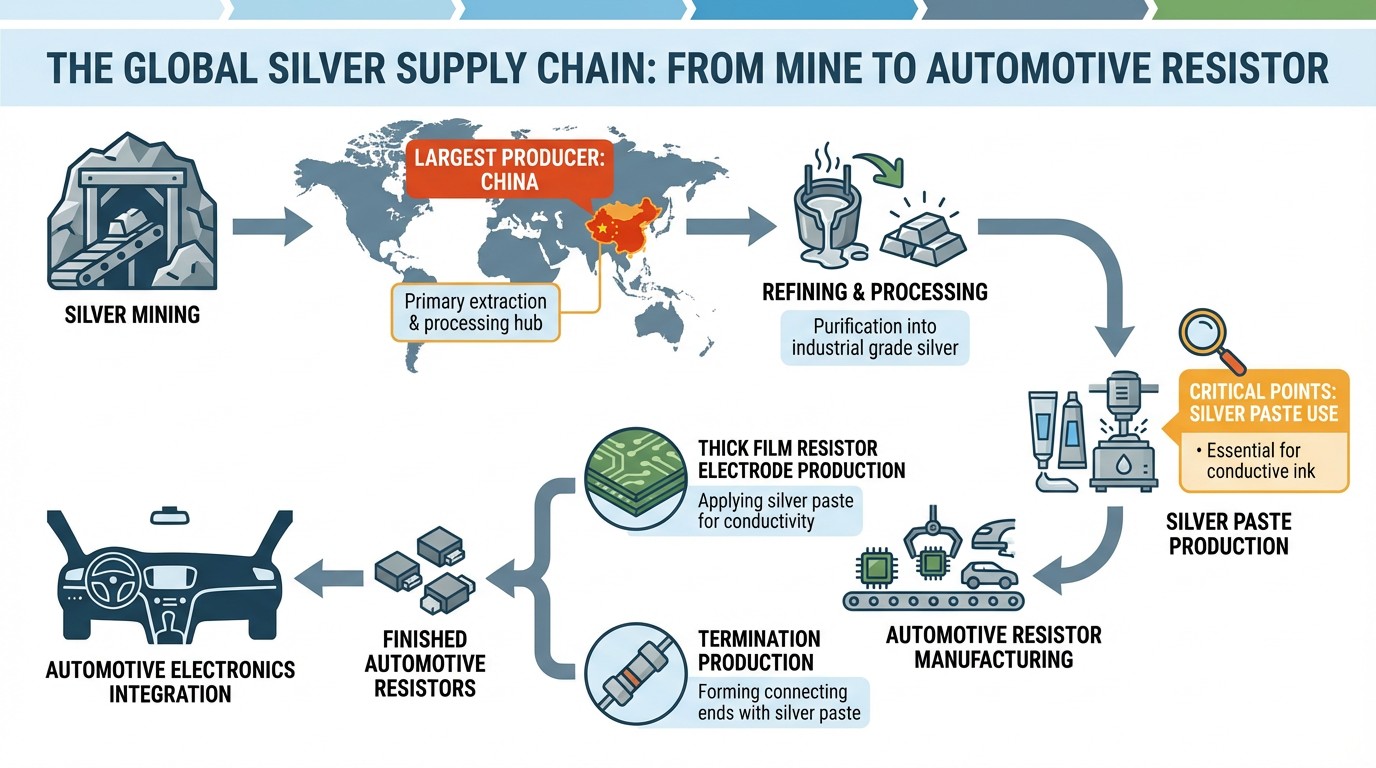
The "Silver Storm" refers to the unprecedented surge in silver prices that began accelerating in 2024 and reached historic highs in 2025-2026, fundamentally reshaping the cost structure of passive electronic components. Silver serves as a critical raw material in thick film resistor manufacturing, where silver paste is used for internal electrodes and terminations. The metal's price rallied 147% throughout 2025, then gained an additional 40% since the beginning of 2026, breaking through the psychological $100 per ounce barrier on January 23, 2026.
This price movement reflects structural factors rather than short-term speculation. China, the world's largest silver producer and third-largest exporter of silver products, has extended control measures on silver items, creating supply constraints that compound existing industrial demand pressures. The automotive electronics sector faces particular vulnerability because AEC-Q200 certified resistors require higher-purity materials and more rigorous manufacturing processes than consumer-grade alternatives.
For automotive electronics buyers, the implications are immediate and substantial. Component manufacturers have limited ability to absorb these costs internally, making price adjustments unavoidable to protect margins and ensure stable supply. Unlike previous market cycles, the current environment shows no signs of near-term price relief, with industry analysts suggesting that silver exceeding $100 per ounce could trigger additional waves of component price increases.
When Will Thick Film Resistor Prices Increase in 2026?
The first wave of chip resistor price hikes takes effect on February 1, 2026, with major manufacturers implementing increases ranging from 10% to 20% across key product lines. Yageo, the global chip resistor market leader, announced selective hikes on its RC0402, RC0603, RC0805, and RC1206 series with increases of approximately 15-20%. Walsin Technology followed with an official price notice on January 21, 2026, covering all resistor values from 0201 to 1206 with increases potentially reaching 20%.
| Manufacturer | Effective Date | Price Increase Range | Affected Products |
|---|---|---|---|
| Yageo | February 1, 2026 | 15-20% | RC0402, RC0603, RC0805, RC1206 |
| Walsin Technology | February 1, 2026 | Up to 20% | All resistor values 0201-1206 |
| UniOhm (China) | January 2026 | 8-15% | Thick film chip resistor |
| Fenghua Advanced | January 2026 | Moderate | Resistors, inductors |
| Sunlord Electronics | January 2026 | Varies | Automotive-grade magnetic components |
The breadth of these announcements confirms that current price adjustments represent an industry-wide response to cost pressure rather than isolated events. Manufacturers cite rising labor, electricity, and raw material costs as key drivers, noting that core metals including silver, palladium, ruthenium, tin, and copper remain under significant pressure amid market volatility. For procurement teams, this creates a narrow window of opportunity to secure inventory at pre-increase pricing levels.
Why Is AEC-Q200 Certification Critical for Automotive Applications?
AEC-Q200 is the international reliability standard for passive components used in automotive electronics, established by the Automotive Electronics Council to ensure components can operate normally even when vehicles run in harsh environments. Automobile manufacturers will not purchase components that fail to meet AEC-Q200 requirements, making this certification non-negotiable for any resistor destined for automotive applications.
The standard classifies components into five temperature grades corresponding to their service temperature ranges, with Grade 0 components required to withstand temperatures from -50°C to 150°C for engine compartment mounting, while Grade 3 components operate in the -40°C to 85°C range typical of passenger compartment electronics.
| Grade | Temperature Range | Typical Application Location |
|---|---|---|
| Grade 0 | -50°C to 150°C | All mounting locations including under-hood |
| Grade 1 | -40°C to 125°C | Most engine compartment applications |
| Grade 2 | -40°C to 105°C | High-temperature passenger compartment areas |
| Grade 3 | -40°C to 85°C | Most passenger compartment electronics |
| Grade 4 | 0°C to 70°C | Non-electrical equipment mounting locations |
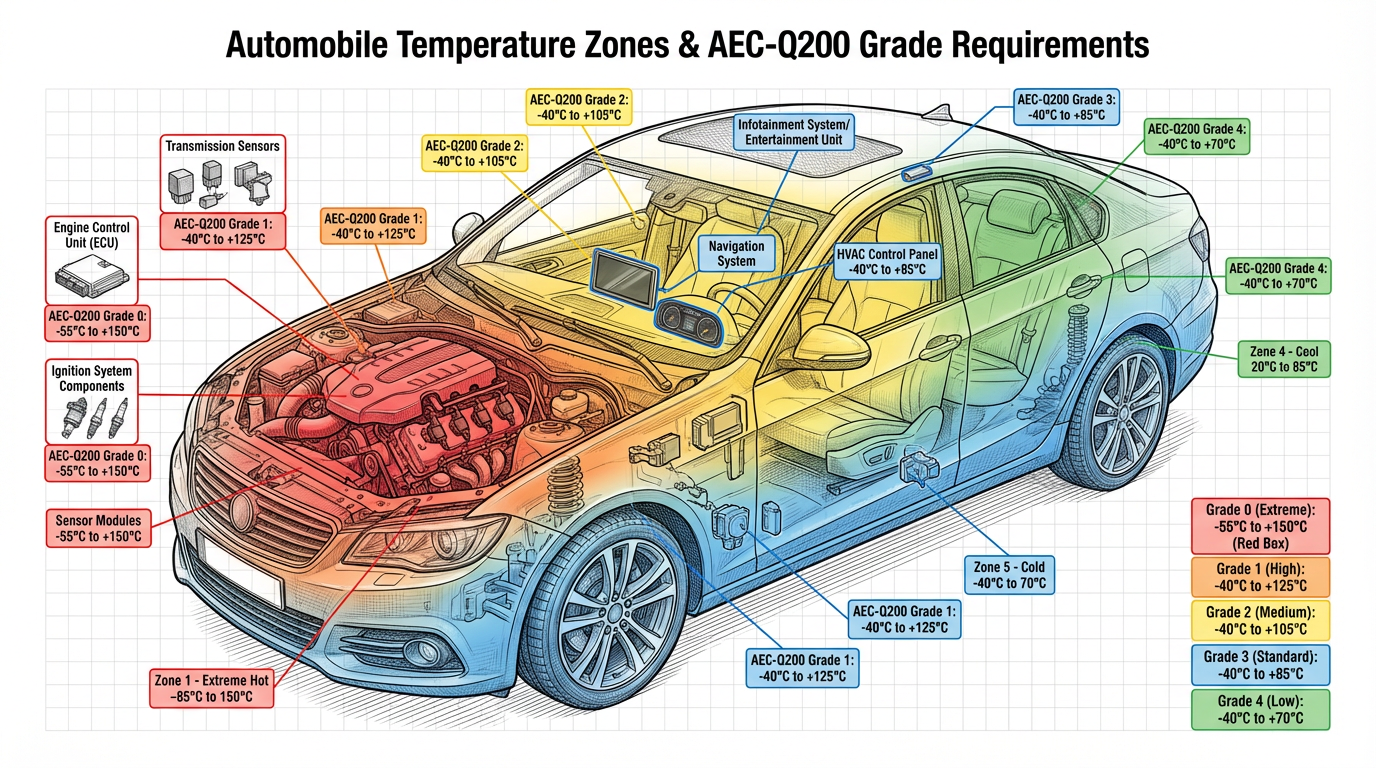
Passive components seeking AEC-Q200 certification must pass rigorous stress tests including high temperature exposure, temperature cycling, humidity bias testing, mechanical shock, vibration testing, and ESD qualification. These requirements explain why AEC-Q200 certified automotive grade resistors command premium pricing compared to commercial-grade alternatives, and why supply constraints in this segment have more severe consequences for automotive production lines.
What Does the 2026 Electronic Component Market Look Like?
The automotive chip resistor market is projected to grow at a compound annual growth rate (CAGR) of 6.2% to 7.5% from 2026 through 2032, driven by increasing electronic content per vehicle and the accelerating transition to electric and autonomous vehicles. The broader passive electronic components market is expected to reach USD 48.45 billion in 2026, growing at a CAGR of 5.48% to reach USD 63.27 billion by 2031.
However, this growth trajectory masks significant supply-demand imbalances in specific segments. The current environment differs fundamentally from the severe shortages of 2017-2018, representing a structural price correction rather than a speculative cycle. Products most affected include automotive-grade thick film resistors, ferrite beads, power inductors, and tantalum capacitors, while low-end MLCCs for consumer electronics remain competitively priced.
| Segment | Market Size 2026 | Projected CAGR | Supply Status |
|---|---|---|---|
| Automotive Chip Resistors | $13.42 billion (2025 base) | 7.34% | Tightening, selective allocation |
| SMD Thick Film Resistors | $1.72 billion | 6.8% | Price pressure, 8-20% increases |
| Current Sensing Resistors | $4.85 billion | 6.7% | Stable with premium pricing |
| Thin Film Resistors | $651 million (2025 base) | 7.0% | Moderate availability |
An important signal emerging at the end of 2025 was unusually strong year-end ordering activity, with many OEMs and EMS companies accelerating procurement in anticipation of price increases. Reports indicate that some leading suppliers have begun selective order acceptance, prioritizing strategic customers and higher-value products. For buyers without established supplier relationships, this creates additional urgency to secure alternative sourcing channels.
How Should Procurement Managers Build a Resistor Stocking Strategy?
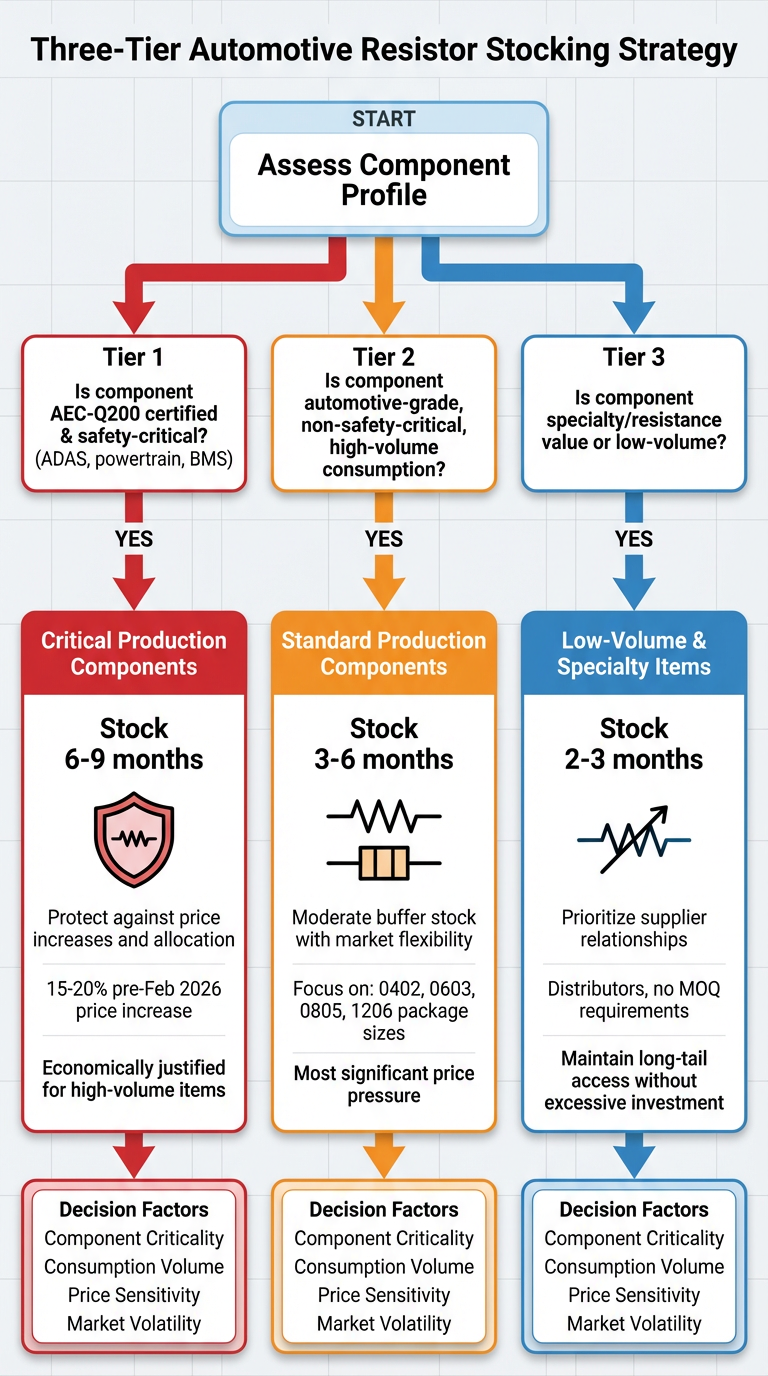
Strategic inventory planning in the current market requires balancing immediate cost savings against supply security risks. Based on the confirmed price increase timeline and market dynamics, procurement managers should consider a three-tier stocking approach calibrated to component criticality and consumption patterns.
Tier 1: Critical Production Components (Stock 6-9 Months) — For AEC-Q200 certified resistors used in safety-critical automotive systems including ADAS, powertrain control, and battery management, maintain extended inventory coverage to protect against both price increases and potential allocation constraints. The 15-20% price increase effective February 1, 2026 makes pre-increase purchasing economically justified for high-volume consumption items.
Tier 2: Standard Production Components (Stock 3-6 Months) — For automotive-grade resistors in non-safety-critical applications, build moderate buffer stock while maintaining flexibility to respond to market changes. Focus on commonly used package sizes (0402, 0603, 0805, 1206) that face the most significant price pressure.
Tier 3: Low-Volume and Specialty Items (Stock 2-3 Months) — For specialty resistance values and less common package sizes, prioritize supplier relationships over inventory depth. Work with distributors offering no minimum order quantity requirements to maintain access to long-tail items without excessive inventory investment.
Successful stocking strategies also require supplier diversification. Relying on a single source for automotive-grade resistors creates unacceptable risk in the current environment. Qualified distributors with ready stock inventory, authentic original manufacturer products, and fast shipping capabilities provide essential flexibility when primary supply channels face constraints.
Which Automotive Resistor Suppliers Offer the Best Value?
Evaluating automotive resistor suppliers requires consideration of factors beyond unit pricing, including inventory availability, minimum order requirements, lead times, and quality assurance capabilities. The following comparison highlights key differentiators between traditional distribution channels and specialized automotive component distributors.
| Factor | Traditional Distribution | JAK Electronics |
|---|---|---|
| Minimum Order Quantity | Often 1,000 pieces per value | No MOQ requirement |
| Inventory Availability | Subject to allocation | Ready stock inventory |
| Lead Time | 8-16 weeks typical | Fast shipping from stock |
| Product Authenticity | Varies by source | 100% original manufacturer products |
| AEC-Q200 Documentation | Available on request | Full certification support |
| Small Quantity Orders | Often declined or premium priced | Welcomed at standard pricing |
| Emergency Orders | Limited flexibility | Expedited processing available |
For engineering teams requiring small quantities for prototyping or qualification testing, and for production teams managing diverse BOMs with varying consumption rates, the flexibility of no minimum order quantity sourcing eliminates the forced choice between excess inventory and production delays. This becomes particularly valuable when managing automotive-grade resistors across multiple resistance values and package sizes.
What Users Say About Navigating the Component Shortage
— Chen Wei, Supply Chain Director, Tier 1 Automotive Electronics Manufacturer, Suzhou"When our primary supplier put us on allocation for 0603 automotive resistors in December, we needed an alternative source immediately. JAK Electronics had the exact AEC-Q200 certified parts we needed in stock, shipped the same day, with no minimum order requirement. We avoided a production line shutdown that would have cost us significantly more than the component cost savings from our original supplier."
— Dr. Liu Xiaoming, Principal Engineer, EV Powertrain Systems, Shanghai"As a design engineer, I often need small quantities of automotive-grade resistors for qualification testing before committing to production volumes. Most distributors either refuse small orders or charge prohibitive premiums. Finding a supplier that treats a 50-piece order with the same priority as a 50,000-piece order has transformed our development workflow and accelerated our time-to-market."
— Zhang Mei, Procurement Manager, EMS Factory, Dongguan"The 2026 price increases caught many of our competitors off guard. Because we had established relationships with multiple qualified distributors including JAK Electronics, we were able to secure three months of buffer stock at pre-increase pricing. That inventory hedge has protected our margins while others are scrambling to pass through cost increases to their customers."
Frequently Asked Questions
What is the difference between automotive grade resistors and commercial grade resistors?
Automotive grade resistors are manufactured and tested to meet AEC-Q200 reliability standards, which require components to withstand extreme temperature ranges (-40°C to 150°C depending on grade), pass rigorous stress tests including temperature cycling, humidity bias, mechanical shock, and vibration testing, and maintain specified electrical characteristics throughout their operational life. Commercial grade resistors are designed for consumer electronics operating in controlled environments and do not undergo the same qualification testing. The manufacturing processes, material purity requirements, and quality control procedures for automotive grade components are significantly more stringent, which accounts for their premium pricing.
How much will thick film resistor prices increase in 2026?
Major thick film resistor manufacturers have announced price increases ranging from 8% to 20% effective in early 2026. Yageo has confirmed 15-20% increases on key series including RC0402, RC0603, RC0805, and RC1206 effective February 1, 2026. Walsin Technology has announced increases up to 20% on all resistor values from 0201 to 1206, also effective February 1, 2026. Chinese manufacturers including UniOhm and Fenghua Advanced have implemented moderate increases in the 8-15% range. Industry analysts suggest that if silver prices remain above $100 per ounce, additional price increases may follow later in 2026.
Why are silver prices affecting resistor costs?
Silver is a critical raw material in thick film resistor manufacturing, where silver paste is used for internal electrodes and terminations. The metal's price surged 147% throughout 2025 and gained an additional 40% since the beginning of 2026, breaking through $100 per ounce. This price movement reflects structural factors including tight supply from major producers like China, strong industrial demand from electronics and solar panel manufacturing, and investment flows into precious metals. Unlike short-term commodity volatility, current silver prices represent a new equilibrium that component manufacturers cannot absorb internally, making price adjustments necessary to maintain supply stability.
What AEC-Q200 grade do I need for automotive resistors?
The required AEC-Q200 grade depends on where the resistor will be mounted in the vehicle. Grade 0 (-50°C to 150°C) is required for components that may be mounted anywhere including directly on the engine. Grade 1 (-40°C to 125°C) covers most engine compartment applications. Grade 2 (-40°C to 105°C) is suitable for high-temperature areas of the passenger compartment. Grade 3 (-40°C to 85°C) is appropriate for most passenger compartment electronics including infotainment and body control modules. Grade 4 (0°C to 70°C) applies only to non-electrical equipment mounting locations. Most automotive electronics applications require Grade 1 or Grade 2 certified components.
How can I verify that automotive resistors are genuine AEC-Q200 certified?
Verifying AEC-Q200 certification requires obtaining documentation directly from the component manufacturer or through authorized distribution channels. Legitimate certification includes the manufacturer's AEC-Q200 qualification report identifying the specific part numbers tested, the qualification grade achieved, and the date of certification. Reputable distributors like JAK Electronics provide full traceability to original manufacturer documentation and can supply certificates of conformance for automotive-grade components. Be cautious of suppliers who cannot provide complete documentation, as counterfeit components lacking proper qualification testing pose significant reliability and safety risks in automotive applications.
Securing Your Automotive Resistor Supply in 2026
The 2026 "Silver Storm" has fundamentally altered the cost structure of automotive grade resistors, with price increases of 15-20% already confirmed by major manufacturers effective February 1, 2026. For automotive electronics procurement managers, design engineers, and supply chain leaders, the strategic imperative is clear: act now to secure inventory at current pricing levels while establishing relationships with flexible distribution partners who can provide supply continuity when primary channels face constraints.
The combination of ready stock inventory, no minimum order quantity requirements, original manufacturer authenticity, and fast shipping capabilities offered by specialized distributors like JAK Electronics provides the flexibility and security that automotive supply chains require in this challenging market environment. Whether you need 50 pieces for engineering qualification or 50,000 pieces for production, having access to AEC-Q200 certified components without allocation constraints or excessive lead times is essential for maintaining production continuity.