ATTENTION: Due to increased demand and order volume, processing time may take an additional 1-3 business days.
HomeAll ProductsRelays

Relays

A relay is an electrical switch device that controls the opening and closing of one or more auxiliary circuits through electromagnetic induction or electronic control. The main function of an electrical relay is to control another circuit within a system, enabling the control and transmission of current or voltage without direct contact.

Relays functions:

Control circuit on/off states as a switch.
Amplify weak signals to control high-power loads.
Isolate control and controlled circuits for safe operations.
Protect circuit devices with features like overload and short-circuit protection.
Provide delay functions for time-delayed circuit operations.
Enable complex logic control, including automatic circuit state switching based on specific conditions.

Jak Electronics offers a diverse range of relay products, covering common types such as Solid State Relays (SSRs), Automotive Relays, and Power Relays. Our relay products play crucial roles not only in industrial equipment and machinery but also find extensive applications in automotive systems like engine control and lighting. Whether your field of application is industrial or automotive, JAK's relay product range provides reliable, efficient control, and protection solutions, offering strong support for your electronic projects.

Our relay product portfolio includes switch solutions from numerous leading brands, including Panasonic, Phoenix contact, weidmuller, Omron, Crydom and TE connectivity. By choosing Jak Electronics, you gain access to high-quality relay products from top brands that meet your requirements for reliability and performance.

Contact us now to discuss how our reliable and high-performance relay solutions can benefit your projects.
Related Manufacturers
OverView

What is relay                                                                                                                                                                                                                          


In the field of electronics and automation control, relays are common control components. The wiring of a relay is a crucial aspect of its normal operation. Before understanding how a relay is wired, let's briefly understand the structure of a relay. Relays typically consist of a coil, contacts, and normally closed/normally open contacts. When the coil receives a certain current, it generates a magnetic field. This magnetic field causes the contacts to close or open, thereby controlling the high current or device.


Common wiring methods for relays                                                                                                                                                                           


  • Direct Connection: Directly connecting the power source and load to a set of contacts on the relay.

Advantages: Simple and suitable for low-power, low-current circuits.

Disadvantages: May result in significant voltage drops affecting circuit performance with larger loads.

  • Indirect Connection: Indirectly connecting the power source and load through an intermediate relay or contactor.

Advantages: Maintains good circuit performance even with higher currents.

Disadvantages: Requires more components, increasing circuit complexity.

  • Reverse Connection: Connecting the power source positive terminal to the relay's normally closed contact and the load to the normally open contact.

Advantages: The load can remain powered when the relay coil loses power.

Disadvantages: Increases circuit power consumption, affecting efficiency.


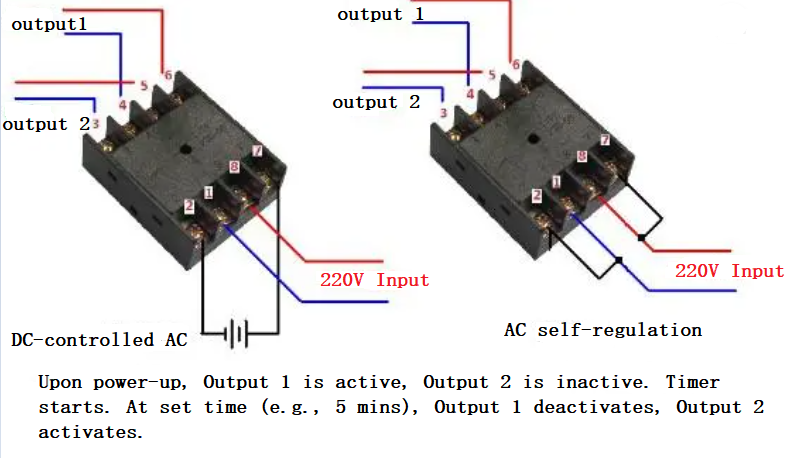
a 4-pin relay wiring diagram 


Types of relays                                                                                                                                                                                                                      


  • Electromechanical Relays (EMRs): The most common type, EMRs use electromagnetic forces to control switches, suitable for various applications.
  • Solid State Relays (SSRs): SSRs utilize semiconductor devices for isolation and control without mechanical parts, offering fast response and longevity.
  • Automotive Relays: Specifically for vehicles, these relays control electrical components with features like high temperature and vibration resistance.
  • Other Types: Include Time Delay Relays for circuit timing, Control Relays for diverse functions, and Safety Relays ensuring system safety.


How do relays work?                                                                                                                                                                                                      


Relays work by using an electromagnet to control the flow of electric current. When a small electrical signal is applied to the relay's coil, it creates a magnetic field that pulls a switch (or multiple switches) to make or break a connection in the larger circuit. This allows relays to control high-power or high-voltage circuits with a low-power signal.


How to check relays                                                                                                                                                                                                          


Common relay malfunctions include no current output, unstable output, abnormal currents (too high or too low), and overheating during operation. These conditions may indicate issues with the relay, requiring prompt maintenance to ensure system stability.


Different inspection methods include:

  • Check the coil: Use a multimeter to measure the coil at both ends of the relay to detect any open circuits or poor contacts. If the coil is damaged, the relay needs to be replaced.
  • Clean or replace contacts: If the contacts have poor contact or welding, gently wipe the contact surface with fine sandpaper to remove oxides and restore normal operation. If the contacts are severely worn or loose, replacing the relay contacts can resolve the issue.
  • Improve ventilation and heat dissipation: If the temperature around the relay is too high, consider adding ventilation equipment or relocating the relay to enhance heat dissipation.

Here is an useful video:


Related Content
Popular Products
Related Categories
FAQ
What does the blower motor relay do in a car?
In a vehicle, the blower motor relay plays a crucial role in controlling the operation of the blower motor, which is responsible for circulating air through the vehicle's HVAC (Heating, Ventilation, and Air Conditioning) system. The blower motor relay acts as a switch that controls the flow of electricity to the blower motor.When the HVAC system is turned on, the blower motor relay receives a signal from the HVAC controls to activate the blower motor. The relay then allows electrical current to flow to the blower motor, causing it to spin and circulate air through the vents of the vehicle.Essentially, the blower motor relay helps regulate the speed and operation of the blower motor based on the settings selected by the driver. It helps ensure that the HVAC system functions properly by controlling when the blower motor turns on and off, thus helping to maintain a comfortable interior temperature in the vehicle. If the blower motor relay malfunctions, it can lead to issues such as the blower motor not working at all or running continuously, impacting the vehicle's climate control system.
What does a relay do?
A relay is an electrical switch that uses an electromagnet to mechanically control the opening and closing of one or multiple sets of contacts. It acts as a remote control switch, allowing a low-power signal to control a high-power circuit, providing isolation between the control and load circuits. A relay works by using an electromagnet to control the flow of electrical current in a circuit. When a small electrical current is applied to the coil of the relay, it generates a magnetic field that pulls an armature, causing the switch contacts to open or close. This action allows the relay to act as a remote-controlled switch, enabling low-power signals to control higher-power devices or circuits. By effectively isolating and controlling electrical currents, relays play a crucial role in automating and controlling various electrical systems, ensuring safe and efficient operation in applications such as industrial control, automotive electronics, and home appliances.
What are the characteristics of switching relay?
Switching relays are versatile electrical devices known for their ability to control the flow of electricity in various applications. These relays operate based on control signals from manual switches, sensors, or timers, allowing them to switch circuits on or off with precision. Characterized by their versatility, durability, low power consumption, multiple contact sets for controlling various circuits, compact size for easy integration, and noiseless operation, switching relays are essential components in automation, HVAC systems, and other applications where efficient and reliable electrical control is necessary.
How to test a starter relay?
To test a starter relay with a multimeter, first, locate the relay in the engine bay and inspect it for any visible damage. Using the continuity or resistance setting on the multimeter, check for continuity between the control terminals (85 and 86) and the switch terminals (30 and 87) while applying 12V power to the relay coil. A functioning relay should produce a click and show continuity when energized. If the relay fails these tests or shows signs of damage, it may be faulty and in need of replacement to address symptoms like the engine not cranking, clicking sounds without starting, or intermittent starting issues in the vehicle's starting system.
How to wiring relay?
When wiring a relay, first identify the control, power supply, normally open, and normally closed terminals. Connect the power supply wire to the power terminal, the load wire to the normally open terminal, the control signal wire to the control terminal, and ground the relay. Test the setup by applying power to the control terminal to verify proper switching before securing all connections, ensuring a correct relay operation for controlling high-power devices with a low-power signal effectively.If you want to hook up a relay in a circuit, it is crucial to follow the relay's datasheet or manufacturer instructions to ensure correct terminal connections and ratings.
What are the 2 basic types of relays?
There are two basic types of relays, one is Electromechanical Relays, these relays use an electromagnet to mechanically operate the switch contacts. When the coil is energized, it creates a magnetic field that pulls the contacts together or pushes them apart to make or break the circuit. Electromechanical relays are commonly used in various applications due to their reliability and simplicity. The other is Solid-State Relays (SSRs), Solid-state relays use semiconductors like silicon-controlled rectifiers (SCRs) or transistors to perform the switching operation without any moving parts. SSRs are known for their fast switching speeds, long lifespan, silent operation, and resistance to mechanical wear, making them suitable for applications where high reliability and noiseless operation are essential.
What are the functions of a relay?
Relays serve essential functions in electrical systems by acting as remote-controlled switches, providing isolation between control and load circuits, amplifying control signals, offering protection to sensitive components, implementing control logic such as time delays and sequencing, and conditioning signals to enable compatibility between different parts of a system, making them indispensable in automating and controlling various applications.
Index: #0123456789ABCDEFGHIJKLMNOPQRSTUVWXYZ