ATTENTION: Due to increased demand and order volume, processing time may take an additional 1-3 business days.
HomeCommunitySubject1N5062 Diode: Features, Pinout, and Datasheet

1N5062 Diode: Features, Pinout, and Datasheet

Diodes - Rectifiers - Single Diode Switching 800V 2A 2-Pin SOD-57 T/R The 1N5062 is a Standard Avalanche Sinterglass Diode. This article mainly introduces features, pinout,

228

Dec 1, 2021

Kay Locke

Diodes Explained - The basics how diodes work working principle pn junction


Diodes - Rectifiers - Single Diode Switching 800V 2A 2-Pin SOD-57 T/R

The 1N5062 is a Standard Avalanche Sinterglass Diode. This article mainly introduces features, pinout, datasheet and other detailed information about Vishay Semiconductor Diodes Division 1N5062.
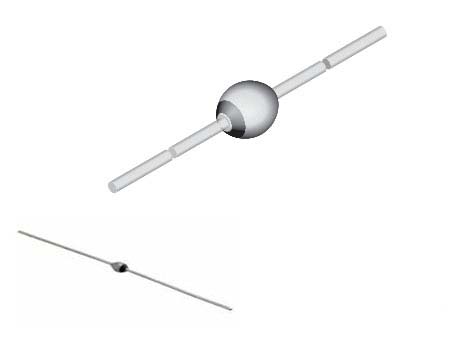
1N5062TR

Inquiry
Min.: 1 Mult.: 1
Price not displayed? Not available to buy online? Please send an RFQ, and we will respond immediately.
Quick Links

1N5062 Description

A standard avalanche Sinterglass Diode with the axial-leaded terminal is the 1N5062. Solderable terminals according to  MIL-STD -750 procedure 2026. The cathode end polarity is indicated by the color band.

1N5062 Pinout

The Pinout of 1N5062 is shown as follows.

Pinout

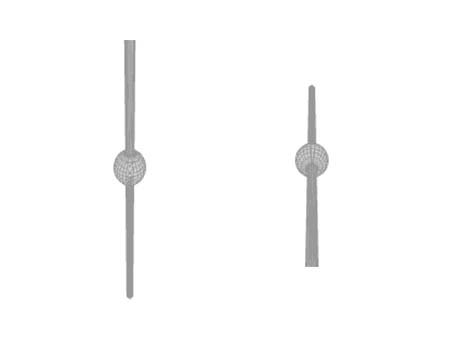
1N5062 CAD Model

The following figure is 1N5062 3D Model.

3D Model

1N5062 Features

• Glass Passivated Junction

• Hermetically Sealed Axial-leaded Glass Envelope

• Controlled Avalanche Characteristics

• Low Reverse Current

• High Surge Current Loading

Specifications

Vishay Semiconductor Diodes Division 1N5062TR technical specifications, attributes, parameters and parts with similar specifications to Vishay Semiconductor Diodes Division 1N5062TR.

1N5062TR Tech Specifications

Vishay Semiconductor Diodes Division 1N5062TR technical specifications, attributes, parameters and parts with similar specifications to Vishay Semiconductor Diodes Division 1N5062TR.

Product Attribute Attribute Value
Factory Lead Time12 Weeks
Contact PlatingSilver, Tin
MountThrough Hole
Mounting TypeThrough Hole
Package / CaseSOD-57, Axial
Number of Pins2Pins
Supplier Device PackageSOD-57
PackagingTape & Reel (TR)
Published2013
Part StatusActive
Moisture Sensitivity Level (MSL)1 (Unlimited)
Max Operating Temperature175°C
Min Operating Temperature-55°C
Current Rating2A
Product Attribute Attribute Value
Base Part Number1N5062
Element ConfigurationSingle
SpeedStandard Recovery >500ns, > 200mA (Io)
Diode TypeAvalanche
Current - Reverse Leakage @ Vr1μA @ 800V
Power Dissipation200mW
Voltage - Forward (Vf) (Max) @ If1.15V @ 2.5A
Forward Current2A
Operating Temperature - Junction-55°C~175°C
Max Surge Current50A
Voltage - DC Reverse (Vr) (Max)800V
Current - Average Rectified (Io)2A
Forward Voltage1.15V
Max Reverse Voltage (DC)800V
Product Attribute Attribute Value
Average Rectified Current2A
Reverse Recovery Time4 μs
Peak Reverse Current1μA
Max Repetitive Reverse Voltage (Vrrm)800V
Capacitance @ Vr, F40pF @ 0V 1MHz
Peak Non-Repetitive Surge Current50A
Reverse Voltage800V
Max Forward Surge Current (Ifsm)50A
Recovery Time4 μs
REACH SVHCUnknown
Radiation HardeningNo
RoHS StatusROHS3 Compliant
Lead FreeLead Free
0 Products View Similar

1N5062 Alternatives

Part Number Description Manufacturer
1N5062GP/51DIODES Rectifier Diode, 1 Element, 1A, 800V V(RRM), Silicon, DO-204AC, PLASTIC, DO-15, 2 PIN Vishay Semiconductors
1N5062GP/54DIODES Rectifier Diode, 1 Element, 1A, 800V V(RRM), Silicon, DO-204AC, PLASTIC, DO-15, 2 PIN Vishay Semiconductors

1N5062 Applications

• Rectification diode, general-purpose

• Industrial

• Defence

• Military

• Aerospace

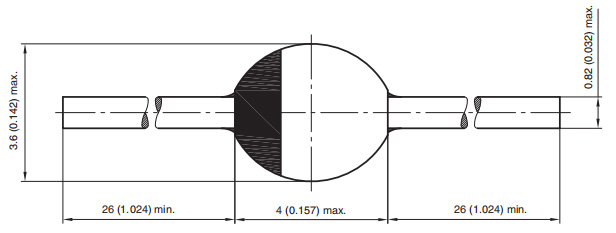
1N5062 Package

The following figure is the Package of 1N5062.

Package

1N5062 Manufacturer

Vishay offers an unrivaled selection of discrete semiconductors (diodes, MOSFETs, and optoelectronics) as well as passive components (resistors, inductors, and capacitors). In the industrial, computing, automotive, consumer, telecommunications, military, aerospace, and medical markets, these components are employed in almost all types of electronic systems and equipment.

Datasheet PDF

1N5062TR Documents

Download datasheets and manufacturer documentation for 1N5062TR

Frequently Asked Questions

What diode can be used instead of 1N5062 diode?
If it is used for rectification, it can be replaced with two 1N4007s that are easily available in parallel, or it is no problem to directly replace them with 1N5408. 5062 seems to be 800V, 2A. If it is in a high frequency or switching circuit, it is better to find a fast recovery type tube.
What does diode mean?
A diode is an electron tube that contains only a cathode that emits electrons and an anode that collects electrons. It is mostly used for rectification, detection and amplitude limiting. Semiconductor diodes are made of semiconductor materials. Electrode tube is one of the earliest semiconductor devices, and its application is very wide. Especially in various electronic circuits, diodes and resistors, capacitors, inductors and other components are used for reasonable connection to form circuits with different functions, which can realize rectification of alternating current, detection of modulated signals, amplitude limiting and clamping, and power supply. Voltage regulation and other functions.
What does a diode do?
1. Rectification: Using the unidirectional conductivity of diodes, alternating current with alternating directions can be converted into pulsed direct current in a single direction 2. Switch: Under the action of forwarding voltage, the resistance of the diode is very small, and it is in an on state, which is equivalent to a switched-on switch; under the action of reverse voltage, the resistance is very large, and it is in a cut-off state, like a disconnected switch. switch. Using the switching characteristics of diodes, various logic circuits can be formed. 3. Limiting: After the diode is turned on, its forward voltage drop remains basically unchanged (silicon tube is 0.7V, germanium tube is 0.3V). Using this feature, as a limiting element in the circuit, the signal amplitude can be limited within a certain range. 4. Freewheeling: play a freewheeling role in the inductance of the switching power supply and in inductive loads such as relays. 5. Detection: It plays the role of detection in the radio. 6. Variable-capacity: used in the high-frequency head of the TV. 7. Display: used on monitors such as VCD, DVD, calculator, etc. 8. Voltage regulator: The Zener diode is essentially a surface junction silicon diode, and the Zener diode works in a reverse breakdown state. In the manufacturing process of the diode, it has low-voltage breakdown characteristics. The reverse breakdown voltage of the Zener diode is constant, and a current limiting resistor is connected in series in the Zener circuit so that the current of the Zener diode does not exceed the allowable value after breakdown, so the breakdown state can last for a long time without damage. 9. Trigger: Trigger diode, also known as bidirectional trigger diode (DIAC), is a three-layer structure and asymmetrical two-terminal semiconductor device. It is often used to trigger the Triac, and it is used for overvoltage protection in the circuit.
FAQ
What diode can be used instead of 1N5062 diode?
If it is used for rectification, it can be replaced with two 1N4007s that are easily available in parallel, or it is no problem to directly replace them with 1N5408. 5062 seems to be 800V, 2A. If it is in a high frequency or switching circuit, it is better to find a fast recovery type tube.
What does diode mean?
A diode is an electron tube that contains only a cathode that emits electrons and an anode that collects electrons. It is mostly used for rectification, detection and amplitude limiting. Semiconductor diodes are made of semiconductor materials. Electrode tube is one of the earliest semiconductor devices, and its application is very wide. Especially in various electronic circuits, diodes and resistors, capacitors, inductors and other components are used for reasonable connection to form circuits with different functions, which can realize rectification of alternating current, detection of modulated signals, amplitude limiting and clamping, and power supply. Voltage regulation and other functions.
What does a diode do?
1. Rectification: Using the unidirectional conductivity of diodes, alternating current with alternating directions can be converted into pulsed direct current in a single direction 2. Switch: Under the action of forwarding voltage, the resistance of the diode is very small, and it is in an on state, which is equivalent to a switched-on switch; under the action of reverse voltage, the resistance is very large, and it is in a cut-off state, like a disconnected switch. switch. Using the switching characteristics of diodes, various logic circuits can be formed. 3. Limiting: After the diode is turned on, its forward voltage drop remains basically unchanged (silicon tube is 0.7V, germanium tube is 0.3V). Using this feature, as a limiting element in the circuit, the signal amplitude can be limited within a certain range. 4. Freewheeling: play a freewheeling role in the inductance of the switching power supply and in inductive loads such as relays. 5. Detection: It plays the role of detection in the radio. 6. Variable-capacity: used in the high-frequency head of the TV. 7. Display: used on monitors such as VCD, DVD, calculator, etc. 8. Voltage regulator: The Zener diode is essentially a surface junction silicon diode, and the Zener diode works in a reverse breakdown state. In the manufacturing process of the diode, it has low-voltage breakdown characteristics. The reverse breakdown voltage of the Zener diode is constant, and a current limiting resistor is connected in series in the Zener circuit so that the current of the Zener diode does not exceed the allowable value after breakdown, so the breakdown state can last for a long time without damage. 9. Trigger: Trigger diode, also known as bidirectional trigger diode (DIAC), is a three-layer structure and asymmetrical two-terminal semiconductor device. It is often used to trigger the Triac, and it is used for overvoltage protection in the circuit.

TAGS

Share