AC Line detector using transistor 2n5551 , a useful tool
Bipolar Transistors - BJT NPN Gen Pur SS
The central semiconductor 2N5551 is a silicon NPN transistor designed for high voltage amplifier applications.

Bipolar Transistors - BJT NPN Gen Pur SS The central semiconductor 2N5551 is a silicon NPN transistor designed for high voltage amplifier applications.
355
Jul 2, 2021
Linda Brook
AC Line detector using transistor 2n5551 , a useful tool
Bipolar Transistors - BJT NPN Gen Pur SS
The central semiconductor 2N5551 is a silicon NPN transistor designed for high voltage amplifier applications.
2N5551
The 2N5551 is an NPN high-voltage transistor in a TO-92 plastic package. It's PNP complements are 2N5400 and 2N5401. The 2N5551 is built to use in general purpose applications such as amplification and switching. The maximum collector to emitter voltage is 160V, and the maximum collector to base voltage is 180V, making it easy to use in circuits with a voltage below 160V. The maximum output load this transistor can handle is 600mA and the maximum power consumption of the collector is 625mW.
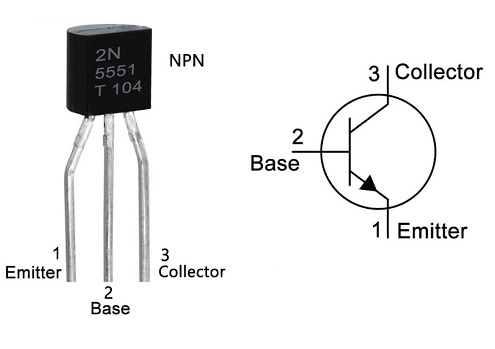
Symbol
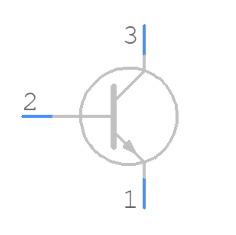
Footprint
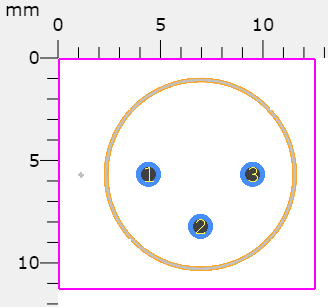
3D Model
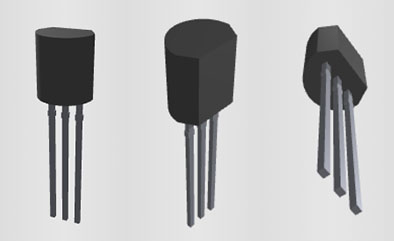
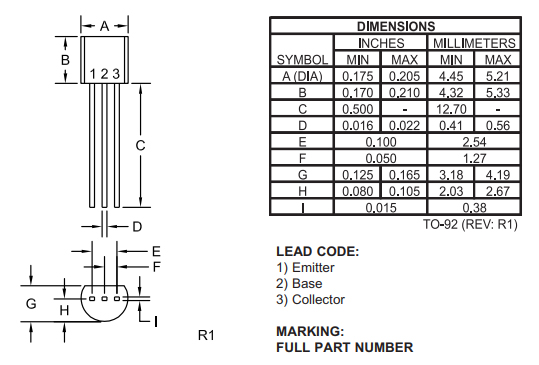
Package Type: TO-92
Transistor Type: NPN
Max Collector Current(IC): 6A or 600mA
Max Collector-Emitter Voltage (VCE): 160V
Max Collector-Base Voltage (VCB): 180V
Max Emitter-Base Voltage (VBE): 6V
Max Collector Dissipation (Pc): 625 mW
Max Transition Frequency (fT): 100 MHz
Minimum & Maximum DC Current Gain (hFE): 80 - 250
Max Storage & Operating temperature Should be: -55 to +150 Centigrade
Central Semiconductor 2N5551 technical specifications, attributes, parameters and parts with similar specifications to Central Semiconductor 2N5551.
Central Semiconductor 2N5551 technical specifications, attributes, parameters and parts with similar specifications to Central Semiconductor 2N5551.
| Product Attribute | Attribute Value | |
|---|---|---|
| Factory Lead Time | 8 Weeks | |
| Mount | Through Hole | |
| Package / Case | TO-92 | |
| Number of Pins | 3Pins | |
| Collector-Emitter Breakdown Voltage | 160V | |
| Collector-Emitter Saturation Voltage | 200mV | |
| Frequency - Gain Bandwidth Product (GBP) | 300MHz | |
| Number of Elements | 1 Element | |
| Power Dissipation (Max) | 625mW | |
| hFEMin | 80 | |
| Packaging | Bulk | |
| Published | 2012 | |
| JESD-609 Code | e0 |
| Product Attribute | Attribute Value | |
|---|---|---|
| Pbfree Code | no | |
| Part Status | Active | |
| Number of Terminations | 3Terminations | |
| ECCN Code | EAR99 | |
| Terminal Finish | Tin/Lead (Sn/Pb) | |
| Max Operating Temperature | 150°C | |
| Min Operating Temperature | -65°C | |
| HTS Code | 8541.21.00.95 | |
| Terminal Position | BOTTOM | |
| Peak Reflow Temperature (Cel) | NOT SPECIFIED | |
| Time@Peak Reflow Temperature-Max (s) | NOT SPECIFIED | |
| JESD-30 Code | O-PBCY-T3 | |
| Qualification Status | Not Qualified |
| Product Attribute | Attribute Value | |
|---|---|---|
| Polarity | NPN | |
| Element Configuration | Single | |
| Transistor Application | AMPLIFIER | |
| Collector Emitter Voltage (VCEO) | 200mV | |
| Max Collector Current | 600mA | |
| Transition Frequency | 100MHz | |
| Frequency - Transition | 300MHz | |
| Collector Base Voltage (VCBO) | 180V | |
| Emitter Base Voltage (VEBO) | 6V | |
| DC Current Gain-Min (hFE) | 80 | |
| Continuous Collector Current | 600mA | |
| RoHS Status | RoHS Compliant |
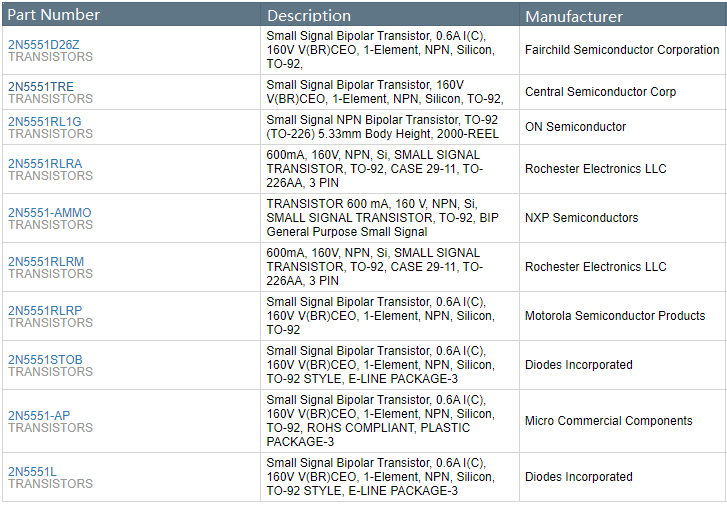
The 2N5551 is an NPN amplifier transistor with an amplification factor (hfe) of 80 when the collector current is 10mA. It also has decent switching characteristics (transition frequency is 100MHz) hence can amplify low-level signals.
Due to this feature, the transistor is commonly used for amplification of audio or other low power signals. So if you are looking for an NPN transistor for you amplifier circuit then this transistor might be the right choice.
The 2N5551 NPN transistor is widely used for amplification. A very simple bare minimum circuit for a transistor to work as an amplifier is shown below. The simulation graph that shows the amplified output sine wave can also be found.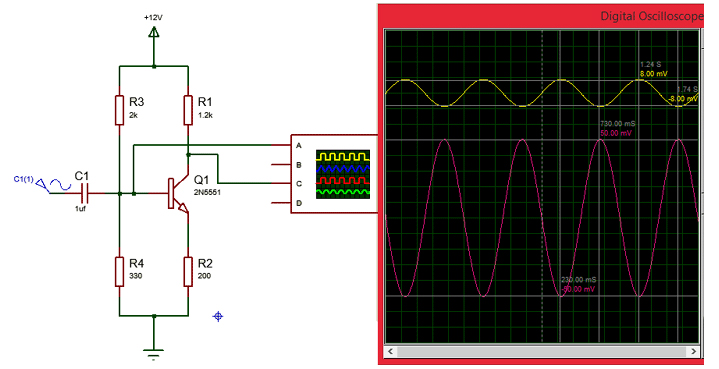
Here the input sine wave of magnitude 8mV (yellow colour) is amplified to 50mV (Pink colour) as shown in the graph. In the above circuit the resistors R3 and R4 form a potential divider which decides the Emitter -Base voltage (VBE). The Resistor R1 is the load resistor and the resistor R2 is the emitter resistor. Changing the value of RL will affect the amplification of the output wave.
A transistor is normally a current amplifier, meaning the current flowing though the base will be amplified in the current flowing through the collector. This amplification depends on the amplification factor (hfe) which is 80 for 2N5551. This means that the collector current will be amplified by 80 times than that of the base current.
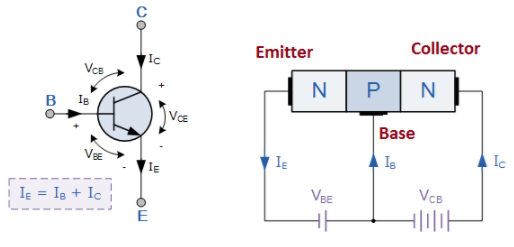
Ic = βIb
Another current that we've brought into consideration is the emitter current (IE), but due to transistor action we assume that the value of Emitter current is almost equal to Collector current, however the difference between the both can be found with the value of α. Normally, the value of collector current is given by
IE = IC + IB
The output is obtained across the collector which is the Collector-Emitter voltage (VCE). This output voltage depends on the Input voltage (Vcc, here 12V) without the voltage drop across the loads resistor (R1). Therefore the output voltage Vout can be given as
Vout = VCE = (Vcc – IcRc)
Low power amplifiers
Current amplifiers
Small signal boosters
Audio or other signal amplifiers
Darlington pair
Since 1974, Central Semiconductor has manufactured innovative discrete semiconductors used in electronic products worldwide. Devices currently include standard and custom small signal transistors, bipolar power transistors, MOSFETs, diodes, rectifiers, protection devices, current limiting diodes, bridge rectifiers, thyristors, and silicon carbide devices. Central’s devices are available in industry standard surface mount and through-hole packages, bare die, TLMs (Tiny Leadless Modules™), and MDMs (Multi Discrete Modules™). Central has earned a reputation as a manufacturer of the highest quality products consistently delivered on-time, and a provider of exceptional value-added services.
Download datasheets and manufacturer documentation for 2N5551
TAGS
Comments