How to make amplifier using 2SA 1302 2SC 3281 Transistor 100W
Unclassified
2SC3281 is an NPN power transistor manufactured in the TO-3PL package. This article is going to explain datasheet pdf, equivalents, pinout, and other details about 2SC3281.

Unclassified 2SC3281 is an NPN power transistor manufactured in the TO-3PL package. This article is going to explain datasheet pdf, equivalents, pinout, and other details about 2SC3281.
497
Nov 13, 2021
Debby Funk
How to make amplifier using 2SA 1302 2SC 3281 Transistor 100W
Unclassified
2SC3281 is an NPN power transistor manufactured in the TO-3PL package. This article is going to explain datasheet pdf, equivalents, pinout, and other details about 2SC3281.
2SC3281
2SC3281 is an NPN power transistor manufactured in the TO-3PL package. 2SC3281 is primarily designed for building power amplifier circuits and can be used to build an audio power amplifier of up to 100 Watts. But it is not limited to these applications and can also be used for switching purposes and is capable of driving loads up to 15A.
Moreover, the maximum collector to emitter voltage is 200V due to which it can drive a load of up to 200V and can also be used in high voltage circuits. The maximum power dissipation of the transistor is 150 watts, minimum and maximum DC gain is 55 to 160 and the transition frequency is 25MHz to 30MHz.
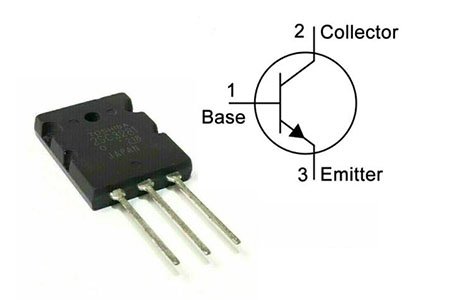
2SC3281 Pinout
| Pin | Description | Doping |
| 1 | Base | P-type |
| 2 | Collector | N-type |
| 3 | Emitter | N-type |
Package Type: TO-3PL
Transistor Type: NPN
Collector to Base Voltage : Vcbo = 200 V
Collector to Emitter Voltage : Vceo = 200 V
Emitter to Base Voltage : Vebo = 5 V
Collector Current: Ic = 15 A
Total Dissipation: Pc = 150 W
Junction Temperature: Tj = 150°C
Storage Temperature: Tsg = -55 ~ +150°C
High power audio amplifiers
Audio amplifiers output stages
Motor Drivers
Drive load of up to 15A
2SA1302, 2SC3320, 2SC5200, 2SC5200N, 2SC5242, 2SC5358, 2SC5949, 2SC6011, 2SC6011A, 2SC6011, 2SD1313, KTC5200, 2SC5200, 2SC5242
Because the IC 2SC3281 is an NPN transistor. it can be used as a switching device or an amplifier, depending on the user's needs. To use a transistor as a switch, it must be operated in either the cut-off or saturation regions of its characteristic curve, which correspond to the OFF and ON switches, respectively. To be used as an amplifier, the transistor must be biased so that it functions in the active area of its characteristic curve.
The transistor is designed particularly for use in audio power amplifiers with output powers of up to 100 watts. Aside from that, it can be utilized as a switch. Because the maximum collector current is 15A. it can drive a wide range of loads under 15A. such as motors, relays, and circuit components.
Transistors can be used as a switch, similarly, IC 2SC3281 can also be used as a switch. As described earlier to use a transistor as a switch it has to be operated in cutoff and saturation regions.
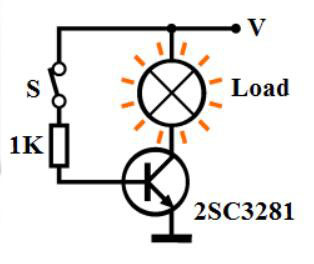
Switch Figure
The figure depicts a transistor used as a switch in a grounded emitter arrangement. When switch "S" is closed, a signal is applied to the transistor's base, and the transistor begins to conduct; the transistor is now in saturation mode. The load attached to the IC 2SC3281's collector terminal will begin to work. Because the maximum current rating of the IC 2SC3281 is 15A, a load with a current rating of more than 15A should not be used directly with the transistor.
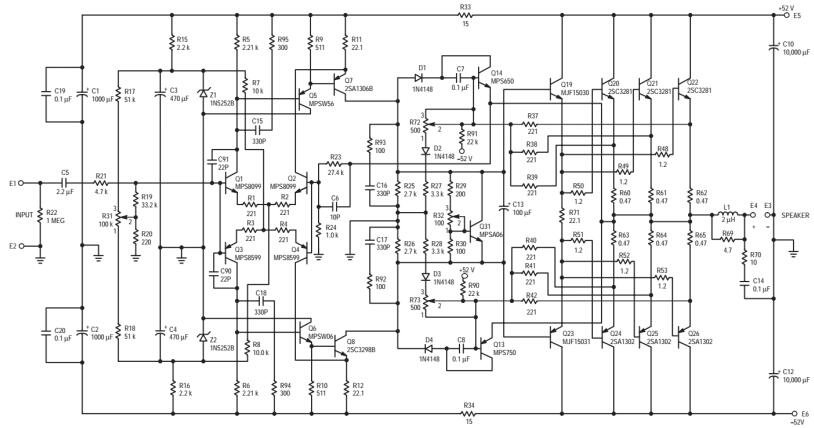
The power transistor IC 2S3281 is utilized in high-power applications, particularly in high-power amplifiers. Figure 1 shows a MOTOROLA 100-watt power amplifier based on the IC 2SC3281. The complementary pair transistors make up the circuit's input stage; the second stage, also known as the transconductance stage, gives the initial voltage gain; and finally, the IC 2SC3281 is used to achieve a power gain of up to 100 watts.
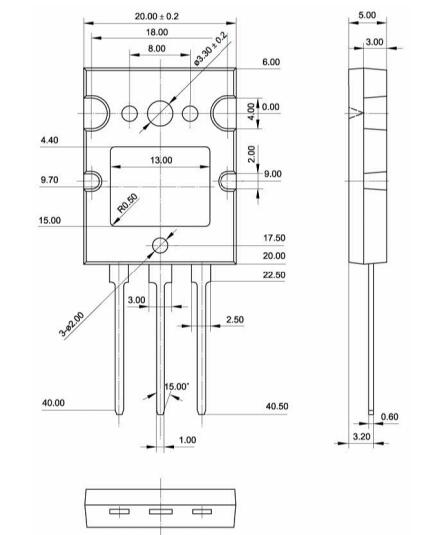
2SC3281 Package Dimensions
New Jersey Semiconductor has been designing, manufacturing, and producing highly reliable electronic devices since 1957. Our mission is to supply you with high-quality, cost-effective discrete devices for commercial, industrial, and military applications.
TAGS
Comments