ATTENTION: Due to increased demand and order volume, processing time may take an additional 1-3 business days.
HomeCommunitySubject4N36 Optocoupler: Datasheet, Pinout, 4N35 vs.4N36 vs.4N37

4N36 Optocoupler: Datasheet, Pinout, 4N35 vs.4N36 vs.4N37

VISHAY - 4N36 - OPTOCOUPLER, PHOTOTRANSISTOR, 5000VRMS This post will unlock more details about 4N36, an optocoupler made for general purpose applications. There is a huge range of Semiconductors, Capacitors, Resistors and ICs in stock. Welcome RFQ.
664

Sep 30, 2021

Ruby Guy

The 4N36


VISHAY - 4N36 - OPTOCOUPLER, PHOTOTRANSISTOR, 5000VRMS

This post will unlock more details about 4N36, an optocoupler made for general purpose applications. There is a huge range of Semiconductors, Capacitors, Resistors and ICs in stock. Welcome RFQ.
4N36

Inquiry
Min.: 1 Mult.: 1
Price not displayed? Not available to buy online? Please send an RFQ, and we will respond immediately.
Quick Links

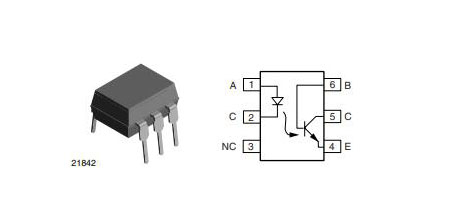
4N36 Pinout

4N36 Pinout

4N36 Pin Description

4N36 Description

The 4N36 optocoupler is a general-purpose optocoupler. It comes in a 6 pin dip package as well as SMD packaging. It has two internal components, one of which is an IR LED and the other is a phototransistor. The 4N36 optocoupler functions in the same way as any other comparable optocoupler.

Specifications

Vishay Semiconductor Opto Division 4N36 technical specifications, attributes, parameters and parts with similar specifications to Vishay Semiconductor Opto Division 4N36.

4N36 Tech Specifications

Vishay Semiconductor Opto Division 4N36 technical specifications, attributes, parameters and parts with similar specifications to Vishay Semiconductor Opto Division 4N36.

Product Attribute Attribute Value
Factory Lead Time14 Weeks
MountPCB, Through Hole
Mounting TypeThrough Hole
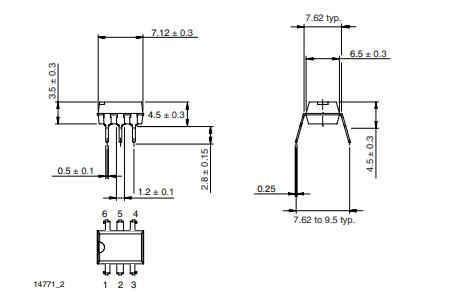
Package / Case6-DIP (0.300, 7.62mm)
Number of Pins6Pins
Supplier Device Package6-DIP
Collector-Emitter Breakdown Voltage30V
Collector-Emitter Saturation Voltage300mV
Current Transfer Ratio-Min100% @ 10mA
Number of Elements1 Element
Operating Temperature-55°C~100°C
PackagingTube
Published2014
Part StatusActive
Moisture Sensitivity Level (MSL)1 (Unlimited)
Max Operating Temperature100°C
Min Operating Temperature-55°C
Product Attribute Attribute Value
Voltage - Rated DC1.3V
Max Power Dissipation70mW
Base Part Number4N36
Approval AgencyBSI, FIMKO, UL
Voltage - Isolation5000Vrms
Output Voltage30V
Output TypeTransistor with Base
Number of Channels1Channel
Voltage6V
Power Dissipation70mW
Voltage - Forward (Vf) (Typ)1.3V
Input TypeDC
Forward Current50mA
Max Output Voltage30V
Output Current per Channel50mA
Rise Time2μs
Forward Voltage1.3V
Product Attribute Attribute Value
Fall Time (Typ)2 μs
Collector Emitter Voltage (VCEO)30V
Max Collector Current100mA
Reverse Breakdown Voltage6V
Max Input Current50mA
Current - DC Forward (If) (Max)50mA
Input Current10mA
Turn On / Turn Off Time (Typ)10μs, 10μs
Current Transfer Ratio50 %
Height4mm
Length7.62mm
Width7mm
REACH SVHCUnknown
Radiation HardeningNo
RoHS StatusROHS3 Compliant
Lead FreeLead Free
0 Products View Similar

4N36 Feature

• Isolation test voltage 5000 VRMS

• Interfaces with common logic families

• Input-output coupling capacitance < 0.5 pF

• Industry-standard dual-in-line 6 pin package

• Compliant to RoHS directive 2002/95/EC and in accordance to WEEE 2002/96/EC


4N36 Application

• AC mains detection

• Reed relay driving

• Switch mode power supply feedback

• Telephone ring detection

• Logic ground isolation

• Logic coupling with high frequency noise rejection


Where to use 4N36

The 4N36 optocoupler can be used in a variety of applications, including protecting circuits from voltage spikes, creating isolation between two circuits, and detecting the presence of AC or DC current. It can also be utilized at the output of microcontrollers and other ICs with low output current so that high-current components, such as high-power transistors, can be operated with these ICs and microcontrollers.

How to use 4N36

It's as simple as using a regular LED and a phototransistor to use a 4N36 optocoupler. Connect the anode of the IR LED to the positive output of your component, which can be an IC or microcontroller, and the other pin (Cathode) to the negative or ground of that component to use the device. It is critical to use a current limiting resistor between the output of the IC or microcontroller and the anode of the IR LED.

When the phototransistor detects light from the IR LED, the collector and emitter pins will link, and anything connected to pins 4 and 5 will become connected as well. As previously stated, the phototransistor can be controlled by its other base, which is connected to pin 6, allowing the user to operate the transistor via its other base / pin6.


4N36 Package

4N36 Package

4N36 Manufacturer

Vishay, an important partner of Digi-Key, serves as a globally recognized manufacturer famous for its discrete semiconductors and passive electronic components. Their discrete semiconductors include diodes, MOSFETs, optoelectronics, etc and their passive components include resistors, inductors, capacitors, etc. These products are widely used for almost all kinds of electronic devices and equipment in the fields of industrial, computing, automotive, telecommunications, military, aerospace, and medical.

Datasheet PDF

4N36 Documents

Download datasheets and manufacturer documentation for 4N36

Datasheets
4N35/36/37

Frequently Asked Questions

What does 4N36 do?
The 4N36 is an optocoupler for general purpose application. It consists of gallium arsenide infrared LED and a silicon NPN phototransistor. What an optocoupler does is to break the connection between the signal source and signal receiver, so as to stop electrical interference.
How does 4N36 operate in safety?
If you want to get the best long-term performance out of your 4N36, make sure you use it at its maximum specs. Always connect a load that draws less than 150 mA. With the IR LED / on pin 1, use a current limiting resistor. Never use the device in temperatures below -55 degrees Fahrenheit and over +100 degrees Fahrenheit, and never store it in temperatures below -55 degrees Fahrenheit and above +150 degrees Fahrenheit.
What is an optocoupler used for?
Optocouplers can either be used on their own as a switching device or used with other electronic devices to provide isolation between low and high voltage circuits. You'll typically find these devices being used for Microprocessor input/output switching. DC and AC power control.
FAQ
What does 4N36 do?
The 4N36 is an optocoupler for general purpose application. It consists of gallium arsenide infrared LED and a silicon NPN phototransistor. What an optocoupler does is to break the connection between the signal source and signal receiver, so as to stop electrical interference.
How does 4N36 operate in safety?
If you want to get the best long-term performance out of your 4N36, make sure you use it at its maximum specs. Always connect a load that draws less than 150 mA. With the IR LED / on pin 1, use a current limiting resistor. Never use the device in temperatures below -55 degrees Fahrenheit and over +100 degrees Fahrenheit, and never store it in temperatures below -55 degrees Fahrenheit and above +150 degrees Fahrenheit.
What is an optocoupler used for?
Optocouplers can either be used on their own as a switching device or used with other electronic devices to provide isolation between low and high voltage circuits. You'll typically find these devices being used for Microprocessor input/output switching. DC and AC power control.

TAGS

Share