ATTENTION: Due to increased demand and order volume, processing time may take an additional 1-3 business days.
HomeCommunitySubject74HC165 Shift Registers: Features, Speicifications and Applications

74HC165 Shift Registers: Features, Speicifications and Applications

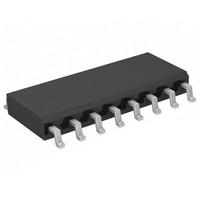
IC 8BIT SHIFT REGISTER 16SOIC The 74HC165 devices are 8-bit parallel-load shift registers that, when clocked, shift the data toward a serial (QH) output.

42

Mar 6, 2021

Valerie

IC 8BIT SHIFT REGISTER 16SOIC

The 74HC165 devices are 8-bit parallel-load shift registers that, when clocked, shift the data toward a serial (QH) output. Parallel-in access to each stage is provided by eight individual direct data (A-H) inputs that are enabled by a low level at the shift/load (SH/LD) input.
74HC165D

4929In Stock
Min.: 1 Mult.: 1
Quantity Unit Price Ext. Price
1+ $0.43327$0.43
10+ $0.40874$4.09
100+ $0.38561$38.56
500+ $0.36378$181.89
1000+ $0.34319$343.19
Unit Price:$0.43327
Subtotal: $0.43
Looking for a better price? Want a lower wholesale price? Please send an RFQ, and we will respond immediately.
Quick Links

74HC165 Description

The 74HC165 devices are 8-bit parallel-load shift registers that, when clocked, shift the data toward a serial (QH ) output. Parallel-in access to each stage is provided by eight individual direct data (A-H) inputs that are enabled by a low level at the shift/load (SH/LD) input. The 74HC165 devices also feature a clock-inhibit (CLK_ INH) function and a complementary serial (QH ) output. Clocking is accomplished by a low-to-high transition of the clock (CLK) input while SH/LD is held high and CLK INH is held low. The functions of CLK and CLK INH are interchangeable. Because a low CLK and a low-to-high transition of CLK INH also accomplish clocking. CLK INH must be changed to the high level only while CLK is high. Parallel loading is inhibited when SH/LD is held high. While SH/LD is low, the parallel inputs to the register are enabled independently of the levels of the CLK. CLK INH, or serial (SER) inputs.


74HC165 Features

• Wide Operating Voltage Range of 2 V to 6 V 

• Outputs Can Drive Up to 10 LSTTL Loads

• Low Power Consumption, 80-µA Maximum ICC 

• Typical t = 13 ns

• ±4-mA Output Drive at 5 V

• Low Input Current of 1 µA Maximum 

• Complementary Outputs C

• Direct Overriding Load (Data) Inputs

• Gated Clock Inputs  

• Parallel-to-Serial Data Conversion

• On Products Compliant to MIL-PRF-38535, clocking, CLK INH must be changed to the high level All Parameters

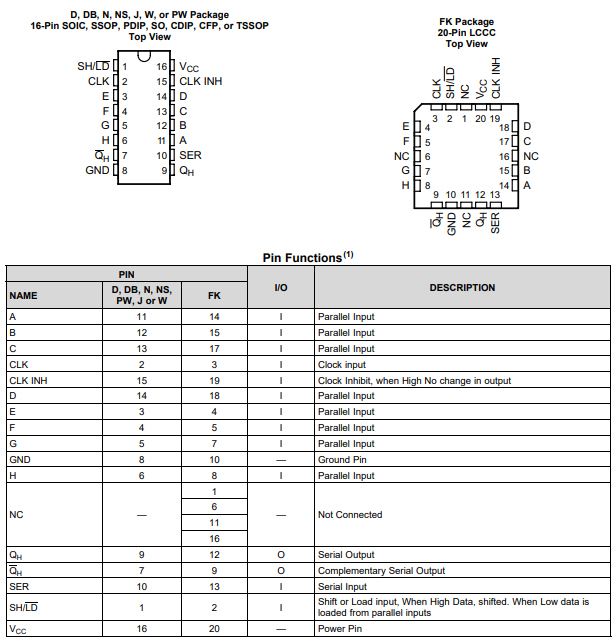
74HC165 Pins

Specifications

Toshiba Semiconductor and Storage 74HC165D technical specifications, attributes, parameters and parts with similar specifications to Toshiba Semiconductor and Storage 74HC165D.

74HC165D Tech Specifications

Toshiba Semiconductor and Storage 74HC165D technical specifications, attributes, parameters and parts with similar specifications to Toshiba Semiconductor and Storage 74HC165D.

Product Attribute Attribute Value
Factory Lead Time12 Weeks
Mounting TypeSurface Mount
Package / Case16-SOIC (0.154, 3.90mm Width)
Surface MountYES
Number of Elements1 Element
Operating Temperature-40°C~85°C
PackagingCut Tape (CT)
Series74HC
Published2016
Part StatusActive
Product Attribute Attribute Value
Moisture Sensitivity Level (MSL)1 (Unlimited)
Number of Terminations16Terminations
Voltage - Supply2V~6V
Terminal PositionDUAL
Terminal FormGULL WING
Peak Reflow Temperature (Cel)NOT SPECIFIED
Supply Voltage4.5V
Time@Peak Reflow Temperature-Max (s)NOT SPECIFIED
FunctionParallel or Serial to Serial
Output TypeComplementary
Product Attribute Attribute Value
Supply Voltage-Max (Vsup)6V
Supply Voltage-Min (Vsup)2V
FamilyHC/UH
Logic TypeShift Register
Number of Bits per Element8Bits per Elements
Trigger TypePOSITIVE EDGE
Count DirectionRIGHT
Length9.9mm
Width3.9mm
RoHS StatusRoHS Compliant
0 Products View Similar

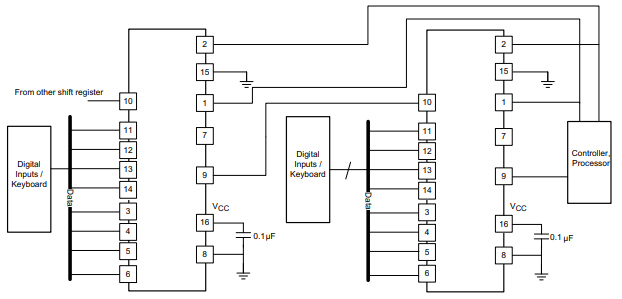
74HC165 Applications

• Programable 

• Appliances 

• Video Display Systems

• Output Expander

• Keyboards

Datasheet PDF

Download datasheets and manufacturer documentation for Toshiba Semiconductor and Storage 74HC165D.

74HC165D Documents

Download datasheets and manufacturer documentation for 74HC165D

Datasheets
74HC165D

Frequently Asked Questions

What is shift register and its types?
Following are the four types of shift registers based on applying inputs and accessing of outputs. Serial In − Serial Out shift register. Serial In − Parallel Out shift register. Parallel In − Serial Out shift register. Parallel In − Parallel Out shift register.
What are shift registers used for?
Shift Registers are used for data storage or for the movement of data and are therefore commonly used inside calculators or computers to store data such as two binary numbers before they are added together, or to convert the data from either a serial to parallel or parallel to serial format.
What is the difference between counter and shift register?
A counter is a special case of a register. Usually, it can only be loaded, stored, or incremented, or used for the stack or as the program counter. Shift registers are a type of sequential logic circuit, mainly for storage of digital data.
What are the advantages of shift register?
The advantages include: They operate faster than the logic circuits in converting Serial to Parallel and Parallel to Serial interfaces. PN (Pseudo Noise) Sequence number in CDMA (Code Division Multiple Access) is generated using them.
What is shift register in PLC?
Shift Registers: The Shift Register (SR) instruction shifts data through a predefined number of BIT locations. These BIT locations can be a range of BITs, a single Word or DWord, or a range of Words or DWords. The instruction has three inputs. Data, Clock and Reset.
FAQ
What is shift register and its types?
Following are the four types of shift registers based on applying inputs and accessing of outputs. Serial In − Serial Out shift register. Serial In − Parallel Out shift register. Parallel In − Serial Out shift register. Parallel In − Parallel Out shift register.
What are shift registers used for?
Shift Registers are used for data storage or for the movement of data and are therefore commonly used inside calculators or computers to store data such as two binary numbers before they are added together, or to convert the data from either a serial to parallel or parallel to serial format.
What is the difference between counter and shift register?
A counter is a special case of a register. Usually, it can only be loaded, stored, or incremented, or used for the stack or as the program counter. Shift registers are a type of sequential logic circuit, mainly for storage of digital data.
What are the advantages of shift register?
The advantages include: They operate faster than the logic circuits in converting Serial to Parallel and Parallel to Serial interfaces. PN (Pseudo Noise) Sequence number in CDMA (Code Division Multiple Access) is generated using them.
What is shift register in PLC?
Shift Registers: The Shift Register (SR) instruction shifts data through a predefined number of BIT locations. These BIT locations can be a range of BITs, a single Word or DWord, or a range of Words or DWords. The instruction has three inputs. Data, Clock and Reset.

TAGS

Share