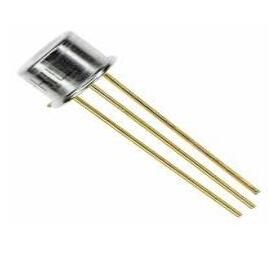
ANALOG DEVICES AD590KH.TEMPERATURE TRANSDUCER, 2.5C, TO-52-3
The AD590 is a 2-terminal integrated circuit temperature sensor that produces an output current proportional to absolute temperature.

ANALOG DEVICES AD590KH.TEMPERATURE TRANSDUCER, 2.5C, TO-52-3 The AD590 is a 2-terminal integrated circuit temperature sensor that produces an output current proportional to absolute temperature.
2584
Sep 15, 2021
Jonas Stevenson
ANALOG DEVICES AD590KH.TEMPERATURE TRANSDUCER, 2.5C, TO-52-3
The AD590 is a 2-terminal integrated circuit temperature sensor that produces an output current proportional to absolute temperature.
AD590KH
| Quantity | Unit Price | Ext. Price |
|---|---|---|
| 1+ | $25.63616 | $25.64 |
| 10+ | $24.18505 | $241.85 |
| 100+ | $22.81609 | $2281.61 |
| 500+ | $21.52461 | $10762.31 |
| 1000+ | $20.30624 | $20306.24 |
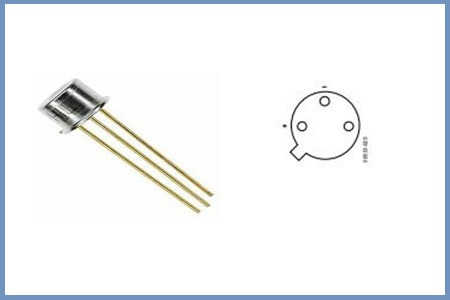
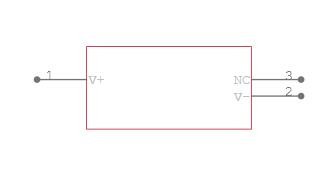
AD590 Symbol

AD590 Footprint
The AD590 is a 2-terminal integrated circuit temperature transducer that produces an output current proportional to absolute temperature. For supply voltages between 4 V and 30 V, the device acts as a high impedance, constant current regulator passing 1 μA/K. Laser trimming of the chip’s thin-film resistors is used to calibrate the device to 298.2 μA output at 298.2 K (25°C).
The AD590 should be used in any temperature-sensing application below 150°C in which conventional electrical temperature sensors are currently employed. The inherent low cost of a monolithic integrated circuit combined with the elimination of support circuitry makes the AD590 an attractive alternative for many temperature measurement situations. Linearization circuitry, precision voltage amplifiers, resistance measuring circuitry, and cold junction compensation are not needed in applying the AD590.
The AD590 is particularly useful in remote sensing applications. The device is insensitive to voltage drops over long lines due to its high impedance current output. Any well-insulated twisted pair is sufficient for operation at hundreds of feet from the receiving circuitry. The output characteristics also make the AD590 easy to multiplex: the current can be switched by a CMOS multiplexer, or the supply voltage can be switched by a logic gate output.
Analog Devices Inc. AD590KH technical specifications, attributes, parameters and parts with similar specifications to Analog Devices Inc. AD590KH.
| Product Attribute | Attribute Value | |
|---|---|---|
| Lifecycle Status | PRODUCTION (Last Updated: 1 month ago) | |
| Factory Lead Time | 8 Weeks | |
| Contact Plating | Gold | |
| Mount | Through Hole | |
| Mounting Type | Through Hole | |
| Package / Case | TO-206AC, TO-52-3 Metal Can | |
| Number of Pins | 3Pins | |
| Test Conditions | 25°C | |
| Operating Temperature | -55°C~125°C | |
| Packaging | Bulk | |
| JESD-609 Code | e4 | |
| Pbfree Code | no | |
| Part Status | Active |
| Product Attribute | Attribute Value | |
|---|---|---|
| Moisture Sensitivity Level (MSL) | 1 (Unlimited) | |
| Number of Terminations | 3Terminations | |
| Termination | Through Hole | |
| ECCN Code | EAR99 | |
| Temperature Coefficient | POSITIVE ppm/°C | |
| Additional Feature | TEMPERATURE COEFFICIENT 1 UA/K | |
| Voltage - Supply | 4V~30V | |
| Base Part Number | AD590 | |
| Pin Count | 3 | |
| Output Type | Analog Current | |
| Power Supplies | 5V | |
| Interface | Analog | |
| Output Current | 298.2μA |
| Product Attribute | Attribute Value | |
|---|---|---|
| Forward Voltage | 44V | |
| Sensor Type | Analog, Local | |
| Linearity | 0.8 Cel | |
| Accuracy - Highest (Lowest) | ±2.5°C | |
| Sensing Temperature - Local | -55°C~150°C | |
| Height | 3.81mm | |
| Length | 5.84mm | |
| Width | 5.84mm | |
| REACH SVHC | No SVHC | |
| Radiation Hardening | No | |
| RoHS Status | ROHS3 Compliant | |
| Lead Free | Contains Lead |
Linear output current: 1 µA/K
Wide temperature range: -55°C to +150°C
Ceramic sensor package compatible with probe
Two-terminal device: voltage input/current output
Laser adjusted to ±0.5°C, calibration accuracy (AD590M)
Excellent linearity: full-scale range ±0.3°C (AD590M)
Wide power supply voltage range: 4 V to 30 V
The sensor is insulated from the housing
Low cost
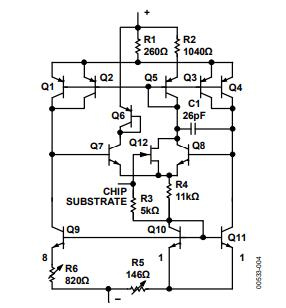
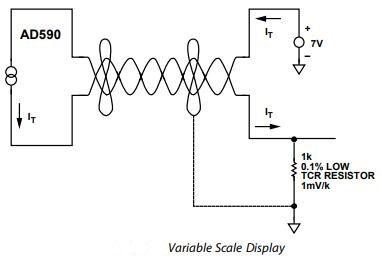
The circuit-1 shows a typical use of the AD590 as a remote temperature sensing application. The AD590 is used as a thermometer circuit that measures temperature from −55°C to +150°C, with an output voltage of 1 mV/°K.
AD590 Application Circuit-1
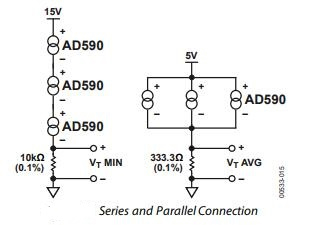
Connecting several AD590 units in series, as shown in circuit-2, allows the minimum of all the sensed temperatures to be indicated. In contrast, using the sensors in parallel yields the average of the sensed temperatures.
AD590 Application Circuit-2
Circuit-3 demonstrates one method by which differential temperature measurements can be made. R1 and R2 can be used to trim the output of the op-amp to indicate the desired temperature difference.

AD590 Application Circuit-3
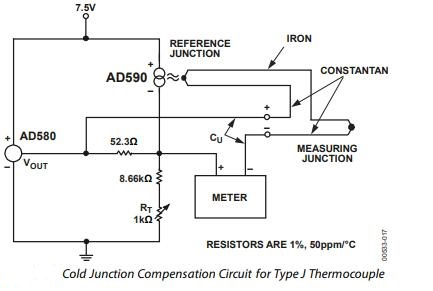
Circuit-4 is an example of a cold junction compensation circuit for a Type J thermocouple using the AD590 to monitor the reference junction temperature. This circuit replaces an ice bath as the thermocouple reference for ambient temperatures between 15°C and 35°C.
AD590 Application Circuit-4
| Parts | Description | Manufacturer |
| 5962-8757104XX SENSORS/TRANSDUCERS | Analog Resistance Sensor, FP-2 | Defense Logistics Agency |
| AD590JH SENSORS/TRANSDUCERS | Analog Resistance Sensor, 298.2uA, Round, 3 Pin, Through Hole Mount | Harris Semiconductor |
| 5962-8757103VXA SENSORS/TRANSDUCERS | Analog Temperature Sensor, ANALOG TEMP SENSOR-CURRENT, FP-2 | Defense Supply Center Columbus |
| 5962-8757104XC SENSORS/TRANSDUCERS | Analog Temperature Sensor, ANALOG TEMP SENSOR-CURRENT, 298.2uA, RECTANGULAR, THROUGH HOLE MOUNT, CERAMIC, FP-2 | Defense Supply Center Columbus |
| 5962-8757103YA SENSORS/TRANSDUCERS | Analog Resistance Sensor, META CAN, 3 PIN | Defense Logistics Agency |
| 5962-8757103XA SENSORS/TRANSDUCERS | 2-Terminal IC Temperature Transducer | Analog Devices Inc |
| 5962-8757102VXA SENSORS/TRANSDUCERS | Analog Temperature Sensor, ANALOG TEMP SENSOR-CURRENT, FP-2 | Analog Devices Inc |
| AD590MH/883B SENSORS/TRANSDUCERS | 2-Terminal IC Temperature Transducer | Analog Devices Inc |
| AD590IH SENSORS/TRANSDUCERS | Analog Resistance Sensor, 298.2uA, Round, 3 Pin, Through Hole Mount | Harris Semiconductor |
| AD590LF SENSORS/TRANSDUCERS | ANALOG TEMP SENSOR-CURRENT, 298.2uA, CERAMIC PACKAGE | Intersil Corporation |
AD590 Alternatives

Analog Devices is an international market leader in the design, production, and commercialization of a large range of high-performance integrated circuits (ICs) for analogue, mixed-signal, and digital signals (DSP) processing of almost all electronic systems. Since we started in 1965, the focus has been on the engineering challenge in electronic equipment related to signal to process.
Download datasheets and manufacturer documentation for AD590KH
TAGS
Comments