ATTENTION: Due to increased demand and order volume, processing time may take an additional 1-3 business days.
HomeCommunitySubjectAD8226 Instrumentation Amplifier: Rail-to-Rail Output, 8SOIC AD8226 Pinout and Datasheet

AD8226 Instrumentation Amplifier: Rail-to-Rail Output, 8SOIC AD8226 Pinout and Datasheet

Linear - Amplifiers - Instrumentation, OP Amps, Buffer Amps 8-SOIC (0.154, 3.90mm Width) Instrumentation 15V -40°C~125°C AD8226 1.5MHz 800MOhm IC, AMP, INST, R-R, LP, 13MA, 8SO

511

Nov 27, 2021

Tammy Piers

Noise of an Instrumentation Amplifier Circuit


Linear - Amplifiers - Instrumentation, OP Amps, Buffer Amps 8-SOIC (0.154, 3.90mm Width) Instrumentation 15V -40°C~125°C AD8226 1.5MHz 800MOhm IC, AMP, INST, R-R, LP, 13MA, 8SO

The AD8226 is a low-cost, wide-supply range instrumentation amplifier that requires only one external resistor to set any gain between 1 and 1000. This article will cover pinout, datasheet, circuit, features, and applications of the AD8226 instrumentation amplifier.
AD8226ARZ

268In Stock
Min.: 1 Mult.: 1
Quantity Unit Price Ext. Price
1+ $3.2918$3.29
10+ $3.10547$31.05
100+ $2.92969$292.97
500+ $2.76386$1381.93
1000+ $2.60741$2607.41
Unit Price:$3.2918
Subtotal: $3.29
Looking for a better price? Want a lower wholesale price? Please send an RFQ, and we will respond immediately.
Quick Links

What is AD8226?

The AD8226  is a low-cost instrumentation amplifier with a wide supply range that just requires one external resistor to set any gain between 1 and 1000.

The AD8226  can deal with a wide range of signal voltages. The signal can make full use of the supply rails thanks to its wide input range and rail-to-rail output. Small signals near the ground can be amplified without the use of dual supplies because the input range includes the ability to descend below the negative supply. The AD8226  requires dual supplies ranging from 1.35 V to 18 V and single supplies ranging from 2.2 V to 36 V.

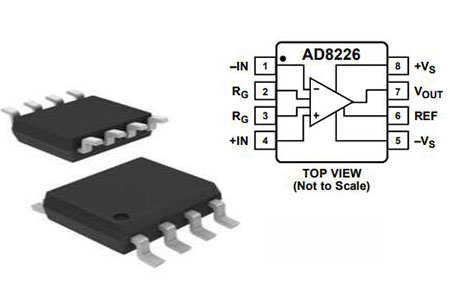
AD8226 Pinout

AD8226 Pinout


Pin No. Mnemonic Description
1 −IN Negative Input
2,3 RG Gain-Setting Pins.   Place again resistor between these two pins
4 +IN Positive Input.
5 −VS Negative Supply.
6 REF Reference. This pin   must be driven by low impedance
7 VOUT Output.
8 +VS Positive Supply.

AD8226 CAD Model

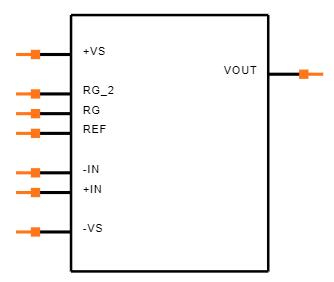
AD8226 Symbol


AD8226 Footprint


AD8226 3D Model


Specifications

Analog Devices Inc. AD8226ARZ technical specifications, attributes, parameters and parts with similar specifications to Analog Devices Inc. AD8226ARZ.

AD8226ARZ Tech Specifications

Analog Devices Inc. AD8226ARZ technical specifications, attributes, parameters and parts with similar specifications to Analog Devices Inc. AD8226ARZ.

Product Attribute Attribute Value
Lifecycle StatusPRODUCTION (Last Updated: 4 weeks ago)
Factory Lead Time26 Weeks
Contact PlatingTin
MountSurface Mount
Mounting TypeSurface Mount
Package / Case8-SOIC (0.154, 3.90mm Width)
Number of Pins8Pins
Operating Temperature-40°C~125°C
PackagingTube
JESD-609 Codee3
Pbfree Codeno
Part StatusActive
Moisture Sensitivity Level (MSL)1 (Unlimited)
Number of Terminations8Terminations
ECCN CodeEAR99
Resistance800MOhm
Terminal PositionDUAL
Product Attribute Attribute Value
Terminal FormGULL WING
Peak Reflow Temperature (Cel)260
Number of Functions1Function
Supply Voltage15V
Time@Peak Reflow Temperature-Max (s)30
Base Part NumberAD8226
Pin Count8
Output TypeRail-to-Rail
Number of Channels1Channel
Operating Supply Current400μA
Nominal Supply Current325μA
Max Supply Current350μA
Slew Rate0.6V/μs
Amplifier TypeInstrumentation
Common Mode Rejection Ratio105 dB
Current - Input Bias20nA
Voltage - Supply, Single/Dual (±)2.2V~36V ±1.35V~18V
Product Attribute Attribute Value
Output Current per Channel13mA
Input Offset Voltage (Vos)2μV
Bandwidth1.5MHz
Gain Bandwidth Product1.5MHz
Neg Supply Voltage-Nom (Vsup)-15V
Voltage Gain60dB
Average Bias Current-Max (IIB)0.027μA
Voltage - Input Offset100μV
-3db Bandwidth1.5MHz
Voltage Gain-Nom5
Height1.5mm
Length5mm
Width4mm
REACH SVHCNo SVHC
Radiation HardeningNo
RoHS StatusROHS3 Compliant
Lead FreeContains Lead
0 Products View Similar

AD8226 Features

  • Gain set with 1 external resistor

  • Gain range: 1 to 1000

  • Input voltage  goes below ground

  • Inputs protected beyond supplies

  • Very wide power supply range 

  • Single supply: 2.2 V to 36 V

  • Dual supplies: ±1.35 V to ±18 V

  • Bandwidth (G = 1): 1.5 MHz

  • CMRR (G = 1): 90 dB minimum for BR models

  • Input noise: 22 nV/√Hz

  • Typical supply current: 350 μA

  • Specified temperature: −40°C to +125°C

  • 8-lead SOIC  and MSOP packages

AD8226 Applications

  • Bridge amplifiers

  • Industrial process controls

  • Medical instrumentation 

  • Portable data acquisition

  • Multichannel systems

AD8226 Theory of Operation

AD8226 Theory of Operation


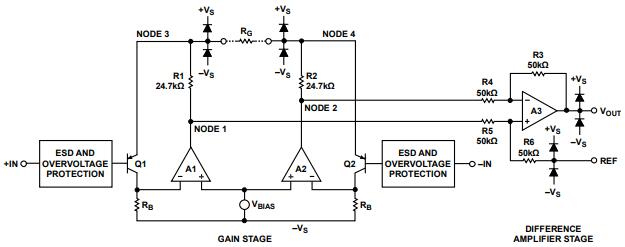
The AD8226  is based on the classic 3- op-amp topology. This topology has two stages: a preamplifier to provide differential amplification, followed by a difference amplifier to remove the common-mode voltage.

Instrumentation Amplifier Benefits

The benefits of the instrumentation amplifier include the following.

  • The gain of a three op-amp instrumentation amplifier circuit can be easily varied by adjusting the value of only one resistor regains.

  • The gain of the amplifier depends only on the external resistors used.

  • The input impedance is very high due to the emitter follower configurations of amplifiers 1 and 2

  • The output impedance of the instrumentation amplifier is very low due to the difference amplifier 3.

  • The  CMRR  of the op-amp 3 is very high and almost all of the common-mode signals will be rejected.


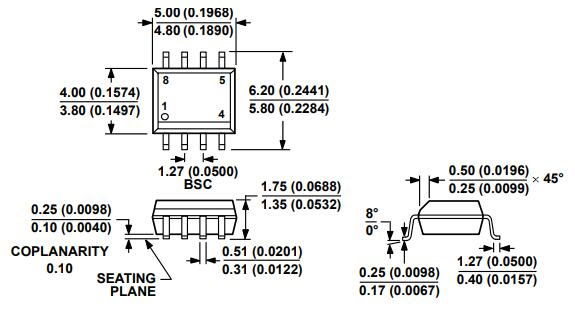
AD8226 Dimensions

 AD8226 Dimensions

AD8226 Manufacturer

Analog Devices (NASDAQ: ADI) is a world leader in the design, manufacture, and marketing of a broad portfolio of high-performance analog, mixed-signal, and digital signal processing (DSP) integrated circuits (ICs) used in virtually all types of electronic equipment. Since our inception in 1965, we have focused on solving the engineering challenges associated with signal processing in electronic equipment. Used by over 100,000 customers worldwide, our signal processing products play a fundamental role in converting, conditioning, and processing real-world phenomena such as temperature, pressure, sound, light, speed, and motion into electrical signals to be used in a wide array of electronic devices.


Hot sale parts from Analog Devices are as follows: op07cpop270gpzadm2587ebrwzadm3053brwzadm2483brwzad8495armzadv7513bswzad9833brmzad620anzad623arz, etc.

Datasheet PDF

Download datasheets and manufacturer documentation for Analog Devices Inc. AD8226ARZ.

AD8226ARZ Documents

Download datasheets and manufacturer documentation for AD8226ARZ

Frequently Asked Questions

What is the use of AD8226?
The AD8226 is a low-cost, wide-supply range instrumentation amplifier that requires only one external resistor to set any gain between 1 and 1000. The AD8226 is designed to work with a variety of signal voltages. A wide input range and rail-to-rail output allow the signal to make full use of the supply rails.
What is the voltage of AD8226?
The AD8226 operates on supplies ranging from ±1.35 V to ±18 V for dual supplies and 2.2 V to 36 V for single supply. The robust AD8226 inputs are designed to connect to real-world sensors. In addition to its wide operating range, the AD8226 can handle voltages beyond the rails.
How is gain calculated in instrumentation amplifier?
The overall gain of the amplifier is given by the term (R3/R2){(2R1+Rgain)/Rgain}. The overall voltage gain of an instrumentation amplifier can be controlled by adjusting the value of resistor Regain.
FAQ
What is the use of AD8226?
The AD8226 is a low-cost, wide-supply range instrumentation amplifier that requires only one external resistor to set any gain between 1 and 1000. The AD8226 is designed to work with a variety of signal voltages. A wide input range and rail-to-rail output allow the signal to make full use of the supply rails.
What is the voltage of AD8226?
The AD8226 operates on supplies ranging from ±1.35 V to ±18 V for dual supplies and 2.2 V to 36 V for single supply. The robust AD8226 inputs are designed to connect to real-world sensors. In addition to its wide operating range, the AD8226 can handle voltages beyond the rails.
How is gain calculated in instrumentation amplifier?
The overall gain of the amplifier is given by the term (R3/R2){(2R1+Rgain)/Rgain}. The overall voltage gain of an instrumentation amplifier can be controlled by adjusting the value of resistor Regain.

TAGS

Share