ATTENTION: Due to increased demand and order volume, processing time may take an additional 1-3 business days.
HomeCommunitySubjectAD8232 ECG Module:Pinout, Advantage and Schematic

AD8232 ECG Module:Pinout, Advantage and Schematic

ANALOG DEVICES - AD8232ACPZ-WP - SIGNAL CONDITIONER, ECG, 20LFCSP The AD8232 is an integrated signal conditioning block for ECG and other biopotential measurement applications.

470

Jun 30, 2021

Ward Grace

AD8232 Analogl Heart Rate Sensor/Single Lead ECG Sensor For Arduino


ANALOG DEVICES - AD8232ACPZ-WP - SIGNAL CONDITIONER, ECG, 20LFCSP

The AD8232 is an integrated signal conditioning block for ECG and other biopotential measurement applications.This article introduces its pinout,advantage, application,theory of operation and more detailed information of AD8232

AD8232ACPZ-WP

5000In Stock
Min.: 1 Mult.: 1
Quantity Unit Price Ext. Price
1+ $7.01833$7.02
10+ $6.62107$66.21
100+ $6.24629$624.63
500+ $5.89272$2946.36
1000+ $5.55917$5559.17
Unit Price:$7.01833
Subtotal: $7.02
Looking for a better price? Want a lower wholesale price? Please send an RFQ, and we will respond immediately.
Quick Links

AD8232 Description

The AD8232 is an integrated signal conditioning block for ECG and other biopotential measurement applications. It is designed to extract, amplify, and filter small biopotential signals in the presence of noisy conditions, such as those created by motion or remote electrode placement.

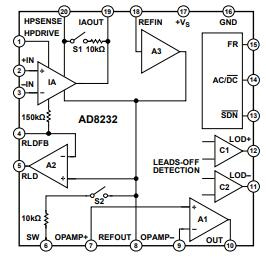
AD8232 Pinout

AD8232 CAD Model

Symbol

Footprint

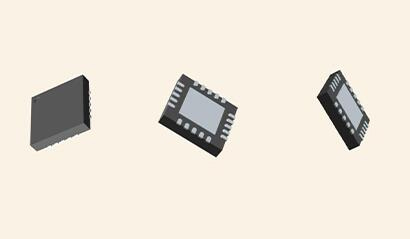
3D Model

AD8232 Features

  • Fully integrated single-lead ECG front end

  • Common-mode rejection ratio: 80 dB (dc to 60 Hz)

  • Two or three-electrode configurations

  • Qualified for automotive application

  • Single-supply operation: 2.0 V to 3.5

  • Fast restore feature improves filter settling

  • Size: 3.5cm x 3cm

AD8232 Advantage

  • The AD8232 can implement a two-pole high-pass filter for eliminating motion artifacts and the electrode half-cell potential.

  • This design allows for an ultralow power analog-to-digital converter (ADC) or an embedded microcontroller to acquire the output signal easily.

  • This filter is tightly coupled with the instrumentation architecture of the amplifier to allow both large gain and

    high-pass filtering in a single stage, thereby saving space and cost.

  • The user can select the frequency cutoff of all filters to suit different types of applications.


Specifications

Analog Devices Inc. AD8232ACPZ-WP technical specifications, attributes, parameters and parts with similar specifications to Analog Devices Inc. AD8232ACPZ-WP.

AD8232ACPZ-WP Tech Specifications

Analog Devices Inc. AD8232ACPZ-WP technical specifications, attributes, parameters and parts with similar specifications to Analog Devices Inc. AD8232ACPZ-WP.

Product Attribute Attribute Value
Lifecycle StatusPRODUCTION (Last Updated: 4 weeks ago)
Factory Lead Time8 Weeks
Contact PlatingTin
MountSurface Mount
Mounting TypeSurface Mount
Package / Case20-WFQFN Exposed Pad, CSP
Number of Pins20Pins
PackagingTray
JESD-609 Codee3
Pbfree Codeno
Part StatusActive
Moisture Sensitivity Level (MSL)3 (168 Hours)
Number of Terminations20Terminations
ECCN CodeEAR99
TypeECG Front End
Product Attribute Attribute Value
Max Operating Temperature85°C
Min Operating Temperature-40°C
ApplicationsHeart Rate Monitoring
Terminal PositionQUAD
Peak Reflow Temperature (Cel)260
Number of Functions1Function
Supply Voltage3V
Terminal Pitch0.5mm
Time@Peak Reflow Temperature-Max (s)30
Base Part NumberAD8232
Pin Count20
Temperature GradeINDUSTRIAL
Number of Channels1Channel
Max Supply Voltage3.5V
Min Supply Voltage2V
Product Attribute Attribute Value
Operating Supply Current170μA
Slew Rate0.2 V/μs
Common Mode Rejection Ratio80 dB
Input Offset Voltage (Vos)3mV
Gain Bandwidth Product100 kHz
Power Supply Rejection Ratio (PSRR)90dB
Input Bias Current200pA
Height750μm
Length4.1mm
Width4.1mm
REACH SVHCNo SVHC
Radiation HardeningNo
RoHS StatusROHS3 Compliant
Lead FreeContains Lead
0 Products View Similar

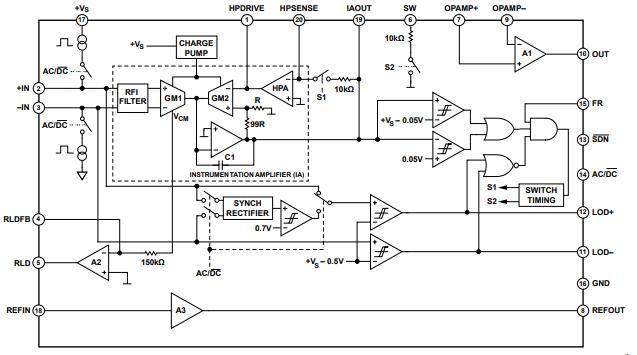
AD8232 Functional Block Diagram

AD8232 Schematic

AD8232 Application

  • Fitness and activity heart rate monitors

  • Portable ECG

  • Remote health monitors

  • Gaming peripherals Biopotential signal acquisition


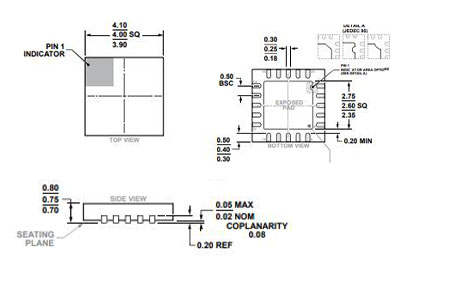
AD8232 Package

AD8232 Manufacturer

Analog Devices (NASDAQ: ADI) is a world leader in the design, manufacture, and marketing of a broad portfolio of high performance analog, mixed-signal, and digital signal processing (DSP) integrated circuits (ICs) used in virtually all types of electronic equipment. Since our inception in 1965, we have focused on solving the engineering challenges associated with signal processing in electronic equipment. Used by over 100,000 customers worldwide, our signal processing products play a fundamental role in converting, conditioning, and processing real-world phenomena such as temperature, pressure, sound, light, speed, and motion into electrical signals to be used in a wide array of electronic devices.

Datasheet PDF

Download datasheets and manufacturer documentation for Analog Devices Inc. AD8232ACPZ-WP.

AD8232ACPZ-WP Documents

Download datasheets and manufacturer documentation for AD8232ACPZ-WP

Frequently Asked Questions

What is AD8232?
The AD8232 is an integrated signal conditioning block for ECG and other biopotential measurement applications. It is designed to extract, amplify, and filter small biopotential signals in the presence of noisy conditions, such as those created by motion or remote electrode placement.
How do I calculate BPM on AD8232?
If you know the interval between heart beats, you can calculate the frequency using the formula: frequency = 1 / time. Now if you take the frequency and multiply it by 60, you should get BPM.
FAQ
What is AD8232?
The AD8232 is an integrated signal conditioning block for ECG and other biopotential measurement applications. It is designed to extract, amplify, and filter small biopotential signals in the presence of noisy conditions, such as those created by motion or remote electrode placement.
How do I calculate BPM on AD8232?
If you know the interval between heart beats, you can calculate the frequency using the formula: frequency = 1 / time. Now if you take the frequency and multiply it by 60, you should get BPM.

TAGS

Share