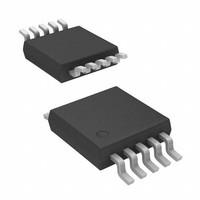
IC ADC 16-BIT I2C PROGBL 10-MSOP
The ADS1115 devices are precision, low-power, 16-bit, I2Ccompatible, analog-to-digital converters (ADCs) offered in an ultra-small, leadless, X2QFN-10 package, and a VSSOP-10 package.

IC ADC 16-BIT I2C PROGBL 10-MSOP The ADS1115 devices are precision, low-power, 16-bit, I2Ccompatible, analog-to-digital converters (ADCs) offered in an ultra-small, leadless, X2QFN-10 package, and a VSSOP-10 package.
384
Mar 4, 2021
Cathy
IC ADC 16-BIT I2C PROGBL 10-MSOP
The ADS1115 devices are precision, low-power, 16-bit, I2Ccompatible, analog-to-digital converters (ADCs) offered in an ultra-small, leadless, X2QFN-10 package, and a VSSOP-10 package.
ADS1115IDGST
| Quantity | Unit Price | Ext. Price |
|---|---|---|
| 1+ | $6.28798 | $6.29 |
| 10+ | $5.93205 | $59.32 |
| 100+ | $5.59628 | $559.63 |
| 500+ | $5.27951 | $2639.76 |
| 1000+ | $4.98067 | $4980.67 |
The ADS1115 devices are precision, low-power, 16-bit, I 2Ccompatible, analog-to-digital converters (ADCs) offered in an ultra-small, leadless, X2QFN-10 package, and a VSSOP-10 package. The ADS111x devices incorporate a low-drift voltage reference and an oscillator. The ADS1115 also incorporates a programmable gain amplifier (PGA) and a digital comparator. These features, along with a wide operating supply range, make the ADS111x well suited for power- and space-constrained, sensor measurement applications. The ADS111x perform conversions at data rates up to 860 samples per second (SPS). The PGA offers input ranges from ±256 mV to ±6.144 V, allowing precise large- and small-signal measurements. The ADS1115 features an input multiplexer (MUX) that allows two differential or four single-ended input measurements. Use the digital comparator in the ADS1115 for under- and overvoltage detection. The ADS111x operate in either continuousconversion mode or single-shot mode. The devices are automatically powered down after one conversion in single-shot mode; therefore, power consumption is significantly reduced during idle periods.
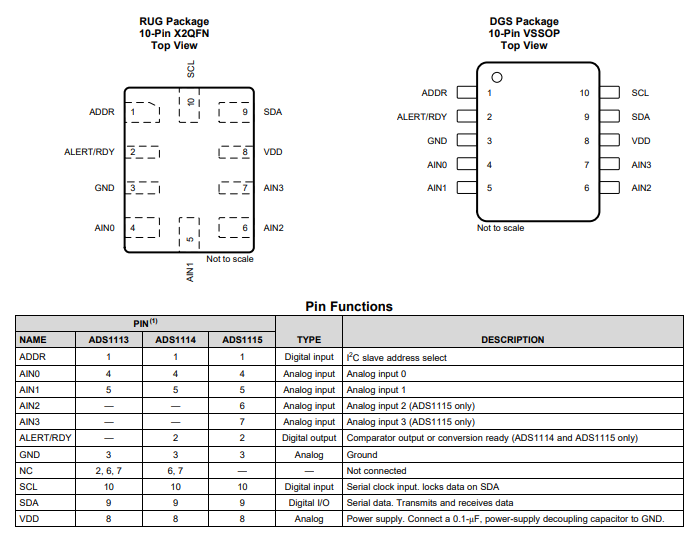
• Ultra-Small X2QFN Package: 2 mm × 1.5 mm × 0.4 mm
• Wide Supply Range: 2.0 V to 5.5 V
• Low Current Consumption: 150 μA (Continuous-Conversion Mode)
• Programmable Data Rate: 8 SPS to 860 SPS
• Single-Cycle Settling
• Internal Low-Drift Voltage Reference
• Internal Oscillator
• I 2C Interface: Four Pin-Selectable Addresses
• Four Single-Ended or Two Differential Inputs (ADS1115)
• Programmable Comparator (ADS1114 and ADS1115)
• Operating Temperature Range: –40°C to +125°C
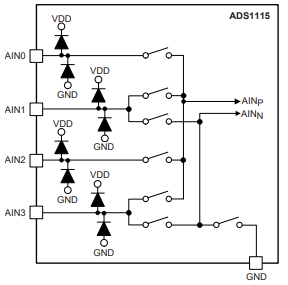
The ADS1115 contains an input multiplexer (MUX), as shown in the figure below. Either four single-ended or two differential signals can be measured. Additionally, AIN0 and AIN1 may be measured differentially to AIN3. The multiplexer is configured by bits MUX[2:0] in the Config register. When single-ended signals are measured, the negative input of the ADC is internally connected to GND by a switch within the multiplexer.
Texas Instruments ADS1115IDGST technical specifications, attributes, parameters and parts with similar specifications to Texas Instruments ADS1115IDGST.
Texas Instruments ADS1115IDGST technical specifications, attributes, parameters and parts with similar specifications to Texas Instruments ADS1115IDGST.
| Product Attribute | Attribute Value | |
|---|---|---|
| Factory Lead Time | 6 Weeks | |
| Contact Plating | Gold | |
| Mounting Type | Surface Mount | |
| Package / Case | 10-TFSOP, 10-MSOP (0.118, 3.00mm Width) | |
| Surface Mount | YES | |
| Number of Pins | 10Pins | |
| Power Dissipation (Max) | 500μW | |
| Current - Supply (Nom) | 150μA | |
| Number of Elements | 1 Element | |
| Operating Temperature | -40°C~125°C | |
| Packaging | Tape & Reel (TR) | |
| JESD-609 Code | e4 | |
| Pbfree Code | yes | |
| Part Status | ACTIVE (Last Updated: 4 days ago) | |
| Moisture Sensitivity Level (MSL) | 2 (1 Year) | |
| Number of Terminations | 10Terminations | |
| Termination | SMD/SMT | |
| ECCN Code | EAR99 | |
| Voltage - Supply | 3.3V | |
| Terminal Position | DUAL |
| Product Attribute | Attribute Value | |
|---|---|---|
| Terminal Form | GULL WING | |
| Peak Reflow Temperature (Cel) | 260 | |
| Number of Functions | 1Function | |
| Terminal Pitch | 0.5mm | |
| Base Part Number | ADS1115 | |
| Polarity | Bipolar | |
| Configuration | MUX-PGA-ADC | |
| Number of Channels | 4Channels | |
| Power Dissipation | 900μW | |
| Number of Bits | 16Bits | |
| Input Type | Differential, Single Ended | |
| Architecture | Sigma-Delta | |
| Number of Inputs | 2, 4Input | |
| Converter Type | ADC, DELTA-SIGMA | |
| Supply Type | Single | |
| Reference Type | Internal | |
| Data Interface | I2C | |
| Resolution | 2 B | |
| Sampling Rate | 860 sps | |
| Voltage - Supply, Analog | 2V~5.5V |
| Product Attribute | Attribute Value | |
|---|---|---|
| Voltage - Supply, Digital | 2V~5.5V | |
| Number of Analog In Channels | 4Analog In Channels | |
| Sampling Rate (Per Second) | 860 | |
| Output Bit Code | 2'S COMPLEMENT BINARY | |
| Integral Nonlinearity (INL) | 1 LSB | |
| Conversion Rate | 860 sps | |
| Output Format | SERIAL | |
| Max Supply Voltage (DC) | 5.5V | |
| Min Supply Voltage (DC) | 2V | |
| Voltage - Supply (Max) | 5.5V | |
| Voltage - Supply (Min) | 2V | |
| Features | PGA, Selectable Address | |
| Height | 1.07mm | |
| Length | 3mm | |
| Width | 3mm | |
| Thickness | 1.02mm | |
| REACH SVHC | No SVHC | |
| Radiation Hardening | No | |
| RoHS Status | ROHS3 Compliant | |
| Lead Free | Lead Free |
• Portable Instrumentation
• Battery Voltage and Current Monitoring
• Temperature Measurement Systems
• Consumer Electronics
• Factory Automation and Process Control
Download datasheets and manufacturer documentation for Texas Instruments ADS1115IDGST.
Download datasheets and manufacturer documentation for ADS1115IDGST
TAGS
Comments