ATTENTION: Due to increased demand and order volume, processing time may take an additional 1-3 business days.
HomeCommunitySubjectATMEGA16U2-MU 8-Bit Microcontroller: Features, Pinout, and Datasheet

ATMEGA16U2-MU 8-Bit Microcontroller: Features, Pinout, and Datasheet

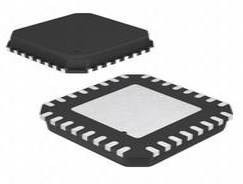
Embedded - Microcontrollers 32-VFQFN Exposed Pad 16kB Brown-out Detect/Reset, POR, PWM, WDT -40°C~85°C TA 2.7V~5.5V AVR? ATmega MICROCONTROLLER, RISC ATMEGA16U2 16MHz MCU 8-bit ATmega AVR RISC 16KB Flash 3.3V/5V 32-Pin QFN EP

221

Dec 13, 2021

Clarence Oliver

Embedded - Microcontrollers 32-VFQFN Exposed Pad 16kB Brown-out Detect/Reset, POR, PWM, WDT -40°C~85°C TA 2.7V~5.5V AVR® ATmega MICROCONTROLLER, RISC ATMEGA16U2 16MHz MCU 8-bit ATmega AVR RISC 16KB Flash 3.3V/5V 32-Pin QFN EP

ATMEGA16U2-MU is a CMOS 8-bit microcontroller with a USB controller and 22 I/O ports, as well as 16KB of ISP flash program memory. This article mainly introduces features, pinout, datasheet and other detailed information about Microchip Technology ATMEGA16U2-MU.

ATMEGA16U2-MU

2547In Stock
Min.: 1 Mult.: 1
Quantity Unit Price Ext. Price
1+ $4.28089$4.28
10+ $4.03858$40.39
100+ $3.80998$381
500+ $3.59432$1797.16
1000+ $3.39087$3390.87
Unit Price:$4.28089
Subtotal: $4.28
Looking for a better price? Want a lower wholesale price? Please send an RFQ, and we will respond immediately.
Quick Links

ATMEGA16U2-MU Description

ATMEGA16U2-MU is a CMOS 8-bit microcontroller with a USB controller and 22  I/O  ports, as well as 16KB of ISP flash program memory. The  AVR  core processor runs at a 16MHz reference frequency. The ATmega16U2 delivers throughputs approaching 1 MIPS per MHz by implementing strong instructions in a single clock cycle, allowing the system designer to optimize processing performance and power consumption.

Atmel's nonvolatile high-density memory technology was used to create and manufacture the ATMEGA16U2-MU. The ISP flash in chip allows for in-system reprogramming via the SPI serial interface. By combining In-System Self-Programmable Flash with an 8-bit RISC CPU on a monolithic chip, the Atmel ATmega16U2 is a well-built powerful microcontroller that offers a highly versatile and cost-effective solution to many embedded control applications.

In-circuit emulators, C compilers, evaluation kits, macro assemblers, and program debugger/simulators are among the program and system development tools available for the ATmega16U2.

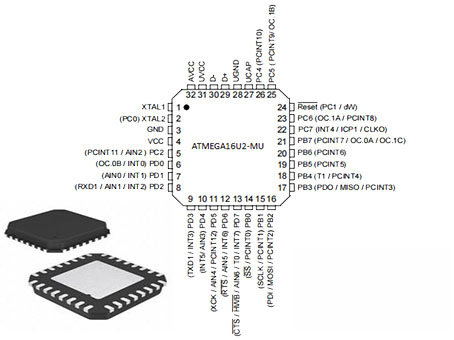
ATMEGA16U2-MU Pinout

The following figure is ATMEGA16U2-MU Pinout.

ATMEGA16U2-MU Pinout


Pin Number Pin Name Description
4 VCC Digital supply voltage.
3 GND Ground.
32 AVCC AVCC is the supply voltage pin (input) for all analog features (Analog Comparator, PLL). It
should be externally connected to VCC through a low-pass filter.
14~21 Port B (PB7..PB0) Port B is an 8-bit bi-directional I/O port with internal pull-up resistors (selected for each bit). The
Port B output buffers have symmetrical drive characteristics with both high sink and source
capability. As inputs, Port B pins that are externally pulled low will source current if the pull-up
resistors are activated. The Port B pins are tri-stated when a reset condition becomes active,
even if the clock is not running.
5,22,23,25,26 Port C (PC7..PC0) Port C is an 8-bit bi-directional I/O port with internal pull-up resistors (selected for each bit). The
Port C output buffers have symmetrical drive characteristics with both high sink and source
capability. As inputs, Port C pins that are externally pulled low will source current if the pull-up
resistors are activated. The Port C pins are tri-stated when a reset condition becomes active,
even if the clock is not running.
6~13 Port D (PD7..PD0) Port D serves as analog inputs to the analog comparator.
Port D also serves as an 8-bit bi-directional I/O port, if the analog comparator is not used (con cerns PD2/PD1 pins). Port pins can provide internal pull-up resistors (selected for each bit). The
Port D output buffers have symmetrical drive characteristics with both high sink and source
capability. As inputs, Port D pins that are externally pulled low will source current if the pull-up
resistors are activated. The Port D pins are tri-stated when a reset condition becomes active,
even if the clock is not running.
30 D- USB Full Speed Negative Data Upstream Port
29 D+ USB Full Speed Positive Data Upstream Port
28 UGND USB Ground.
31 UVCC USB Pads Internal Regulator Input supply voltage.
27 UCAP USB Pads Internal Regulator Output supply voltage. Should be connected to an external capac itor (1μF).
24 RESET/PC1/dW Reset input. A low level on this pin for longer than the minimum pulse length will generate a
reset, even if the clock is not running. Shorter pulses are not guaranteed to generate a reset. This pin alternatively
serves as debugWire channel or as generic I/O. The configuration depends on the fuses RST DISBL and DWEN.
1 XTAL1 Input to the inverting Oscillator amplifier and input to the internal clock operating circuit.
2 XTAL2/PC0 Output from the inverting Oscillator amplifier if enabled by Fuse. Also serves as a generic I/O.

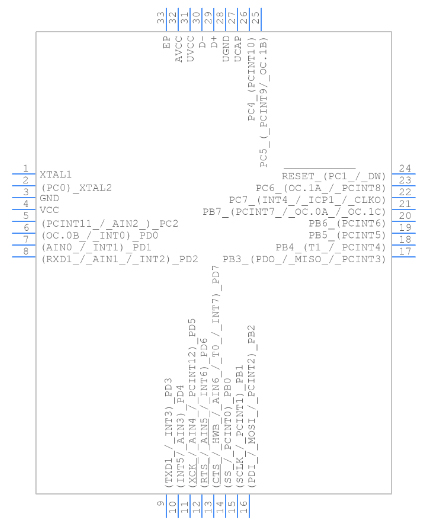
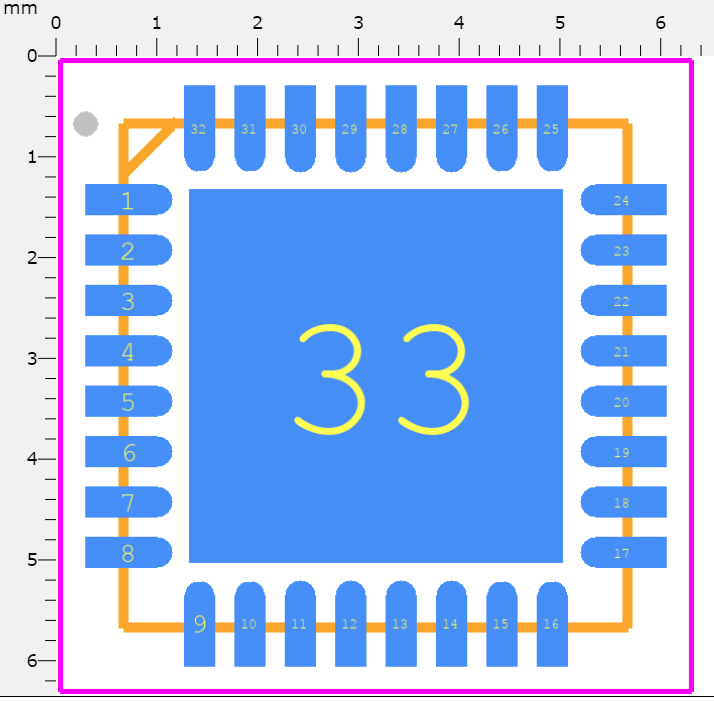
ATMEGA16U2-MU CAD Model

The followings are ATMEGA16U2-MU Symbol, Footprint and 3D Model.

Symbol

Footprint

3D Model

ATMEGA16U2-MU Features

  • High Performance, Low Power AVR®  8-Bit  Microcontroller

  • Advanced RISC Architecture

– 125 Powerful Instructions – Most Single Clock Cycle Execution

– 32 x 8 General Purpose Working Registers

– Fully Static Operation

– Up to 16 MIPS Throughput at 16 MHz

  • Non-volatile Program and Data Memories

–  8K /16K/32K Bytes of In-System Self-Programmable Flash

– 512/512/1024 EEPROM

– 512/512/1024 Internal  SRAM 

– Write/Erase Cycles: 10,000 Flash/ 100,000 EEPROM

– Data retention: 20 years at 85°C/ 100 years at 25°C

– Optional Boot Code Section with Independent Lock Bits

In-System Programming by on-chip  Boot Program  hardware-activated after reset

True Read-While-Write Operation

– Programming Lock for Software Security

  • USB 2.0 Full-speed Device Module with Interrupt on Transfer Completion

– Complies fully with Universal Serial Bus Specification REV 2.0

– 48 MHz PLL for Full-speed Bus Operation : data transfer rates at 12 Mbit/s

– Fully independant 176 bytes USB  DPRAM  for endpoint memory allocation

– Endpoint 0 for Control Transfers: from 8 up to 64-bytes

– 4 Programmable Endpoints:

IN or Out Directions

Bulk, Interrupt and IsochronousTransfers

Programmable maximum packet size from 8 to 64 bytes

Programmable single or double buffer

– Suspend/Resume Interrupts

– Microcontroller reset on USB Bus Reset without detach

– USB Bus Disconnection on Microcontroller Request

  • Peripheral Features

– One 8-bit Timer/Counters with Separate Prescaler and Compare Mode (two 8-bit  PWM  channels)

– One 16-bit Timer/Counter with Separate Prescaler, Compare and Capture Mode (three 8-bit PWM channels)

–  USART  with SPI master only mode and hardware flow control (RTS/CTS)

– Master/Slave  SPI Serial Interface

– Programmable Watchdog Timer with Separate On-chip Oscillator

– On-chip Analog Comparator

– Interrupt and Wake-up on Pin Change

  • On Chip Debug Interface (debugWIRE)

  • Special Microcontroller Features

–  Power-On Reset  and Programmable Brown-out Detection

– Internal Calibrated Oscillator

– External and Internal Interrupt Sources

– Five Sleep Modes: Idle, Power-save, Power-down, Standby, and Extended Standby

  • I/O and Packages

– 22 Programmable I/O Lines

– QFN32 (5x5mm) / TQFP32 packages

  • Operating Voltages

– 2.7 - 5.5V

  • Operating temperature

– Industrial (-40°C to +85°C)

  • Maximum Frequency

– 8 MHz at 2.7V - Industrial range

– 16 MHz at 4.5V - Industrial range


Specifications

Microchip Technology ATMEGA16U2-MU technical specifications, attributes, parameters and parts with similar specifications to Microchip Technology ATMEGA16U2-MU.

ATMEGA16U2-MU Tech Specifications

Microchip Technology ATMEGA16U2-MU technical specifications, attributes, parameters and parts with similar specifications to Microchip Technology ATMEGA16U2-MU.

Product Attribute Attribute Value
Factory Lead Time11 Weeks
Contact PlatingTin
MountSurface Mount
Mounting TypeSurface Mount
Package / Case32-VFQFN Exposed Pad
Number of Pins32Pins
Manufacturer Package Identifier32M1-A
Number of I/Os22I/Os
Watchdog TimersYes
Operating Temperature-40°C~85°C TA
PackagingTray
SeriesAVR® ATmega
Published2009
Pbfree Codeyes
Part StatusActive
Moisture Sensitivity Level (MSL)3 (168 Hours)
Number of Terminations32Terminations
Product Attribute Attribute Value
Terminal PositionQUAD
Supply Voltage5V
Terminal Pitch0.5mm
Frequency16MHz
Base Part NumberATMEGA16U2
Supply Voltage-Max (Vsup)5.5V
Power Supplies3/5V
Supply Voltage-Min (Vsup)4.5V
InterfaceSPI, UART, USART, USB
Memory Size16kB
Oscillator TypeInternal
RAM Size512 x 8
Voltage - Supply (Vcc/Vdd)2.7V~5.5V
uPs/uCs/Peripheral ICs TypeMICROCONTROLLER, RISC
Core ProcessorAVR
PeripheralsBrown-out Detect/Reset, POR, PWM, WDT
Program Memory TypeFLASH
Product Attribute Attribute Value
Core Size8-Bit
Program Memory Size16KB 8K x 16
ConnectivitySPI, UART/USART, USB
Bit Size8
Has ADCNO
DMA ChannelsNO
Data Bus Width8b
PWM ChannelsYES
DAC ChannelsNO
Number of Timers/Counters2Timers/Counters
EEPROM Size512 x 8
Length5mm
Height Seated (Max)1mm
Radiation HardeningNo
RoHS StatusROHS3 Compliant
Lead FreeLead Free
0 Products View Similar

ATMEGA16U2-MU Functional Block Diagram

The following figure is ATMEGA16U2-MU Functional Block Diagram.

Functional Block Diagram


The AVR core has 32 general-purpose working registers and a large instruction set. The Arithmetic Logic Unit (ALU) is directly coupled to all 32 registers, allowing two independent registers to be accessed in a single instruction executed in one clock cycle. The resulting architecture is more code efficient while achieving throughputs up to ten times faster than conventional CISC microcontrollers.

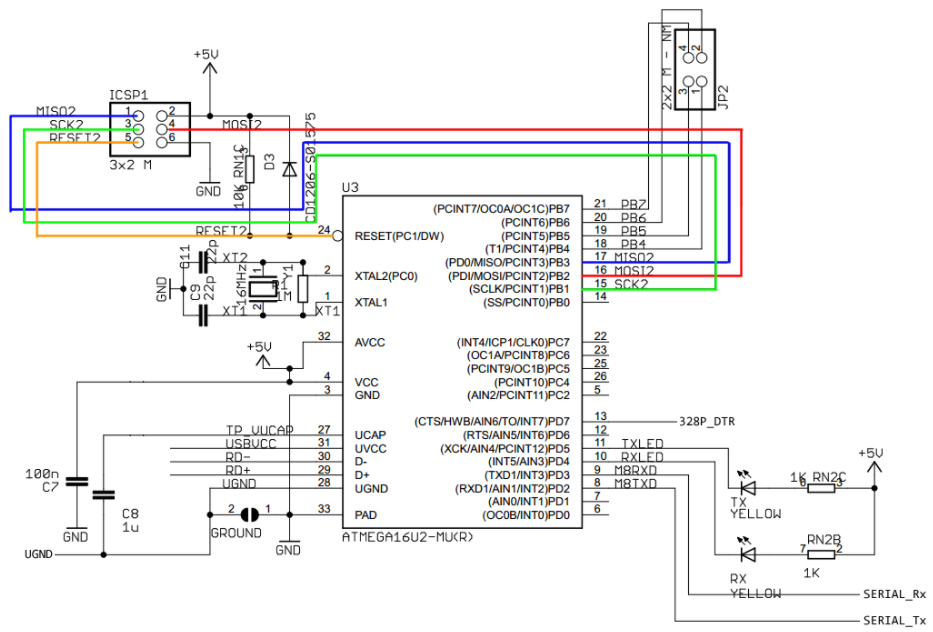
ATMEGA16U2-MU Schematic

The following figure shows the ATMEGA16U2-MU Schematic.

Schematic

ATMEGA16U2-MU Equivalent

ATMEGA16U2-MUR, ATMEGA16U2-AU,  ATMEGA16U2-AUR

ATMEGA16U2-MU Applications

• Consumer Electronics

• Appliances

• Monitoring Medical Equipment

• Circuitry to Control Processes

• Motor Control

• Rectification

• Power Regulation

• DAC Applications

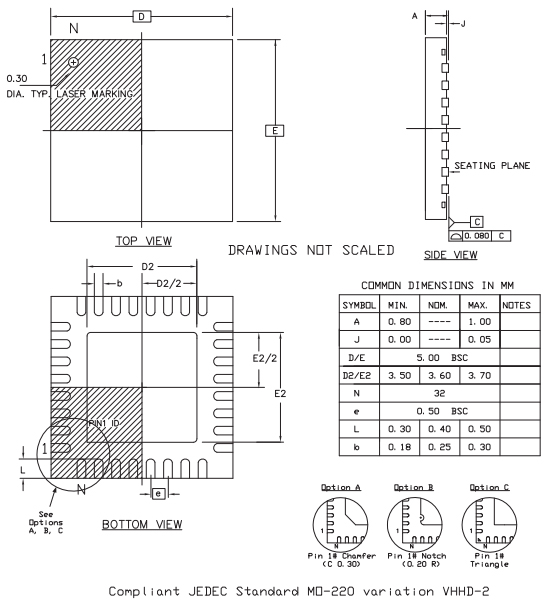
ATMEGA16U2-MU Package

The following figure shows the ATMEGA16U2-MU Package.

Package

ATMEGA16U2-MU Manufacturer

Microchip Technology Inc. is a leading provider of microcontroller and analog semiconductors, delivering low-risk product development, reduced overall system cost, and faster time to market to thousands of customers across the world. Microchip, based in Chandler, Arizona, provides excellent technical support as well as consistent delivery and quality.

Datasheet PDF

Download datasheets and manufacturer documentation for Microchip Technology ATMEGA16U2-MU.

ATMEGA16U2-MU Documents

Download datasheets and manufacturer documentation for ATMEGA16U2-MU

Frequently Asked Questions

What is the difference between ATmega16u2 and ATmega328?
These two are Atmel MCUs. ATMEGA16 and ATMEG328 are both 8bit AVR MCUs, 16U2 is a USB interface chip; 328 is the microcontroller chip used for programming.
How much ISP flash memory does ATMEGA16U2-MU have?
16KB.
What technology was used to create and manufacture the ATMEGA16U2-MU?
"Atmels nonvolatile high-density memory technology"
What does the ISP flash in chip allow for in-system reprogramming?
SPI serial interface.
What does the Atmel ATmega16U2 combine?
In-System Self-Programmable Flash with an 8-bit RISC CPU on a monolithic chip.
FAQ
What is the difference between ATmega16u2 and ATmega328?
These two are Atmel MCUs. ATMEGA16 and ATMEG328 are both 8bit AVR MCUs, 16U2 is a USB interface chip; 328 is the microcontroller chip used for programming.
How much ISP flash memory does ATMEGA16U2-MU have?
16KB.
What technology was used to create and manufacture the ATMEGA16U2-MU?
"Atmels nonvolatile high-density memory technology"
What does the ISP flash in chip allow for in-system reprogramming?
SPI serial interface.
What does the Atmel ATmega16U2 combine?
In-System Self-Programmable Flash with an 8-bit RISC CPU on a monolithic chip.

TAGS

Share