ATTENTION: Due to increased demand and order volume, processing time may take an additional 1-3 business days.
HomeCommunitySubjectATMEGA328P-PU Microcontroller: Features, Pinout, and Datasheet

ATMEGA328P-PU Microcontroller: Features, Pinout, and Datasheet

Embedded - Microcontrollers A/D 6x10b 28-DIP (0.300, 7.62mm) 32kB Brown-out Detect/Reset, POR, PWM, WDT -40°C~85°C TA 1.8V~5.5V AVR? ATmega MICROCONTROLLER,

516

Dec 8, 2021

Daisy Alerander

Arduino Uno to ATmega328 - Shrinking your Arduino Projects


Embedded - Microcontrollers A/D 6x10b 28-DIP (0.300, 7.62mm) 32kB Brown-out Detect/Reset, POR, PWM, WDT -40°C~85°C TA 1.8V~5.5V AVR® ATmega MICROCONTROLLER, RISC ATMEGA328P 20MHz MICROCHIP - ATMEGA328P-PU - MICROCONTROLLER MCU, 8 BIT, ATMEGA, 20MHZ, DIP-28

The ATMEGA328P-PU is a CMOS 8-bit microcontroller based on the AVR® improved RISC architecture with reduced power consumption. This article mainly introduces features, pinout, datasheet and other detailed information about Microchip Technology ATMEGA328P-PU.

ATMEGA328P-PU

5600In Stock
Min.: 1 Mult.: 1
Quantity Unit Price Ext. Price
1+ $2.86907$2.87
10+ $2.70667$27.07
100+ $2.55346$255.35
500+ $2.40892$1204.46
1000+ $2.27257$2272.57
Unit Price:$2.86907
Subtotal: $2.87
Looking for a better price? Want a lower wholesale price? Please send an RFQ, and we will respond immediately.
Quick Links

ATMEGA328P-PU Description

The ATMEGA328P-PU  is a CMOS 8-bit microcontroller based on the AVR ® improved RISC architecture with reduced power consumption. The devices achieve CPU throughput approaching one million instructions per second (MIPS) per megahertz by executing instructions in a single clock cycle, allowing the system designer to optimize power consumption versus processing performance.

The picoPower 8bit AVR  RISC   -based microcontroller features 32KB ISP flash memory with read-while-write capabilities, 1024B EEPROM, 2KB SRAM, 23 general-purpose I/O lines, 32 general-purpose working registers, three flexible timer/counters with compare modes, internal and external interrupts, serial programmable USART, a byte-oriented 2-wire serial interface, SPI serial port, a 6-channel 10-bit A/D converter (8- The device works with a voltage range of 1.8 to 5.5 volts.

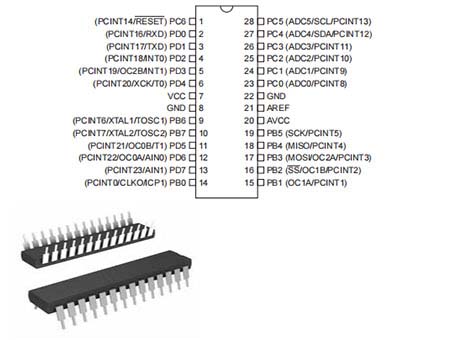
ATMEGA328P-PU Pinout

The following figure is ATMEGA328P-PU Pinout.

ATMEGA328P-PU CAD Model

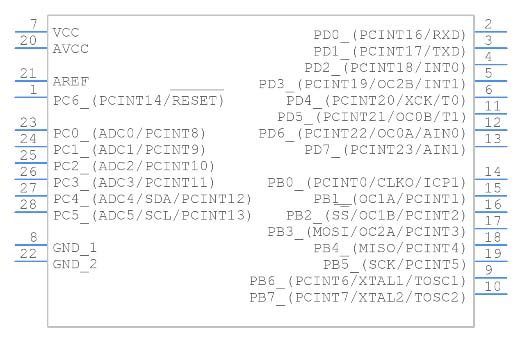
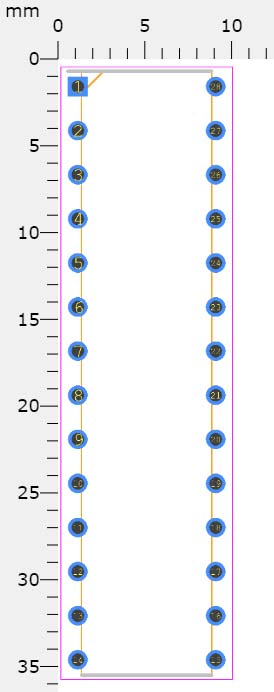
The following figures are ATMEGA328P-PU Symbol, Footprint and 3D Model.

Symbol

Footprint

3D Model

ATMEGA328P-PU Features

• High Performance, Low Power AVR®  8-Bit  Microcontroller Family

• Advanced RISC Architecture

̶ 131 Powerful Instructions – Most Single Clock Cycle Execution

̶ 32 x 8 General Purpose Working Registers

̶ Fully Static Operation

̶ Up to 20 MIPS Throughput at 20MHz

̶ On-chip 2-cycle Multiplier

• High Endurance Non-volatile Memory Segments

̶ 4/8/16/32KBytes of In-System Self-Programmable Flash program memory

̶ 256/512/512/1KBytes EEPROM

̶ 512/1K/1K/2KBytes Internal SRAM

̶ Write/Erase Cycles: 10,000 Flash/100,000 EEPROM

̶ Data retention: 20 years at 85°C/100 years at 25°C(1)

̶ Optional Boot Code Section with Independent Lock Bits

· In-System Programming by On-chip Boot Program

· True Read-While-Write Operation

̶ Programming Lock for Software Security

• QTouch® library support

̶ Capacitive touch buttons, sliders and wheels

̶ QTouch and QMatrix™ acquisition

̶ Up to 64 sense channels

• Peripheral Features

̶ Two 8-bit  Timer /Counters with Separate Prescaler and Compare Mode

̶ One 16-bit Timer/Counter with Separate Prescaler, Compare Mode, and Capture Mode

̶  Real Time  Counter with Separate Oscillator

̶ Six PWM Channels

̶ 8-channel 10-bit  ADC  in  TQFP  and  QFN /MLF package

· Temperature Measurement

̶ 6-channel 10-bit ADC in  PDIP Package 

· Temperature Measurement

̶ Programmable Serial USART

̶ Master/Slave SPI Serial Interface

̶ Byte-oriented 2-wire Serial Interface (Philips I2C compatible)

̶ Programmable Watchdog Timer with Separate On-chip Oscillator

̶ On-chip Analog Comparator

̶ Interrupt and Wake-up on Pin Change

• Special Microcontroller Features

̶  Power-on Reset  and Programmable Brown-out Detection

̶ Internal Calibrated Oscillator

̶ External and Internal Interrupt Sources

̶ Six Sleep Modes: Idle, ADC Noise Reduction, Power-save, Power-down, Standby, and Extended Standby

•  I/O  and Packages

̶ 23 Programmable I/O Lines

̶ 28-pin PDIP, 32-lead TQFP, 28-pad QFN/MLF and 32-pad QFN/MLF

• Operating Voltage:

̶ 1.8 - 5.5V

• Temperature Range:

̶ -40°C to 85°C

• Speed Grade:

̶ 0 - 4MHz@1.8 - 5.5V, 0 - 10MHz@2.7 - 5.5.V, 0 - 20MHz @ 4.5 - 5.5V

• Power Consumption at 1MHz, 1.8V, 25°C

̶ Active Mode: 0.2mA

̶ Power-down Mode: 0.1µA

· Power-save Mode: 0.75µA (Including 32kHz RTC)

Specifications

Microchip Technology ATMEGA328P-PU technical specifications, attributes, parameters and parts with similar specifications to Microchip Technology ATMEGA328P-PU.

ATMEGA328P-PU Tech Specifications

Microchip Technology ATMEGA328P-PU technical specifications, attributes, parameters and parts with similar specifications to Microchip Technology ATMEGA328P-PU.

Product Attribute Attribute Value
Factory Lead Time8 Weeks
Contact PlatingTin
MountThrough Hole
Mounting TypeThrough Hole
Package / Case28-DIP (0.300, 7.62mm)
Number of Pins28Pins
Data ConvertersA/D 6x10b
Number of I/Os23I/Os
Watchdog TimersYes
Operating Temperature-40°C~85°C TA
PackagingTube
SeriesAVR® ATmega
Published1997
JESD-609 Codee3
Pbfree Codeyes
Part StatusActive
Moisture Sensitivity Level (MSL)1 (Unlimited)
Number of Terminations28Terminations
Product Attribute Attribute Value
Terminal PositionDUAL
Supply Voltage5V
Terminal Pitch2.54mm
Frequency20MHz
Base Part NumberATMEGA328P
Supply Voltage-Max (Vsup)5.5V
Power Supplies2/5V
Supply Voltage-Min (Vsup)4.5V
Interface2-Wire, I2C, SPI, UART, USART
Memory Size32kB
Oscillator TypeInternal
RAM Size2K x 8
Voltage - Supply (Vcc/Vdd)1.8V~5.5V
uPs/uCs/Peripheral ICs TypeMICROCONTROLLER, RISC
Core ProcessorAVR
PeripheralsBrown-out Detect/Reset, POR, PWM, WDT
Program Memory TypeFLASH
Core Size8-Bit
Product Attribute Attribute Value
Program Memory Size32KB 16K x 16
ConnectivityI2C, SPI, UART/USART
Bit Size8
Has ADCYES
DMA ChannelsNO
Data Bus Width8b
PWM ChannelsYES
Number of Timers/Counters3Timers/Counters
EEPROM Size1K x 8
Number of ADC Channels6ADC Channels
Number of I2C Channels1I2C Channel
Height3.28mm
Length37.4mm
Width6.76mm
REACH SVHCNo SVHC
Radiation HardeningNo
RoHS StatusROHS3 Compliant
Lead FreeLead Free
0 Products View Similar

ATMEGA328P-PU Functional Block Diagram

The following figure shows the ATMEGA328P-PU Functional Block Diagram.

Functional Block Diagram

The  AVR  core has 32 general-purpose working registers and a large instruction set. The  Arithmetic Logic Unit  (ALU) is directly coupled to all 32 registers, allowing two independent registers to be accessed in a single instruction executed in one clock cycle. The resulting architecture is more code efficient than traditional  CISC  microcontrollers, with throughputs up to ten times faster.


ATMEGA328P-PU Applications

• Commonly used in many projects and autonomous systems where a simple, low-powered, low-cost micro-controller is needed.

• The most common implementation is on the popular Arduino development platform, namely the Arduino Uno, Arduino Pro Mini and Arduino Nano models.


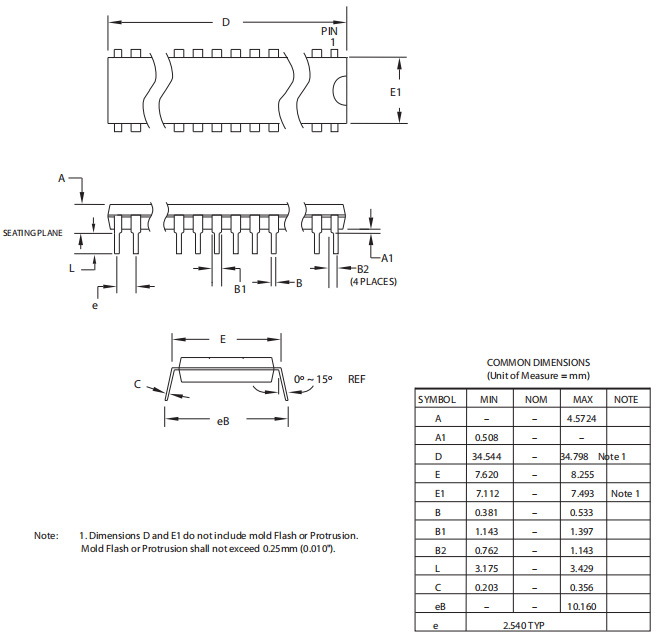
ATMEGA328P-PU Package

ATMEGA328P-PU Manufacturer

Microchip Technology Incorporated is a leading manufacturer of smart, networked, and secure embedded control solutions. Customers may create optimal designs using the company's simple development tools and broad product choices, which reduce risk while lowering overall system costs and time to market. The company's technologies are used by over 120,000 clients in the industrial, automotive, consumer, aerospace and defense, communications, and computing sectors.

Datasheet PDF

ATMEGA328P-PU Documents

Download datasheets and manufacturer documentation for ATMEGA328P-PU

Frequently Asked Questions

What is the difference between ATMEGA328P-PU and ATMEGA328P-AU?
The same thing, just the packaging is different. PU is the PDIP20 package, AU is the TQFP32 package. The former is a dual in-line package and the latter is a thin quad-lead flat pack.
What is the difference between Atmega328p-pu and Atmega16?
The biggest difference between Atmega328p-PU and Atmega16 is that their FLSAH capacity is different, the former is 32KB, the latter is 16KB, the number of external interrupts is also different, the rest are basically the same, the ATMEGA series of microcontrollers mainly have different FLASH capacities, and increase Some functional modules are essentially the same, the assembly instructions are basically the same, and there is no substantial difference.
How to connect the reset circuit of ATMega328p?
For stability, a pull-up resistor and a reset button are generally connected to reset the microcontroller. In addition, the internal crystal oscillator is only 8Mhz. If you want to make it faster, you can use a crystal oscillator and two capacitors to form an external oscillator circuit. The frequency becomes 16Mhz.
FAQ
What is the difference between ATMEGA328P-PU and ATMEGA328P-AU?
The same thing, just the packaging is different. PU is the PDIP20 package, AU is the TQFP32 package. The former is a dual in-line package and the latter is a thin quad-lead flat pack.
What is the difference between Atmega328p-pu and Atmega16?
The biggest difference between Atmega328p-PU and Atmega16 is that their FLSAH capacity is different, the former is 32KB, the latter is 16KB, the number of external interrupts is also different, the rest are basically the same, the ATMEGA series of microcontrollers mainly have different FLASH capacities, and increase Some functional modules are essentially the same, the assembly instructions are basically the same, and there is no substantial difference.
How to connect the reset circuit of ATMega328p?
For stability, a pull-up resistor and a reset button are generally connected to reset the microcontroller. In addition, the internal crystal oscillator is only 8Mhz. If you want to make it faster, you can use a crystal oscillator and two capacitors to form an external oscillator circuit. The frequency becomes 16Mhz.

TAGS

Share