ATTENTION: Due to increased demand and order volume, processing time may take an additional 1-3 business days.
HomeCommunitySubjectATmega8A 8-bit microcontroller: ATmega8A, Pinout, Datasheet

ATmega8A 8-bit microcontroller: ATmega8A, Pinout, Datasheet

Embedded - Microcontrollers A/D 6x10b 28-DIP (0.300, 7.62mm) 8kB Brown-out Detect/Reset, POR, PWM, WDT -40°C~85°C TA 2.7V~5.5V AVR? ATmega MICROCONTROLLER, RISC ATMEGA8A 16MHz MCU 8-bit ATmega AVR RISC 8KB Flash 3.3V/5V 28-Pin PDIP

4928

Nov 15, 2021

Cliff Felton

How to Programm Atmega328p\Atmega8a IC in Details

Embedded - Microcontrollers A/D 6x10b 28-DIP (0.300, 7.62mm) 8kB Brown-out Detect/Reset, POR, PWM, WDT -40°C~85°C TA 2.7V~5.5V AVR® ATmega MICROCONTROLLER, RISC ATMEGA8A 16MHz MCU 8-bit ATmega AVR RISC 8KB Flash 3.3V/5V 28-Pin PDIP

The Microchip AVR® ATmega8A is a low-power CMOS 8-bit microcontroller. This article will unlock more details about ATmega8A. There is a huge of Semiconductors, Capacitors, Resistors and ICs in stock. Welcome RFQ!


ATMEGA8A-PU

4500In Stock
Min.: 1 Mult.: 1
Quantity Unit Price Ext. Price
1+ $3.6987$3.7
10+ $3.48934$34.89
100+ $3.29183$329.18
500+ $3.1055$1552.75
1000+ $2.92972$2929.72
Unit Price:$3.6987
Subtotal: $3.7
Looking for a better price? Want a lower wholesale price? Please send an RFQ, and we will respond immediately.
Quick Links

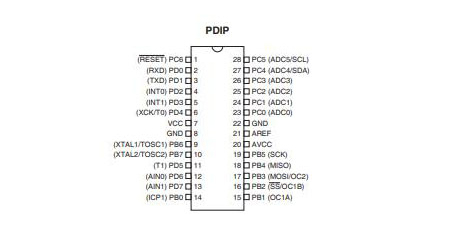
ATmega8A Pinout

ATmega8A CAD Model

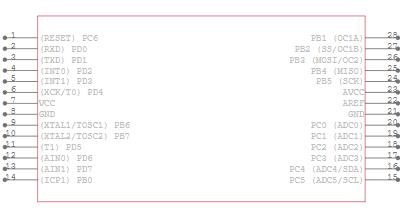
ATmega8A Symbol


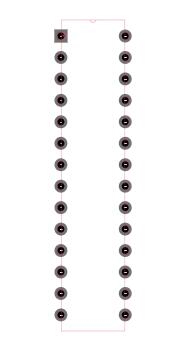
ATmega8a Footprint


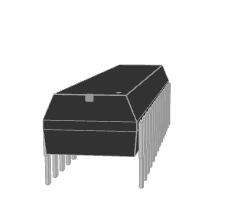
ATmega8A 3D Model

ATmega8A Description

The Microchip  AVR ® ATmega8A is a low-power CMOS 8-bit microcontroller based on the  AVR RISC architecture. By executing powerful instructions in a single clock cycle, the ATmega8A achieves throughputs approaching 1 MIPS per MHz, allowing the system designer to optimize power consumption versus processing speed.


The Microchip AVR® core combines a rich instruction set with 32 general purpose working registers. All the 32 registers are directly connected to the  Arithmetic Logic Unit  (ALU), allowing two independent registers to be accessed
in one single instruction executed in one clock cycle. The resulting architecture is more code efficient while achieving throughputs up to ten times faster than conventional CISC microcontrollers.


The ATmega8A provides the following features: 8K bytes of In-System Programmable Flash with Read-WhileWrite capabilities, 512 bytes of EEPROM, 1K byte of SRAM, 23 general-purpose I/O lines, 32 general purpose working registers, three flexible  Timer /Counters with compare modes, internal and external interrupts, a serial programmable USART, a byte-oriented Two-wire  Serial Interface, a 6-channel ADC (eight channels in TQFP and VQFN packages) with 10-bit accuracy, a programmable Watchdog  Timer with Internal Oscillator, an  SPI  serial port, and five software selectable power saving modes. 


The Idle mode stops the CPU while allowing the SRAM, Timer/Counters,  SPI port, and interrupt system to continue functioning. The Power-down mode saves the register contents but freezes the Oscillator, disabling all other chip functions until the next Interrupt or Hardware Reset. In Power-save mode, the asynchronous timer continues to run, allowing the user to maintain a timer base while the rest of the device is sleeping. The ADC Noise Reduction mode stops the CPU and all I/O modules except asynchronous timer and ADC, to minimize switching noise during ADC conversions. In Standby mode, the
crystal/resonator Oscillator is running while the rest of the device is sleeping. This allows very fast start-up combined with low-power consumption. 

ATmega8A Feature

  • High-performance, Low-power  Atmel AVR  8-bit Microcontroller 

  • Advanced RISC Architecture 

   - 131 powerful instructions – most single clock cycle execution 

   - 32 × 8 General Purpose Working Registers + Peripheral Control Registers 

   - Fully Static Operation 

   - Up to 16MIPS Throughput at 16MHz 

   - On-chip 2-cycle Multiplier

  • High Endurance Non-volatile Memory segments 

   - 8KBytes of In-System Self-programmable Flash program memory 

   - 512Bytes EEPROM  

   - 1KByte Internal SRAM 

   - Write/erase cycles: 10,000 flash/100,000 EEPROM 

   - Data retention: 20 years at 85°C/100 years at 25°C(1) 

   - Optional Boot Code Section with Independent Lock Bits 

  • In-System Programming by On-chip Boot Program 

  • True Read-While-Write Operation 

   -  Programming Lock for Software Security 

  • Peripheral Features 

   – Two 8-bit Timer/Counters with Separate Prescaler and compare mode 

   – One 16-bit Timer/Counter with Separate Prescaler, Compare Mode, and Capture Mode 

   – Real-Time Counter with Separate Oscillator 

   – Three PWM Channels 

   – 8-channel ADC in TQFP and VQFN package  

  • Eight Channels 10-bit Accuracy 

   – 6-channel ADC in PDIP package 

  • Six Channels 10-bit Accuracy 

   –  Master/Slave SPI  Serial Interface 

   – Programmable Watchdog Timer with On-chip Oscillator 

   – On-chip Analog Comparator 

   – Byte-Oriented 2-wire Serial Interface 

  • Special Microcontroller Features 

  – Power-on Reset and Programmable Brown-out Detection 

  – Internal Calibrated RC Oscillator 

  – External and Internal Interrupt Sources 

  – Six Sleep Modes: Idle, ADC Noise Reduction, Power-save, Power-down, Standby, and  Extended Standby '

  • I/O and Packages 

    ̶  23 Programmable  I/O  Lines 

    ̶  28-lead PDIP, 32-lead TQFP, and 32-pad VQFN 

  • Operating voltage 

   – 2.7 - 5.5V 

   – 0 - 16MHz 

  • Power Consumption at 4MHz, 3V, 25°C 

   - Active: 3.6mA 

   - Idle Mode: 1.0mA 

   - Power-down Mode: 0.5µA 

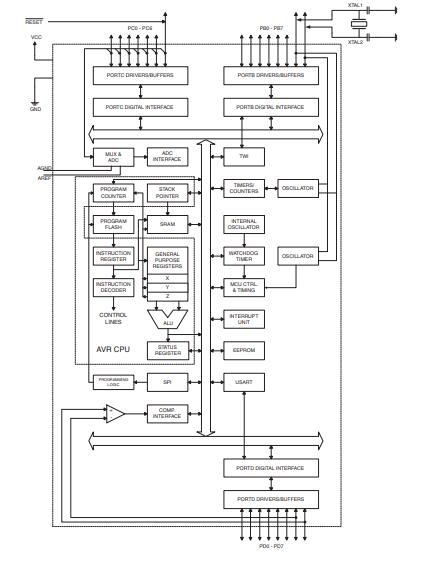
ATmega8A Block Diagram

ATmega8A Block Diagram

Specifications

Microchip Technology ATMEGA8A-PU technical specifications, attributes, parameters and parts with similar specifications to Microchip Technology ATMEGA8A-PU.

ATMEGA8A-PU Tech Specifications

Microchip Technology ATMEGA8A-PU technical specifications, attributes, parameters and parts with similar specifications to Microchip Technology ATMEGA8A-PU.

Product Attribute Attribute Value
Factory Lead Time2 Weeks
Contact PlatingTin
MountThrough Hole
Mounting TypeThrough Hole
Package / Case28-DIP (0.300, 7.62mm)
Number of Pins28Pins
Data ConvertersA/D 6x10b
Number of I/Os23I/Os
Watchdog TimersYes
Operating Temperature-40°C~85°C TA
PackagingTube
SeriesAVR® ATmega
Published2009
JESD-609 Codee3
Pbfree Codeyes
Part StatusActive
Moisture Sensitivity Level (MSL)1 (Unlimited)
Number of Terminations28Terminations
Product Attribute Attribute Value
Additional FeatureOPERATES AT 2.7 V MINIMUM SUPPLY AT 8 MHZ
Terminal PositionDUAL
Supply Voltage5V
Terminal Pitch2.54mm
Frequency16MHz
Base Part NumberATMEGA8A
Supply Voltage-Max (Vsup)5.5V
Supply Voltage-Min (Vsup)4.5V
InterfaceI2C, SPI, UART, USART
Memory Size8kB
Oscillator TypeInternal
RAM Size1K x 8
Voltage - Supply (Vcc/Vdd)2.7V~5.5V
uPs/uCs/Peripheral ICs TypeMICROCONTROLLER, RISC
Core ProcessorAVR
PeripheralsBrown-out Detect/Reset, POR, PWM, WDT
Program Memory TypeFLASH
Core Size8-Bit
Product Attribute Attribute Value
Program Memory Size8KB 4K x 16
ConnectivityI2C, SPI, UART/USART
Bit Size8
Has ADCYES
DMA ChannelsNO
Data Bus Width8b
EEPROM Size512 x 8
Number of ADC Channels6ADC Channels
Number of PWM Channels3PWM Channels
Number of I2C Channels1I2C Channel
Height4.572mm
Length34.8mm
Width7.49mm
REACH SVHCNo SVHC
Radiation HardeningNo
RoHS StatusROHS3 Compliant
Lead FreeLead Free
0 Products View Similar

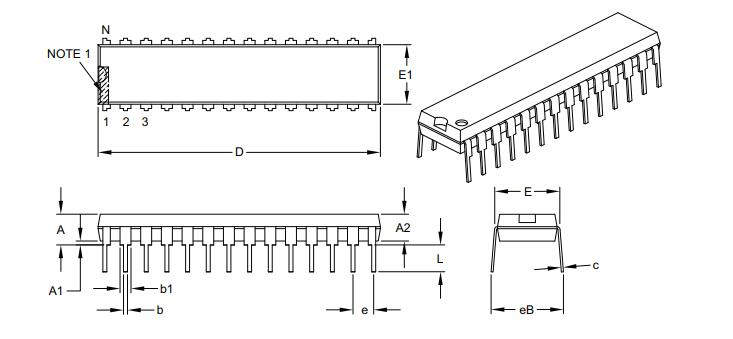
ATmega8A Package

ATmega8A Package

Note: More details can see in the datasheet of ATmega8A below.

ATmega8A Manufacturer

Microchip Technology Inc. is a leading provider of microcontroller and analogue semiconductors, providing low-risk product development, lower total system cost and faster time to market for thousands of diverse customer applications worldwide. Headquartered in Chandler, Arizona, Microchip offers outstanding technical support along with dependable delivery and quality.

Datasheet PDF

Download datasheets and manufacturer documentation for Microchip Technology ATMEGA8A-PU.

ATMEGA8A-PU Documents

Download datasheets and manufacturer documentation for ATMEGA8A-PU

Frequently Asked Questions

What is AVR atmega8a?
The Microchip AVR®ATmega8A is a low-power CMOS 8-bit microcontroller based on the AVR RISC architecture. By executing powerful instructions in a single clock cycle, the ATmega8A achieves throughputs approaching 1 MIPS per MHz, allowing the system designer to optimize power consumption versus processing speed.
How to set up ATmega8A as ISP?
Go to Tools > Board and select ATmega8A. You can also select your clock type and frequency in the Tools menu. Select programmer type in Tools > Programmer: as “Arduino as ISP”.
What is ATmega8 Arduino?
Features: ATmega8A microcontroller (Self Programmable) CAN be used as ARDUINO Board as well as AVR's 28 PIN ATMEGA8 DEVELOPMENT BOARD. Built In Power Supply: Input voltage - +7-+12V 14 Digital I/O Pins (6 PWM outputs) 6 Analog Inputs 8k Flash Memory 16Mhz Clock Speed No Need of any Programmer.
How do I program an AVR microcontroller with Arduino?
Step 1: Gather All the Stuff. Here is all that you will need: ... Step 2: Upload the ISP Program to the Arduino Board. ... Step 3: Connect the Target AVR Board to the Arduino Board. ... Step 4: Burn the Bootloader on the AVR Board. ... Step 5: Test the AVR Board. Step 6: It's Done!
FAQ
What is AVR atmega8a?
The Microchip AVR®ATmega8A is a low-power CMOS 8-bit microcontroller based on the AVR RISC architecture. By executing powerful instructions in a single clock cycle, the ATmega8A achieves throughputs approaching 1 MIPS per MHz, allowing the system designer to optimize power consumption versus processing speed.
How to set up ATmega8A as ISP?
Go to Tools > Board and select ATmega8A. You can also select your clock type and frequency in the Tools menu. Select programmer type in Tools > Programmer: as “Arduino as ISP”.
What is ATmega8 Arduino?
Features: ATmega8A microcontroller (Self Programmable) CAN be used as ARDUINO Board as well as AVR's 28 PIN ATMEGA8 DEVELOPMENT BOARD. Built In Power Supply: Input voltage - +7-+12V 14 Digital I/O Pins (6 PWM outputs) 6 Analog Inputs 8k Flash Memory 16Mhz Clock Speed No Need of any Programmer.
How do I program an AVR microcontroller with Arduino?
Step 1: Gather All the Stuff. Here is all that you will need: ... Step 2: Upload the ISP Program to the Arduino Board. ... Step 3: Connect the Target AVR Board to the Arduino Board. ... Step 4: Burn the Bootloader on the AVR Board. ... Step 5: Test the AVR Board. Step 6: It's Done!

TAGS

Share