Programming Attiny85 and Attiny13A
8-bit Microcontrollers - MCU 1KB In-system Flash 20MHz 1.8V-5.5V
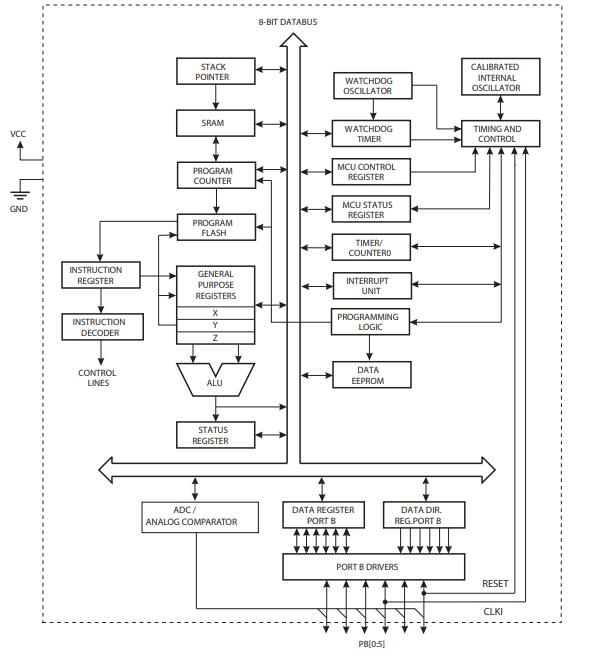
This post will unlock more details about ATtiny13A, a low-power CMOS 8-bit microcontroller based on the AVR enhanced RISC architecture.

8-bit Microcontrollers - MCU 1KB In-system Flash 20MHz 1.8V-5.5V This post will unlock more details about ATtiny13A, a low-power CMOS 8-bit microcontroller based on the AVR enhanced RISC architecture.
2445
Sep 15, 2021
Jodie Norris
Programming Attiny85 and Attiny13A
8-bit Microcontrollers - MCU 1KB In-system Flash 20MHz 1.8V-5.5V
This post will unlock more details about ATtiny13A, a low-power CMOS 8-bit microcontroller based on the AVR enhanced RISC architecture.
ATTINY13A-PU
| Quantity | Unit Price | Ext. Price |
|---|---|---|
| 1+ | $1.90281 | $1.9 |
| 10+ | $1.79511 | $17.95 |
| 100+ | $1.6935 | $169.35 |
| 500+ | $1.59764 | $798.82 |
| 1000+ | $1.50721 | $1507.21 |
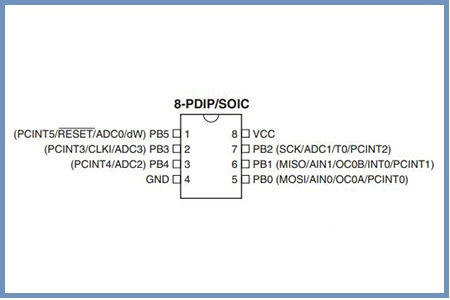
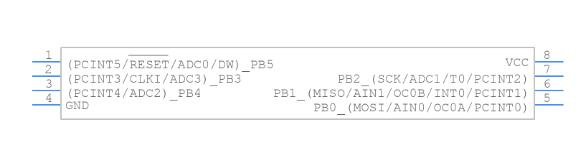
ATtiny13A Symbol
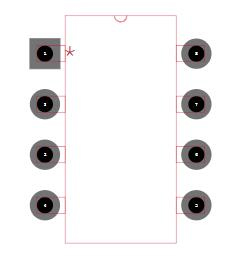
ATtiny13A Footprint
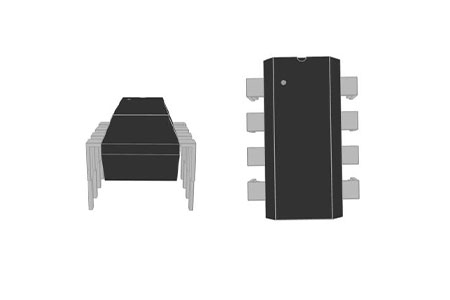
ATtiny13A 3D Model
Microchip Technology ATTINY13A-PU technical specifications, attributes, parameters and parts with similar specifications to Microchip Technology ATTINY13A-PU.
| Product Attribute | Attribute Value | |
|---|---|---|
| Factory Lead Time | 8 Weeks | |
| Contact Plating | Tin | |
| Mount | Through Hole | |
| Mounting Type | Through Hole | |
| Package / Case | 8-DIP (0.300, 7.62mm) | |
| Number of Pins | 8Pins | |
| Data Converters | A/D 4x10b | |
| Number of I/Os | 6I/Os | |
| Watchdog Timers | Yes | |
| Operating Temperature | -40°C~85°C TA | |
| Packaging | Tube | |
| Series | AVR® ATtiny | |
| Published | 2004 | |
| JESD-609 Code | e3 | |
| Pbfree Code | yes | |
| Part Status | Active | |
| Moisture Sensitivity Level (MSL) | 1 (Unlimited) |
| Product Attribute | Attribute Value | |
|---|---|---|
| Number of Terminations | 8Terminations | |
| Voltage - Supply | 5V | |
| Terminal Position | DUAL | |
| Frequency | 20MHz | |
| Base Part Number | ATTINY13A | |
| Interface | SPI | |
| Memory Size | 1kB | |
| Oscillator Type | Internal | |
| RAM Size | 64 x 8 | |
| uPs/uCs/Peripheral ICs Type | MICROCONTROLLER, RISC | |
| Core Processor | AVR | |
| Peripherals | Brown-out Detect/Reset, POR, PWM, WDT | |
| Program Memory Type | FLASH | |
| Core Size | 8-Bit | |
| Program Memory Size | 1KB 512 x 16 | |
| Bit Size | 8 | |
| Has ADC | YES |
| Product Attribute | Attribute Value | |
|---|---|---|
| DMA Channels | NO | |
| Data Bus Width | 8b | |
| Address Bus Width | 8b | |
| EEPROM Size | 64 x 8 | |
| Number of ADC Channels | 4ADC Channels | |
| Voltage - Supply (Max) | 5.5V | |
| Number of PWM Channels | 2PWM Channels | |
| Number of SPI Channels | 1SPI Channel | |
| Height | 4.953mm | |
| Length | 10.16mm | |
| Width | 7.112mm | |
| REACH SVHC | No SVHC | |
| Radiation Hardening | No | |
| RoHS Status | ROHS3 Compliant | |
| Lead Free | Lead Free |
• High Performance, Low Power AVR® 8-Bit Microcontroller
• Advanced RISC Architecture
– 120 Powerful Instructions – Most Single Clock Cycle Execution
– 32 x 8 General Purpose Working Registers
– Fully Static Operation
– Up to 20 MIPS Throughput at 20 MHz
• High Endurance Non-volatile Memory segments
– 1K Bytes of In-System Self-programmable Flash program memory
– 64 Bytes EEPROM
– 64 Bytes Internal SRAM
– Write/Erase Cycles: 10,000 Flash/100,000 EEPROM
– Data retention: 20 Years at 85°C/100 Years at 25°C (see page 6)
– Programming Lock for Self-Programming Flash & EEPROM Data Security
• Peripheral Features
– One 8-bit Timer/Counter with Prescaler and Two PWM Channels
– 4-channel, 10-bit ADC with Internal Voltage Reference
– Programmable Watchdog Timer with Separate On-chip Oscillator
– On-chip Analog Comparator
• Special Microcontroller Features
– debugWIRE On-chip Debug System
– In-System Programmable via SPI Port
– External and Internal Interrupt Sources
– Low Power Idle, ADC Noise Reduction, and Power-down Modes
– Enhanced Power-on Reset Circuit
– Programmable Brown-out Detection Circuit with Software Disable Function
– Internal Calibrated Oscillator
• I/O and Packages
– 8-pin PDIP/SOIC: Six Programmable I/O Lines
– 10-pad MLF: Six Programmable I/O Lines
– 20-pad MLF: Six Programmable I/O Lines
• Operating Voltage:
– 1.8 – 5.5V
• Speed Grade:
– 0 – 4 MHz @ 1.8 – 5.5V
– 0 – 10 MHz @ 2.7 – 5.5V
– 0 – 20 MHz @ 4.5 – 5.5V
• Industrial Temperature Range
• Low Power Consumption
– Active Mode:
• 190 µA at 1.8 V and 1 MHz
– Idle Mode:
• 24 µA at 1.8 V and 1 MHz
A-grade AVRs are minor improvements over the previous iteration; these improvements vary from chip to chip, e.g. the difference between ATtiny2313 and ATtiny2313A is different from the difference between ATmega128 and ATmega128A.
To be more specific, the ATtiny13 is the original version and uses a different process technology than the ATtiny13A. The A-suffixed parts are fabricated with a low power process marketed as "picoPower", and the main difference is that they generally consume less power at the same voltage and frequency.
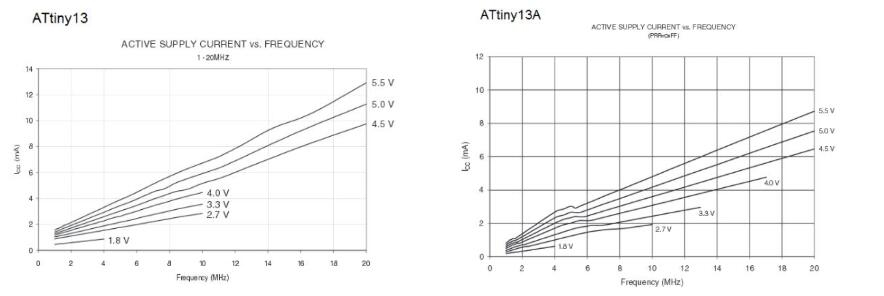
ATtiny13 vs.ATtiny13A
Regarding differences from the point of view of code compatibility, I see no reason why the ATtiny13A would not be code and binary compatible with programs written for the ATtiny13. However, the reverse is not strictly the case: While the instruction sets and most peripherals are identical, the ATtiny13A has the extra registers PRR (Power Reduction Register) and BODCR (Brown-Out Detector Control Register).
Microchip Technology Incorporated is a leading provider of smart, connected and secure embedded control solutions. Its easy-to-use development tools and comprehensive product portfolio enable customers to create optimal designs, which reduce risk while lowering total system cost and time to market. The company's solutions serve more than 120,000 customers across the industrial, automotive, consumer, aerospace and defence, communications and computing markets. Headquartered in Chandler, Arizona, Microchip offers outstanding technical support along with dependable delivery and quality.
Download datasheets and manufacturer documentation for Microchip Technology ATTINY13A-PU.
Download datasheets and manufacturer documentation for ATTINY13A-PU
TAGS
Comments