ATTENTION: Due to increased demand and order volume, processing time may take an additional 1-3 business days.
HomeCommunitySubjectATTINY2313 8-bit AVR Microcontroller: Pinout, Datasheet and Programming

ATTINY2313 8-bit AVR Microcontroller: Pinout, Datasheet and Programming

MCU 8-bit ATtiny AVR RISC 2KB Flash 2.5V/3.3V/5V 20-Pin PDIP W The ATtiny2313 is a low-power CMOS 8-bit microcontroller based on the AVR enhanced RISC. This article mainly covers pinout, datasheet, features, programming, and other details about the ATTINY2313 microcontroller. Furthermore, there is a huge range of semiconductors, capacitors, resistors, and ICs in stock

156

Oct 6, 2021

Meredith Piers

Arduino Project Programming ATtiny2313


MCU 8-bit ATtiny AVR RISC 2KB Flash 2.5V/3.3V/5V 20-Pin PDIP W

The ATtiny2313 is a low-power CMOS 8-bit microcontroller based on the AVR enhanced RISC. This article mainly covers pinout, datasheet, features, programming, and other details about the ATTINY2313 microcontroller. Furthermore, there is a huge range of semiconductors, capacitors, resistors, and ICs in stock


ATTINY2313A-PU

5434In Stock
Min.: 1 Mult.: 1
Quantity Unit Price Ext. Price
1+ $4.10979$4.11
10+ $3.87716$38.77
100+ $3.6577$365.77
500+ $3.45066$1725.33
1000+ $3.25534$3255.34
Unit Price:$4.10979
Subtotal: $4.11
Looking for a better price? Want a lower wholesale price? Please send an RFQ, and we will respond immediately.
Quick Links

ATTINY2313 Pinout

ATTINY2313 Pinout


Pin   Number Pin Name Description
1 RESET/dW/PA2 Port A BIt 2 or RESET   used mainly for programming or dW
2 PD0/RXD Bidirectional I/O Pin   of Port D Bit 0 or UART DATA Receive
3 PD1/TXD Bidirectional I/O Pin   of Port D Bit 1 or UART DATA Transmit
4 PA1/XTAL2 Port A BIt 1 or   Crystal Out
5 PA0/XTAL1 Port A Bit 0 or   Crystal In
6 PD2/CKOUT/XCK/INT0 Bidirectional I/O Pin   of Port D Bit 2 or External Interrupt 0 or System clock output or USART clock   for synchronous transfer
7 PD3/INT1 Bidirectional I/O Pin   of Port D Bit 3 or External Interrupt 1
8 PD4/T0 Bidirectional I/O Pin   of Port D Bit 4 or Timer 0 Output/counter
9 PD5/OC0B/T1 Bidirectional I/O Pin   of Port D Bit 5 or Output compare match Bout or Timer 1 Output / Counter
10 GND Ground Pin of MCU
11 PD6/ICP Bidirectional I/O Pin   of Port D Bit 6 or Input Capture
12 PB0/AIN0/PCINT0 Bidirectional I/O Pin   of Port B Bit 0 or Analog comparator 0 or Pin change Interrupt source
13 PB1/AIN1/PCINT1 Bidirectional I/O Pin   of Port B Bit 1 or Analog comparator 1 or Pin change Interrupt source
14 PB2/OC0A/PCIN2 Bidirectional I/O Pin   of Port B Bit 2 or Output compare match A out or Pin change Interrupt source
15 PB3/OC1A/PCINT3 Bidirectional I/O Pin   of Port B Bit 3 or Output compare match A out or Pin change Interrupt source
16 PB4/OC1B/PCINT4 Bidirectional I/O Pin   of Port B Bit 4 or Output compare match Bout or Pin change Interrupt source
17 PB5/MOSI/DI/SDA/PCINT5 Bidirectional I/O Pin   of Port B Bit 5 or SPI MOSI, also used in Programming or I2C SDA or Pin   change Interrupt source
18 PB6/MISO/DO/PCINT6 Bidirectional I/O Pin   of Port B Bit 5 or SPI MISO, also used in Programing or Pin change Interrupt   source or three-wire Universal Interface Data output
19 PB7/UCSK/SCL/PCINT7 Bidirectional I/O Pin   of Port B Bit 7 or Three-wire mode Universal serial interface or I2C SCL or   Pin change Interrupt source or SCK for Programming
20 VCC Positive Pin of MCU   (+5V)

ATTINY2313 CAD Model

ATTINY2313 Symbol


ATTINY2313 Footprint

What is ATTINY2313?

The ATTINY2313 is a low-power, 8-bit CMOS microcontroller that uses the AVR enhanced RISC architecture. The ATtiny2313 achieves throughputs approaching 1 MIPS per MHz by executing strong instructions in a single clock cycle, allowing the system designed to optimize power consumption versus processing performance.

Specifications

ATTINY2313A-PU Tech Specifications

Microchip Technology ATTINY2313A-PU technical specifications, attributes, parameters and parts with similar specifications to Microchip Technology ATTINY2313A-PU.

Product Attribute Attribute Value
Factory Lead Time7 Weeks
Contact PlatingTin
MountThrough Hole
Mounting TypeThrough Hole
Package / Case20-DIP (0.300, 7.62mm)
Number of Pins20Pins
Number of I/Os18I/Os
Watchdog TimersYes
Operating Temperature-40°C~85°C TA
PackagingTube
SeriesAVR® ATtiny
Published1997
JESD-609 Codee4
Pbfree Codeyes
Part StatusActive
Moisture Sensitivity Level (MSL)1 (Unlimited)
Number of Terminations20Terminations
Terminal FinishNICKEL PALLADIUM GOLD
Product Attribute Attribute Value
Terminal PositionDUAL
Peak Reflow Temperature (Cel)NOT APPLICABLE
Supply Voltage5V
Frequency20MHz
Time@Peak Reflow Temperature-Max (s)NOT APPLICABLE
Base Part NumberATTINY2313A
Qualification StatusNot Qualified
Supply Voltage-Max (Vsup)5.5V
Supply Voltage-Min (Vsup)4.5V
InterfaceI2C, SPI, UART, USART
Memory Size2kB
Oscillator TypeInternal
RAM Size128 x 8
Voltage - Supply (Vcc/Vdd)1.8V~5.5V
uPs/uCs/Peripheral ICs TypeMICROCONTROLLER, RISC
Core ProcessorAVR
PeripheralsBrown-out Detect/Reset, POR, PWM, WDT
Program Memory TypeFLASH
Product Attribute Attribute Value
Core Size8-Bit
Program Memory Size2KB 1K x 16
ConnectivityI2C, SPI, UART/USART
Bit Size8
Has ADCNO
DMA ChannelsNO
Data Bus Width8b
PWM ChannelsYES
DAC ChannelsYES
Number of Timers/Counters2Timers/Counters
EEPROM Size128 x 8
Number of I2C Channels1I2C Channel
Height4.953mm
Length25.98mm
Width7.112mm
REACH SVHCNo SVHC
RoHS StatusROHS3 Compliant
Lead FreeLead Free
0 Products View Similar

ATTINY2313 Features

  • DataBus Width: 8bits

  • Pin Count: 20 (PDIP/SOIC/MLF/QFN)

  • Processor Speed: 12 Million Instructions per Second

  • Program Memory: 2 KB

  • StaticRAM: 128 bytes

  • Data EEPROM: 128 Bytes

  • PWM channels: 4

  • Operational Temperature: -400C – 850C

  • High-performance CMOS microcontrollers with Flash Technology

  • Operates at a wide range of 2.7 – 5.5 volts, so it is power-efficient

  • Inbuilt Brown Out detection circuit for urgency

  • Operational frequency is up to 4MHz but can be altered for saving energy

  • 32X8 general purpose registers


ATTINY2313 Alternatives

ATtiny2313A (Exact Alternative with the new release)

ATtiny417

ATtiny28L

ATtiny48

ATmega328P

ATmega88PA

ATmega8A

ATmega8515

ATmega8535

ATmega645A

ATmega6490

ATmega16

ATMega32

ATtiny45

ATtiny88

ATtiny85 

ATTINY2313 Applications

  • Sensor Systems

  • Medical systems

  • Home automation systems

  • Low-cost embedded systems

  • Automobiles

  • Defense and safety purposes


How to Program ATTINY2313 AVR Microcontroller

To create a program, we'll need an IDE, an IPE, a suitable compiler, and a programmer/debugger. The purpose of an IDE (Integrated Development Environment) is to create a programming environment. The compiler transforms the program into HEX files that can be read by humans. The IPE (Integrated Programming Environment) is used to program AVR MCUs to burn HEX files.

IDE: Atmel Studio 7

Compiler: AVR and ARM Toolchains


Assembly Language can still be used to program. Micro C for AVR, AVR, and ARM Toolchains, all given by Atmel's manufacturers, Microchip, are among the most widely used compilers.

Atmel-ICE is an in-circuit programmer/debugger that is used to program AVR microcontrollers. It uses Atmel Studio to burn the code into the ATtiny2313 AVR utilizing In-Circuit-Serial-Programming, which is controlled by a computer. Hardware such as a Perfboard, soldering station, Crystal Oscillator, capacitors, and an AVR IC is also required.
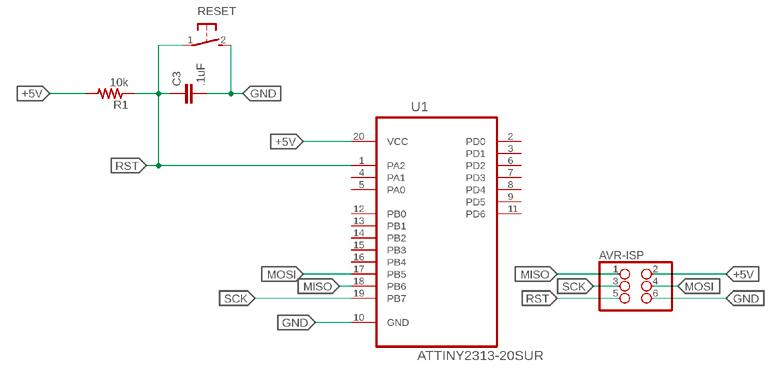
ATTINY2313 Circuit

ATTINY2313 Package Dimensions

ATTINY2313 Manufacturer

Microchip Technology Inc. is a leader that provides microcontroller and analog semiconductors. The microchip was headquartered in Chandler, Arizona. We are dedicated to offering low-risk product development, reducing total system cost, and accelerating time to market. We mainly serve different fields of customers applications around the world. To provide prominent technical support along with reliable delivery and quality is our goal.

Datasheet PDF

ATTINY2313A-PU Documents

Download datasheets and manufacturer documentation for ATTINY2313A-PU

Frequently Asked Questions

What is the use of ATtiny2313?
ATtiny2313 is one of the small Flash technology-based microcontrollers based on RISC architecture. An integrated IC with GPIO pins, processor, memory, and other peripherals. A low-power, hi-tech chip introduced by Microchip has a speed of 12 million instructions per second and a data EEPROM of 128 Bytes. It finds its applications from domestic devices to the industrial level to provide digital control to systems.
What are the features of ATtiny2313?
The ATtiny2313 provides the following features: 2K bytes of In-System Programmable Flash, 128 bytes EEPROM, 128 bytes SRAM, 18 general-purpose I/O lines, 32 general-purpose working registers, a single-wire Interface for On-chip Debugging, two flexible Timer/Counters with compare modes, etc.
How to use ATtiny2313?
1. First make sure that you have already uploaded the ArduinoISP to the Arduino. 2. Select the (ATtiny2313@1MHz) board. ... 3. Under 'programmer' select 'Arduino as ISP. 4. Open the blink sketch and change the led pin 13 to pin 7. 5. Click the upload button and pray!
FAQ
What is the use of ATtiny2313?
ATtiny2313 is one of the small Flash technology-based microcontrollers based on RISC architecture. An integrated IC with GPIO pins, processor, memory, and other peripherals. A low-power, hi-tech chip introduced by Microchip has a speed of 12 million instructions per second and a data EEPROM of 128 Bytes. It finds its applications from domestic devices to the industrial level to provide digital control to systems.
What are the features of ATtiny2313?
The ATtiny2313 provides the following features: 2K bytes of In-System Programmable Flash, 128 bytes EEPROM, 128 bytes SRAM, 18 general-purpose I/O lines, 32 general-purpose working registers, a single-wire Interface for On-chip Debugging, two flexible Timer/Counters with compare modes, etc.
How to use ATtiny2313?
1. First make sure that you have already uploaded the ArduinoISP to the Arduino. 2. Select the (ATtiny2313@1MHz) board. ... 3. Under 'programmer' select 'Arduino as ISP. 4. Open the blink sketch and change the led pin 13 to pin 7. 5. Click the upload button and pray!

TAGS

Share