Top 5 Elctronic Project with Bc547 Transistor, Tri AC, RGB LED, Photo Diode
TRANS NPN 45V 0.1A TO-92
The BC547 is a general purpose BJT NPN transistor mostly used in electronics hobbyists and educational electronics projects.

TRANS NPN 45V 0.1A TO-92 The BC547 is a general purpose BJT NPN transistor mostly used in electronics hobbyists and educational electronics projects.
9418
Jul 24, 2021
Harry Steele
1
Top 5 Elctronic Project with Bc547 Transistor, Tri AC, RGB LED, Photo Diode
TRANS NPN 45V 0.1A TO-92
The BC547 is a general purpose BJT NPN transistor mostly used in electronics hobbyists and educational electronics projects.
BC547
The BC547 is a general purpose BJT NPN transistor mostly used in electronics hobbyists and educational electronics projects. Besides that it can also be used in commercial circuits. The BC547 comes in TO-92 packaging and the maximum output current it can handle is 100mA. The BC547 is having very good DC current gain and low noise capabilities due to which it is ideal to use in signal amplification stages. The typical saturation voltage is only 90 millivolts which is also a good sign to use it as a switch.

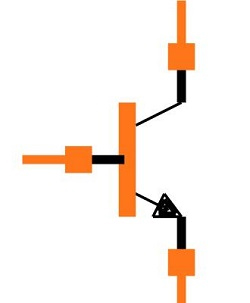
Symbol
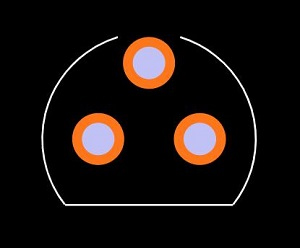
Footprint
3D Model
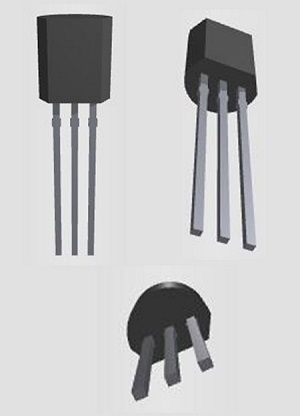
Package Type: TO-92
Transistor Type: NPN
Max Collector Current(IC): 100mA
Max Collector-Emitter Voltage (VCE): 45V
Max Collector-Base Voltage (VCB): 50V
Max Emitter-Base Voltage (VEBO): 6V
Max Collector Dissipation (Pc): 500 miliWatt
Max Transition Frequency (fT): 300 MHz
Minimum & Maximum DC Current Gain (hFE): 110 - 800
Max Storage & Operating temperature Should Be: -65 to +150 Centigrade
ON Semiconductor BC547 technical specifications, attributes, parameters and parts with similar specifications to ON Semiconductor BC547.
| Product Attribute | Attribute Value | |
|---|---|---|
| Mount | Through Hole | |
| Mounting Type | Through Hole | |
| Package / Case | TO-226-3, TO-92-3 (TO-226AA) | |
| Number of Pins | 3Pins | |
| Supplier Device Package | TO-92-3 | |
| Weight | 200mg | |
| Collector-Emitter Breakdown Voltage | 45V | |
| Collector-Emitter Saturation Voltage | 250mV | |
| Current-Collector (Ic) (Max) | 100mA | |
| Frequency - Gain Bandwidth Product (GBP) | 300MHz | |
| Power Dissipation (Max) | 500mW | |
| Number of Elements | 1 Element | |
| hFEMin | 110 | |
| Operating Temperature | 150°C TJ |
| Product Attribute | Attribute Value | |
|---|---|---|
| Packaging | Bulk | |
| Published | 2012 | |
| Part Status | Obsolete | |
| Moisture Sensitivity Level (MSL) | 1 (Unlimited) | |
| Max Operating Temperature | 150°C | |
| Min Operating Temperature | -65°C | |
| Voltage - Rated DC | 45V | |
| Current Rating | 100mA | |
| Frequency | 300MHz | |
| Base Part Number | BC547 | |
| Polarity | NPN | |
| Element Configuration | Single | |
| Power Dissipation | 500mW | |
| Power - Max | 500mW |
| Product Attribute | Attribute Value | |
|---|---|---|
| Transistor Type | NPN | |
| Collector Emitter Voltage (VCEO) | 45V | |
| Max Collector Current | 100mA | |
| DC Current Gain (hFE) (Min) @ Ic, Vce | 110 @ 2mA 5V | |
| Current - Collector Cutoff (Max) | 15nA ICBO | |
| Vce Saturation (Max) @ Ib, Ic | 600mV @ 5mA, 100mA | |
| Voltage - Collector Emitter Breakdown (Max) | 45V | |
| Frequency - Transition | 300MHz | |
| Collector Base Voltage (VCBO) | 50V | |
| Emitter Base Voltage (VEBO) | 6V | |
| REACH SVHC | No SVHC | |
| RoHS Status | RoHS Compliant | |
| Lead Free | Lead Free |
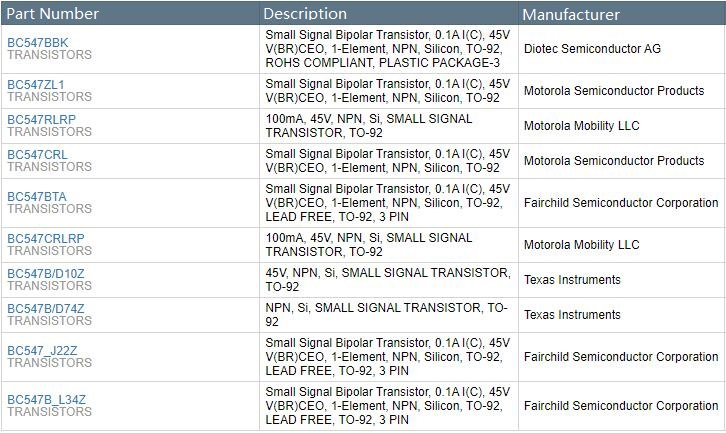
The BC547 is a widely used transistor that can be used in any general purpose applications or as a substitute and replacement to many transistors. The BC547 can be used in variety of electronic circuits, for example, switch small load on very low input voltage and current. And it can also be used in amplification applications like amplification of small audio and other signals. The max transition frequency of the transistor is 300MHz so it will also perform well in RF circuits under 300MHz frequency.
BC547 is an NPN transistor hence the collector and emitter will be left open (Reverse biased) when the base pin is held at ground and will be closed (Forward biased) when a signal is provided to base pin. BC547 has a gain value of 110 to 800, this value determines the amplification capacity of the transistor. The maximum amount of current that could flow through the Collector pin is 100mA, hence we cannot connect loads that consume more than 100mA using this transistor. To bias a transistor we have to supply current to base pin, this current (IB) should be limited to 5mA.
When this transistor is fully biased then it can allow a maximum of 100mA to flow across the collector and emitter. This stage is called Saturation Region and the typical voltage allowed across the Collector-Emitter (VCE) or Base-Emitter (VBE) could be 200 and 900 mV respectively. When base current is removed the transistor becomes fully off, this stage is called as the Cut-off Region and the Base Emitter voltage could be around 660 mV.
Audio Amplifier Stages
Switching Loads under 100mA
Amplification of current
Amplifiers like Audio, signal, etc.
Darlington pair
Quick switching
PWM (Pulse Width Modulation)
Driver Modules like Relay Driver, LED driver etc.
Alarm circuits
LED flasher circuit
Water level indicator
Sensor-based circuits
Audio Preamp circuits
RF Circuits
Touch-sensitive switch circuit
Heat sensor circuit
Moisture sensitive alarm
Latch circuit
Street light circuit
Relay driver based on one channel
Indication of volume level
Radio Frequency Circuits

Touch Switch Circuit Using BC547
The ON/OFF touch switch using transistor BC547 is shown above. The circuit is activated once the power supply is given to the circuit. And then, the relay gets off mode. Thus, the base terminal of the Q3 transistor is high throughout the R7 resistor to maintain in cut-off condition.
When the S2 switch is ON, the Q4 transistor will start conducting & relay ‘L3’ can be latched. The base terminal of the Q3 transistor will be pulled downward, and then L2 LED will blink to indicate power is ON. The Q4 transistor is ON because of the voltage at the collector terminal of the transistor Q3 using R8 resistor.
When the switch S1 is pressed for a moment the base terminal of transistor Q3 will be pulled up then the L2 will turn off because of the Q4 transistor’s pull-down base throughout the R8 resistor so the relay L3 will be turned off.

BC547 Package Outline
ON Semiconductor (Nasdaq: ON) is driving energy efficient innovations, empowering customers to reduce global energy use. The company offers a comprehensive portfolio of energy efficient power and signal management, logic, discrete and custom solutions to help design engineers solve their unique design challenges in automotive, communications, computing, consumer, industrial, LED lighting, medical, military/aerospace and power supply applications. ON Semiconductor operates a responsive, reliable, world-class supply chain and quality program, and a network of manufacturing facilities, sales offices and design centers in key markets throughout North America, Europe, and the Asia Pacific regions.
Download datasheets and manufacturer documentation for BC547
TAGS
Comments