Light Sensor for Arduino- BH1750 Tutorial
LIGHT SENSOR-BH1750
The BH1750 is a digital Ambient Light Sensor IC that connects to the I2C bus. So this article is going to talk about more detailed information about BH1750.

LIGHT SENSOR-BH1750 The BH1750 is a digital Ambient Light Sensor IC that connects to the I2C bus. So this article is going to talk about more detailed information about BH1750.
17
Apr 15, 2022
Atwood Jacob
Light Sensor for Arduino- BH1750 Tutorial
LIGHT SENSOR-BH1750
The BH1750 is a digital Ambient Light Sensor IC that connects to the I2C bus. So this article is going to talk about more detailed information about BH1750.
SEN0097
The BH1750 is a digital Ambient Light Sensor IC that connects to the I2C bus. This IC is the best for obtaining ambient light data in order to regulate the LCD and keypad backlight power of a mobile phone. At high resolution, a wide range can be detected. It is a digital Ambient Light Sensor IC with an I2C bus interface. This IC is the best for obtaining ambient light data in order to regulate the LCD and keypad backlight power of a mobile phone. At high resolution, a wide range can be detected.
Power Supply: 2.4V-3.6V (typically 3.0V)
Less current consumption: 0.12mA
Measuring Rang: 1-65535lx
Communication: I2C bus
Accuracy: +/-20%
Built-in A/D converter for converting analog illuminance into digital data.
Very small effect of IR radiation
Highly responsive near to the human eye.
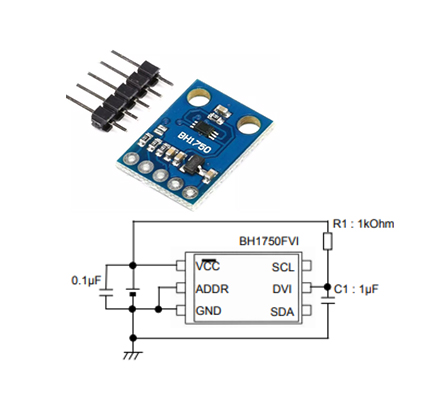
BH1750 Pinout
| Pin Number | Pin Name | Description |
| 1 | VCC | The power supply for the module can be 2.4V to 3.6V, typically 3.0V is used |
| 2 | GND | The ground of the module, connected to the ground of the circuit |
| 3 | SCL | Serial Clock Line used to provide clock pulse for I2C communication |
| 4 | SDA | Serial Data Address used to transfer the data through I2C communication |
| 5 | ADDR | The device address pin is used to select the address when more than two modules are connected |
DFRobot SEN0097 technical specifications, attributes, parameters and parts with similar specifications to DFRobot SEN0097.
DFRobot SEN0097 technical specifications, attributes, parameters and parts with similar specifications to DFRobot SEN0097.
| Product Attribute | Attribute Value | |
|---|---|---|
| Factory Lead Time | 4 Weeks | |
| Packaging | Bulk | |
| Published | 2011 | |
| Part Status | Active |
| Product Attribute | Attribute Value | |
|---|---|---|
| Moisture Sensitivity Level (MSL) | 1 (Unlimited) | |
| Voltage - Supply | 3V~5V | |
| Interface | I2C | |
| Utilized IC / Part | BH1750 |
| Product Attribute | Attribute Value | |
|---|---|---|
| Supplied Contents | Board(s) | |
| Sensor Type | Light, Ambient | |
| Embedded | No | |
| RoHS Status | ROHS3 Compliant |
The BH1750 is a light intensity sensor that may be used to regulate the brightness of LCD screens and mobile phones. It can also be used to turn on/off automobile headlights based on the lighting outside. Because the sensor communicates with microcontrollers using the I2C protocol, it's quite simple to use. I2C is supported by the SCL and SDA pins. The LUX value is directly provided by the sensor, therefore no calculations are required to determine it. In fact, it determines the intensity by the amount of light that strikes it. It functions between 2.4 and 3.6 volts and draws only 0.12 milliamperes. The sensor's output is unaffected by the light source used or the influence of the light source.
The BH1750's hardware is fairly basic. The BH1750FVI IC is the key component. A voltage regulator is necessary because the module operates at 3.3V. A 4.7K pull-up resistor is utilized for I2C lines.
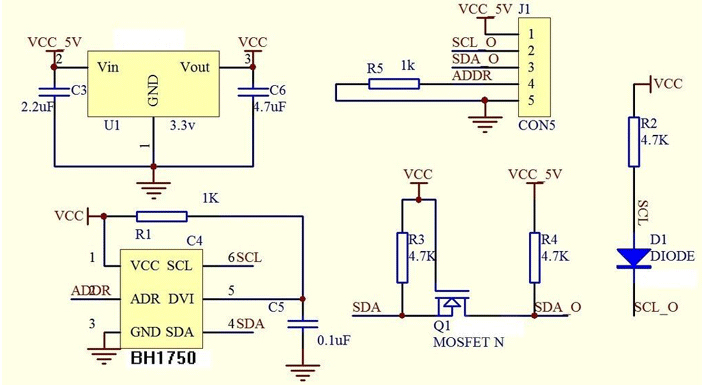
The lux readings are obtained from the BH1750 via the I2C bus. The analog illuminance is converted to a digital lux value by the ADC in the IC. With the help of I2C pins SCL and SDA, this data is now sent to the microcontroller. The clock pulse is provided by the SCL, while the lux value is transferred by the SDA. The IC employs a photodiode to produce a reaction that is comparable to that of the human eye. There is also an internal oscillator in the IC which is used for the clock of the internal logic of the IC.
1) Illuminance to Digital Converter
2) Wide range and High resolution. ( 1 - 65535 lx )
3) Low Current by power down function
4) 50Hz / 60Hz Light noise reject-function
5) I2C bus Interface ( f / s Mode Support )
6) No need for any external parts
7) It is possible to select 2 types of I2C slave addresses.
8) It is possible to detect min. 0.11 lx, max. 100000 lx by using this function.
Manipulate brightness in mobile phones/LCD
Automobile Headlights on/off control based on surrounding lighting conditions.
Used as Ambient light sensors to control the brightness of Display screens.
ROHM was founded in 1958 in Kyoto, Japan. ROHM is a semiconductor, integrated circuits, and another electronic component manufacturer. The dynamic and ever-growing wireless, computer, automobile, and consumer electronics businesses all use these components. ROHM products are used in some of the most cutting-edge technology and technologies. With a logistic headquarters in San Diego, California, a design center in San Jose, California, a QA Center in Novi, Michigan, a sales office in Guadalajara, Mexico, and a sales network that covers marketing, sales, and engineering support for North and South American clients from Canada to Brazil, ROHM's presence in the North American market continues to grow. ROHM benefits from the collaboration of many sales-representative organizations and industry-leading electronics in addition to a direct sales team.
Download datasheets and manufacturer documentation for SEN0097
TAGS
Comments