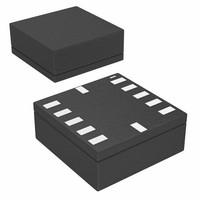
ACCELEROMETER 2-8G I2C/SPI 12LGA
The BMA020 is a low-g triaxial acceleration sensor with digital interfaces that is aimed at low-power user applications.

ACCELEROMETER 2-8G I2C/SPI 12LGA The BMA020 is a low-g triaxial acceleration sensor with digital interfaces that is aimed at low-power user applications.
223
May 29, 2021
Deborah
ACCELEROMETER 2-8G I2C/SPI 12LGA
The BMA020 is a low-g triaxial acceleration sensor with digital interfaces that is aimed at low-power user applications.
BMA020
The BMA020 is a low-g triaxial acceleration sensor with digital interfaces that is aimed at low-power user applications.
The BMA020 was created to meet a wide range of hardware specifications. The customer will program key features such as g-range and filtering characteristics. The sensor is ideal for mobile applications because it comes in a compact package and consumes very little power. The BMA020 can be customized to improve functionality and efficiency in a wide range of user applications. The suitability for cutting-edge mobile low-power designs is highlighted by the extremely low stand-by current and fast wake-up time.
The BMA020 will calculate accelerations along three perpendicular axes. The performance of a three-channel micromechanical acceleration sensing structure that operates on the differential capacitance principle is converted by an evaluation circuitry. More than 100 million Bosch accelerometers and gyroscopes have proved the capability of Bosch Sensortec's micromachining technology. The modular design methodolgy used by Bosch Sensortec allows the company to respond quickly to potential customer requests for additional sensor functionality.
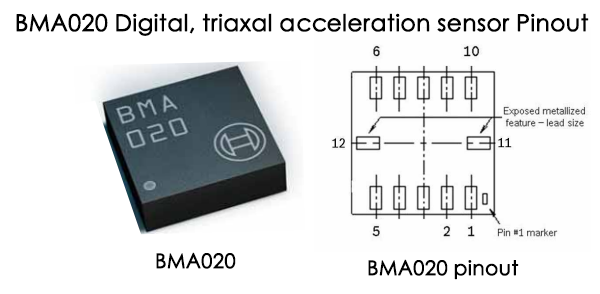 pinout description of BMA020: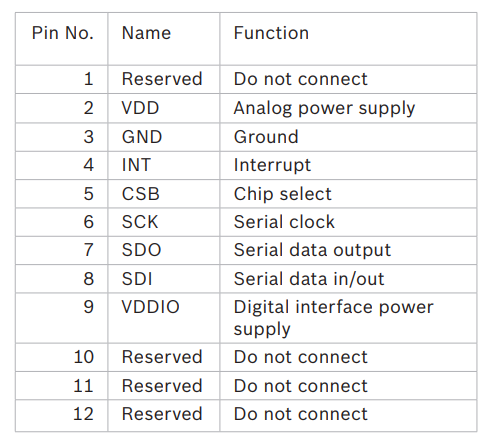
Switchable g-range and bandwidth
Low-power consumption
SPI (3-wire/4-wire) and I²C interfaces
Programmable interrupt feature for mobile wake-up
Ultra-low-power self-wake-up mode
Self-test capability
LGA package (3 mm x 3 mm x 0.9 mm)
RoHS compliant
Bosch Sensortec BMA020 technical specifications, attributes, parameters and parts with similar specifications to Bosch Sensortec BMA020.
Bosch Sensortec BMA020 technical specifications, attributes, parameters and parts with similar specifications to Bosch Sensortec BMA020.
| Product Attribute | Attribute Value | |
|---|---|---|
| Mount | Surface Mount | |
| Mounting Type | Surface Mount | |
| Package / Case | 12-VFLGA | |
| Number of Pins | 12Pins | |
| Operating Temperature | -40°C~85°C TA | |
| Packaging | Tape & Reel (TR) |
| Product Attribute | Attribute Value | |
|---|---|---|
| Published | 2008 | |
| Part Status | Obsolete | |
| Moisture Sensitivity Level (MSL) | 1 (Unlimited) | |
| Type | Digital | |
| Voltage - Supply | 2V~3.6V | |
| Output Type | I2C, SPI |
| Product Attribute | Attribute Value | |
|---|---|---|
| Bandwidth | 25Hz ~ 750Hz | |
| Axis | X, Y, Z | |
| Acceleration Range | ±2g, 4g, 8g | |
| Features | Adjustable Bandwidth, Selectable Scale, Sleep Mode | |
| Sensitivity (LSB/g) | 256 (±2g) ~ 64 (±8g) | |
| RoHS Status | RoHS Compliant |
Advanced power management for mobile devices
Drop detection for warranty logging
Menu scrolling, tip-tap function
Display profile switching (portrait/landscape)
Shock detection
Gaming
The BMA020 is packaged in a 3mm x 3mm x 0.9mm LGA package following JEDEC MO-229.
Basic outline geometry is based on:
Mold package footprint: 3mm x 3mm (tolerance ±0.1mm)
Height: 0.9mm
No. of leads: 12
- 8 used for electrical connection
- 2 not used / reserved
- 2 additional metal features on front edges without electrical functionality (not available on first engineering samples)
Lead pitch 0.5mm
Top, bottom and side views of the 3mm x 3mm x 0.9mm LGA package outline drawing (dimensions in mm):
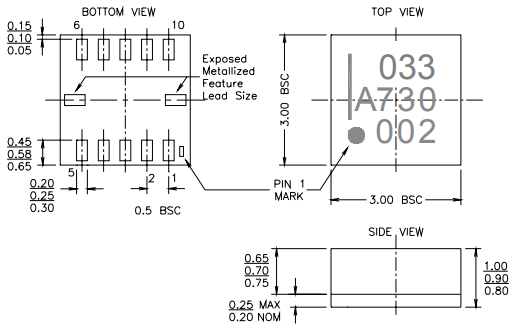
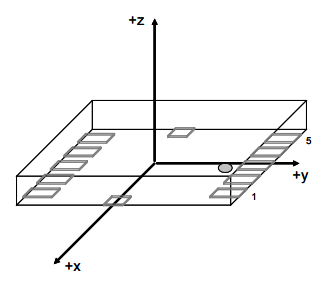
Axes orientation of the BMA020:
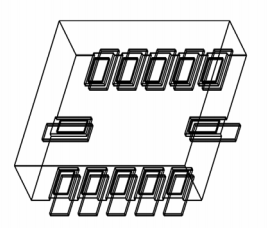
Perspective view of the BMA020 relative to the PCB pattern:
The BMA020's function and performance can be tailored to meet the needs of individual customers using parameter and control settings. The BMA020 outputs a digital 10bit signal in either SPI or I2C format. The full measurement range can be set to 2g, 4g, or 8g via a serial interface order. To precondition the calculated acceleration signal, a second-order filter with a pole frequency of 1500Hz is included. 3KHz is the highest data conversion rate. S/N ratio can be improved with additional optical filtering (down to 25Hz bandwidth). The resolution is 4mg due to the typical noise level and quantization.
The typical current consumption is 200A. Several features have been introduced to assist the host system in lowering power consumption. In addition to normal operation, in which acceleration values are provided to the output registers, the BMA020 can perform internal computations of the performance. The customer may specify basic parameters, such as high-g or low-g thresholds, as well as smooth motion profile recognition criteria. An interrupt pin on the sensor will alert the host system to a violation of one of these criteria. This function can be used for a variety of things, such as waking up the host system from a deep sleep or signaling a shock situation.
The BMA020 also has a self-test feature that allows you to test the entire signal evaluation course, including the micromachined sensor structure and the evaluation ASIC.
Download datasheets and manufacturer documentation for Bosch Sensortec BMA020.
Download datasheets and manufacturer documentation for BMA020
TAGS
Comments