ACCELEROMETER 2-8G I2C/SPI 12LGA
The BMA150 is a consumer-market-oriented triaxial low-g acceleration sensor IC with digital performance. It has the ability to calculate acceleration in perpendicular axes as well as absolute temperature.

ACCELEROMETER 2-8G I2C/SPI 12LGA The BMA150 is a consumer-market-oriented triaxial low-g acceleration sensor IC with digital performance. It has the ability to calculate acceleration in perpendicular axes as well as absolute temperature.
187
Jun 3, 2021
Yetta
ACCELEROMETER 2-8G I2C/SPI 12LGA
The BMA150 is a consumer-market-oriented triaxial low-g acceleration sensor IC with digital performance. It has the ability to calculate acceleration in perpendicular axes as well as absolute temperature.
BMA150
The BMA150 is a consumer-market-oriented triaxial low-g acceleration sensor IC with digital performance. It has the ability to calculate acceleration in perpendicular axes as well as absolute temperature.
The performance of a three-channel micromechanical accelerationsensing structure that operates on the differential capacitance principle is converted by an evaluation circuitry. The package and interface have been designed to work with a wide range of hardware. The sensor IC is appealing for mobile applications because of its compact footprint and flat box. In customer-specific applications, the sensor IC can be configured to optimize functionality, efficiency, and power consumption.
In mobile phones, handhelds, computer peripherals, man-machine interfaces, virtual reality features, and game controllers, the BMA150 detects tilt, motion, and shock vibration. The SMB380 triaxial acceleration sensor is available in a 3mm x 3mm x 0.9mm QFN package, and the BMA150 is the LGA package version.
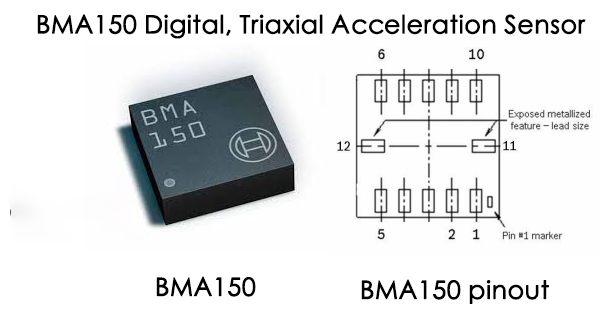 pinout description of BMA150: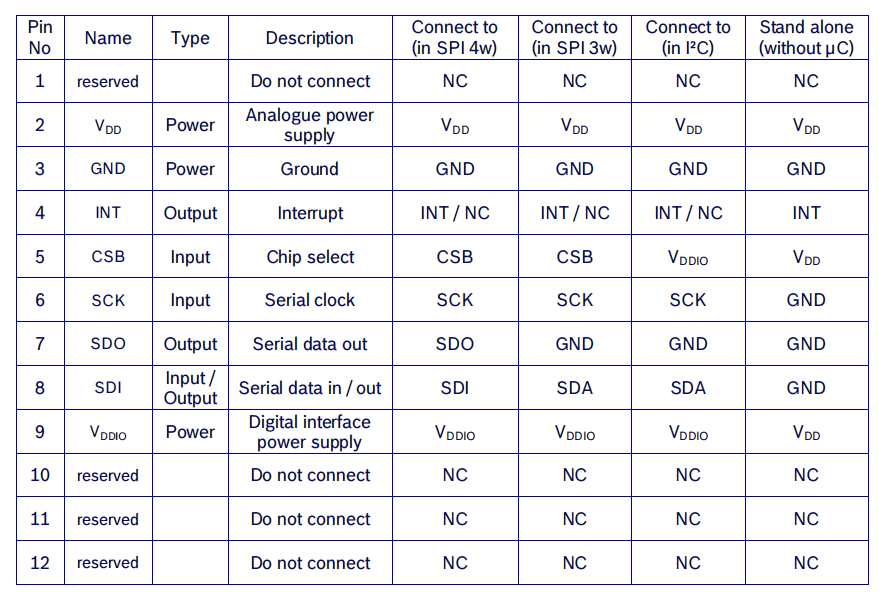
Three-axis accelerometer
Temperature output
Small package
LGA package Footprint 3mm x 3mm
height 0.90mm
Digital interface
SPI (4-wire, 3-wire), FC, interrupt pin
Programmable functionality
g-range ±2g/±4g/±8g, bandwidth 25-1500Hz, internal acceleration evaluation for interrupt trigger also enabling stand-alone capability (without use of microcontroller), self-test
Ultra-low power ASIC
Low current consumption, short wake-up time, advanced features for system power management
Eco-friendly
RoHS compliant Halogen-free (part number 0 273 141 043 only)
Bosch Sensortec BMA150 technical specifications, attributes, parameters and parts with similar specifications to Bosch Sensortec BMA150.
Bosch Sensortec BMA150 technical specifications, attributes, parameters and parts with similar specifications to Bosch Sensortec BMA150.
| Product Attribute | Attribute Value | |
|---|---|---|
| Mount | Surface Mount | |
| Mounting Type | Surface Mount | |
| Package / Case | 12-VFLGA | |
| Number of Pins | 12Pins | |
| Operating Temperature | -40°C~85°C TA | |
| Packaging | Tape & Reel (TR) |
| Product Attribute | Attribute Value | |
|---|---|---|
| Published | 2007 | |
| Part Status | Obsolete | |
| Moisture Sensitivity Level (MSL) | 1 (Unlimited) | |
| Type | Digital | |
| Voltage - Supply | 2.4V~3.6V | |
| Output Type | I2C, SPI |
| Product Attribute | Attribute Value | |
|---|---|---|
| Bandwidth | 25Hz ~ 750Hz | |
| Axis | X, Y, Z | |
| Acceleration Range | ±2g, 4g, 8g | |
| Sensitivity (mV/G) | 256 (±2g) ~ 64 (±8g) | |
| Features | Sleep Mode, Temperature Sensor | |
| RoHS Status | RoHS Compliant |
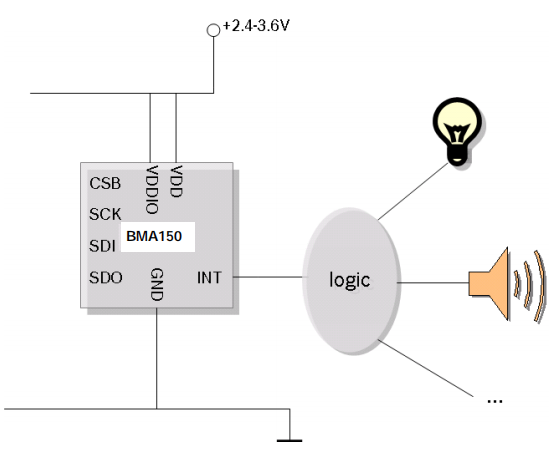
Connection diagram for use with 3-wire SPI interface: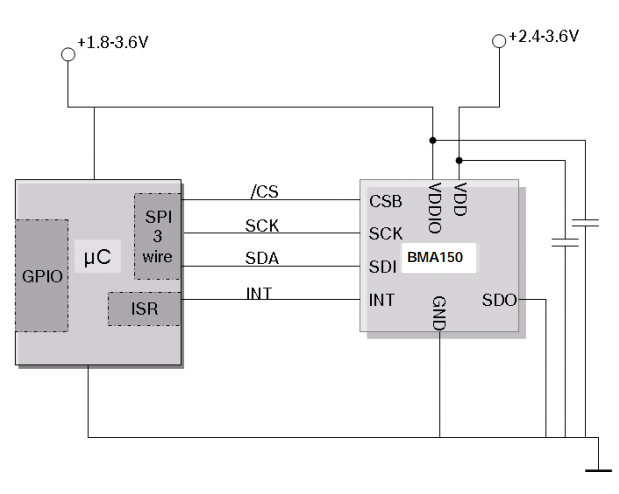
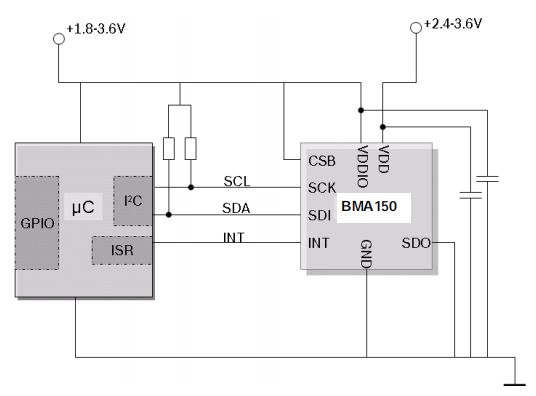
HDD protection
Menu scrolling, tap sensing function
Gaming
Pedometer/step-counting
Drop detection for warranty logging
Display profile switching
Advanced system power management for mobile applications
Shock detection
The BMA150 is packaged in a 3mm x 3mm x 0.9mm LGA package following JEDEC MO-229.
Basic outline geometry is based on:
Mold package footprint: 3mm x 3mm (tolerance ±0.1mm)
Height: 0.9mm
No. of leads: 12
- 8 used for electrical connection
- 2 not used / reserved
- 2 additional metal features on front edges without electrical functionality (not available on first engineering samples)
Lead pitch: 0.5mm
Top, bottom and side views of the 3mm x 3mm x 0.9mm LGA package outline drawing (dimensions in mm):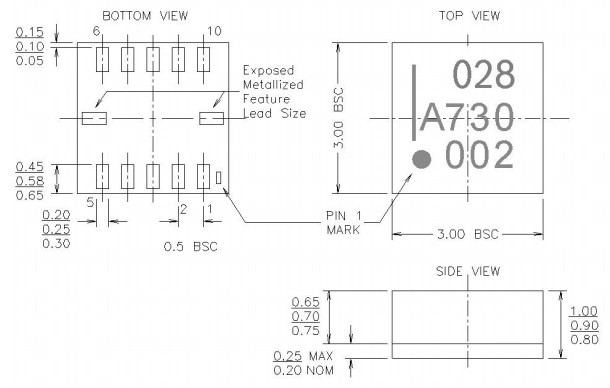
Notes:
1) The vertical bar on the left-hand side of the marking on top of the package is just optional.
2) For the halogen-free version of BMA150 (order code 0 273 141 043) the number on top of the package marking is “043” instead of “028”.
The BMA150 have the following logic functions:
Internal logic functions
The sensor IC can inform the host system about specific conditions (e.g. new data ready flag or acceleration thresholds passed) by setting an interrupt pin high even if interface communication is not taking place. This feature can be used as “freefall indicator”, “wake-up” or “data ready flag” for instance.
The interrupt performance can be programmed by means of control bits. Thus the criteria to identify a special event can be tailored to a customer’s application and the sensor IC output can be defined specifically.
Freefall logic
For freefall detection the absolute value of the acceleration data of all axes are investigated (global criteria). A freefall situation is likely to occur when all axes fall below a lower threshold value (“LG_thres”). The interrupt pin will be raised high if the threshold is passed for a minimum duration. The duration time can be programmed in units of ms (max. 255ms). The function “Freefall Interrupt” can be switched on/off by a control bit which is located within the image of the non-volatile memory. Thus this functionality can be stored as default setting of the sensor IC (EEPROM) but can also rapidly be changed within the image. The reset of the freefall interrupt can be accomplished by means of a master reset of the interrupt flag (latched interrupt) or the reset can be triggered by the acceleration signal itself
(validation of a programmable “hysteresis”).
High-g logic
For indicating high-g events an upper threshold can be programmed. This logic can also be activated by a control bit. Threshold, duration and reset behaviour can be programmed. The high-g and freefall criteria can be logically combined with an <OR>.
Any motion detection
The “any motion algorithm” can be used to detect changes of the acceleration. Thus it provides a relative evaluation of the acceleration signals. The criterion is kind of a gradient threshold of the acceleration over time. Thus one can distinguish between fast events with strong inertial dynamic (e.g. shock), instant changes of force balance (e.g. drop, tumbling) and even slight changes (e.g. touch of a mobile device). Due to a high bandwidth and a fast response MEMS device the BMA150 is capable to detect shock situations. The “any motion interrupt’ or a high-g criterion setting can be used to give a shock alert. The phase shift between onset of mechanical shock and interrupt output is defined
by the mechanical transfer function of the chassis and internal mounting interfaces (e.g. PDA shell) and the data output rate of the sensor IC (currently 330psec, lOOpsec under consideration).
Alert Mode
Using the BMA150 it is possible to combine the “any motion criterion” with low-g and high-g interrupt logic to improve the reaction time for e.g. free-fall identification.
TAGS
Comments