ATTENTION: Due to increased demand and order volume, processing time may take an additional 1-3 business days.
HomeCommunitySubjectBME280 Sensor: Datasheet, Pinout and Applications

BME280 Sensor: Datasheet, Pinout and Applications

Pressure, Temperature and Humidity Sensor Digital Output 1.8V 8-Pin LGA T/R The BME280 sensor is used to measure readings regarding ambient temperature, barometric pressure, and relative humidity. This blog covers pinout, datasheet, applications and other information about BME280.
736

Jul 1, 2021

Allen Brooke

How to use BME280 sensor


Pressure, Temperature and Humidity Sensor Digital Output 1.8V 8-Pin LGA T/R

The BME280 sensor is used to measure readings regarding ambient temperature, barometric pressure, and relative humidity. This blog covers pinout, datasheet, applications and other information about BME280.
BME280

283In Stock
Min.: 1 Mult.: 1
Price not displayed? Not available to buy online? Please send an RFQ, and we will respond immediately.
Quick Links

BME280 Description

The BME280 is a humidity sensor especially developed for mobile applications and wearables where size and low power consumption are key design parameters. The unit combines high linearity and high accuracy sensors and is perfectly feasible for low current consumption, long-term stability and high EMC robustness.

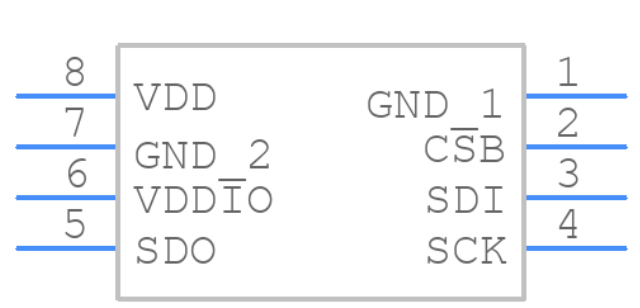
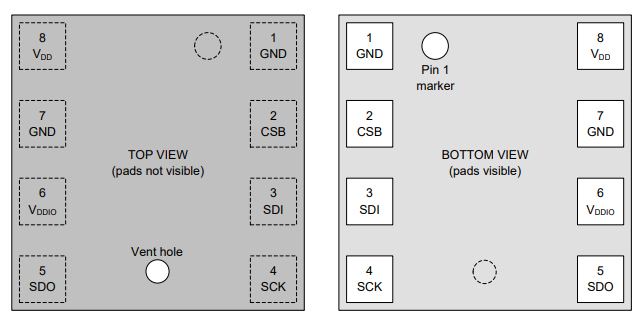
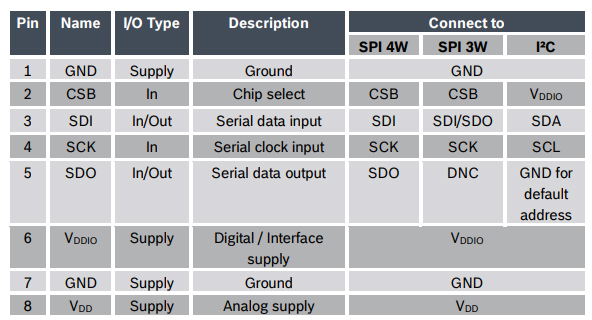
BME280 Pinout

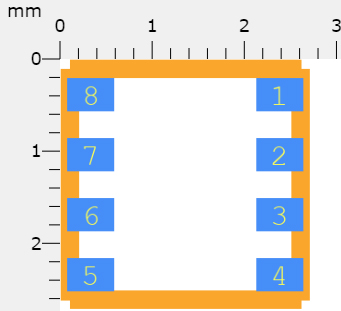
BME280 CAD Model

Symbol


Footprint

BME280 Features

  • Compatible with 3.3V/5V microcontrollers

  • Environmental monitoring: temperature, humidity and barometer

  • Gravity I2C interface and reserve XH2.54 SPI interface

  • Small size, convenient to install

Specifications

Bosch Sensortec BME280 technical specifications, attributes, parameters and parts with similar specifications to Bosch Sensortec BME280.

BME280 Tech Specifications

Bosch Sensortec BME280 technical specifications, attributes, parameters and parts with similar specifications to Bosch Sensortec BME280.

Product Attribute Attribute Value
Factory Lead Time14 Weeks
Mounting TypeSurface Mount
Package / Case8-VFLGA
Surface MountYES
Number of Pins8Pins
Operating Temperature-40°C~85°C
PackagingTape & Reel (TR)
Published2015
Part StatusActive
Moisture Sensitivity Level (MSL)1 (Unlimited)
Product Attribute Attribute Value
Number of Terminations8Terminations
Voltage - Supply1.71V~3.6V
Terminal PositionBOTTOM
Terminal FormNO LEAD
Peak Reflow Temperature (Cel)NOT SPECIFIED
Number of Functions1Function
Time@Peak Reflow Temperature-Max (s)NOT SPECIFIED
Output16b
Output TypeI2C, SPI
Supply Voltage-Max (Vsup)3.6V
Product Attribute Attribute Value
Supply Voltage-Min (Vsup)1.71V
Analog IC - Other TypeANALOG CIRCUIT
Accuracy±3%
Response Time1s
Sensor TypeHumidity, Pressure, Temperature
Humidity Range0 ~ 100% RH
RoHS StatusROHS3 Compliant
Lead FreeLead Free
0 Products View Similar

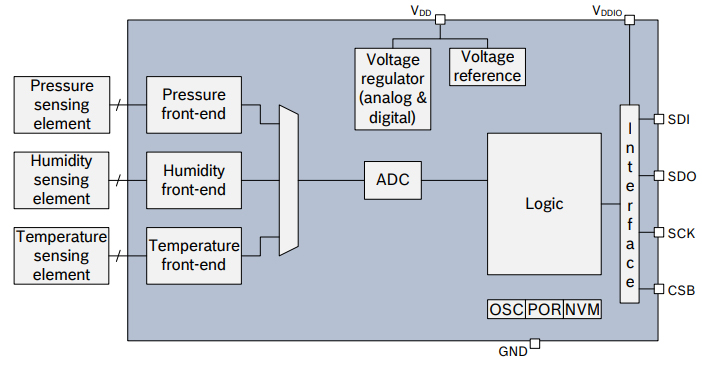
BME280 Block Diagram

How to use BME280

The BME280 is an integrated environmental sensor developed specifically for mobile applications where size and low power consumption are key design constraints. The unit combines individual high linearity, high accuracy sensors for pressure, humidity and temperature in an 8-pin metal-lid 2.5 x 2.5 x 0.93 mm³ LGA package, designed for low current consumption (3.6 μA @1Hz), long term stability and high EMC robustness.


BME280 Applications

  • Context awareness, e.g. skin detection, room change detection

  • Home automation control (control heating, venting, air conditioning (HVAC))

  • Internet of things

  • GPS enhancement (e.g. time-to-first-fix improvement, dead reckoning, slope detection)

  • Indoor navigation (change of floor detection, elevator detection)

  • Outdoor navigation, leisure and sports applications

  • Weather forecast

  • Vertical velocity indication (rise/sink speed)

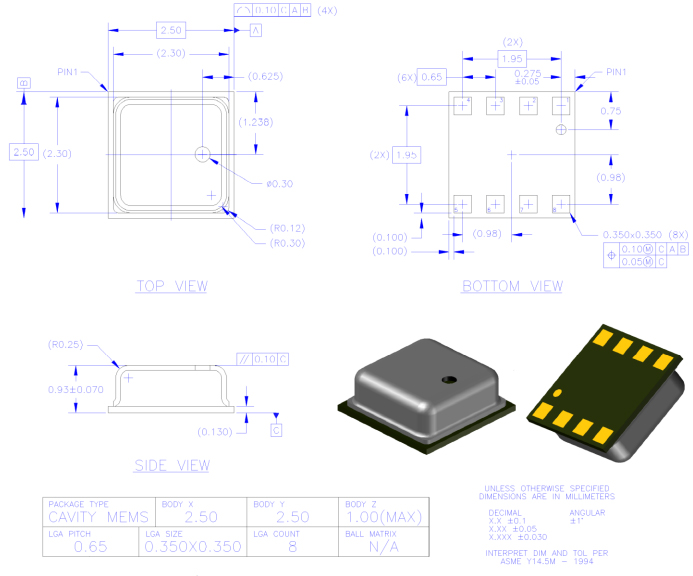
BME280 Package

BME280 Manufacturer

Bosch Sensortec GmbH is a fully owned subsidiary of Robert Bosch GmbH dedicated to the world of consumer electronics; offering a complete portfolio of micro-electro-mechanical systems (MEMS) based sensors and solutions that enable mobile devices to feel and sense the world around them. Bosch Sensortec develops and markets a broad portfolio of MEMS sensors, solutions and systems for applications in smart phones, tablets, wearable devices, and various products within the IoT (Internet of Things).

Datasheet PDF

Download datasheets and manufacturer documentation for Bosch Sensortec BME280.

BME280 Documents

Download datasheets and manufacturer documentation for BME280

Frequently Asked Questions

How do I connect a BME280 with an Arduino?
You can easily wire this breakout to any microcontroller, we'll be using an Arduino. For another kind of microcontroller, as long as you have 4 available pins it is possible to 'bit-bang SPI' or you can use two I2C pins, but usually those pins are fixed in hardware. Just check out the library, then port the code.
How do I get started with a BME280 sensor?
The BME280 is an integrated environmental sensor developed specifically for mobile applications where size and low power consumption are key design constraints. The unit combines individual high linearity, high accuracy sensors for pressure, humidity and temperature in an 8-pin metal-lid 2.5 x 2.5 x 0.93 mm³ LGA package, designed for low current consumption (3.6 μA @1Hz), long term stability and high EMC robustness.
How do I use I2C with a BME280 sensor?
The BME280 supports either SPI or I2C interface to communicate with the micro controller. Because of the small size of the sensor, the best way to use this sensor is with a breakout board. The Adafruit breakout board is used here. In this hookup we are only connecting one device to the Arduino using the I2C bus. We can use either address (0x77 or 0x76). It reads the barometric pressure, humidity and temperature and displays it on the console.
Where can I compare BME280 with BMP280 sensors?
Device driver interface for the Bosch BMP280 and BME280 sensors. BMP280 and BME280 measure temperature in centi °C and pressure in Pa. BME280 can also measure relative humidity in %.For more information, see the datasheets.
Where can I find a BME280 calibration tutorial?
Zero point calibration of DS18B20. The best resolution of the DS18B20 is 0.06°C, giving highly quantised data. We can average over time and derive a mean temperature with a standard error of <0.001°C, however without understanding a lot more about how the DS18B20 internally handles analogue-to-digital conversion and rounding, the best error I am willing to quote is half the native resolution, or 0.03°C.
FAQ
How do I connect a BME280 with an Arduino?
You can easily wire this breakout to any microcontroller, we'll be using an Arduino. For another kind of microcontroller, as long as you have 4 available pins it is possible to 'bit-bang SPI' or you can use two I2C pins, but usually those pins are fixed in hardware. Just check out the library, then port the code.
How do I get started with a BME280 sensor?
The BME280 is an integrated environmental sensor developed specifically for mobile applications where size and low power consumption are key design constraints. The unit combines individual high linearity, high accuracy sensors for pressure, humidity and temperature in an 8-pin metal-lid 2.5 x 2.5 x 0.93 mm³ LGA package, designed for low current consumption (3.6 μA @1Hz), long term stability and high EMC robustness.
How do I use I2C with a BME280 sensor?
The BME280 supports either SPI or I2C interface to communicate with the micro controller. Because of the small size of the sensor, the best way to use this sensor is with a breakout board. The Adafruit breakout board is used here. In this hookup we are only connecting one device to the Arduino using the I2C bus. We can use either address (0x77 or 0x76). It reads the barometric pressure, humidity and temperature and displays it on the console.
Where can I compare BME280 with BMP280 sensors?
Device driver interface for the Bosch BMP280 and BME280 sensors. BMP280 and BME280 measure temperature in centi °C and pressure in Pa. BME280 can also measure relative humidity in %.For more information, see the datasheets.
Where can I find a BME280 calibration tutorial?
Zero point calibration of DS18B20. The best resolution of the DS18B20 is 0.06°C, giving highly quantised data. We can average over time and derive a mean temperature with a standard error of <0.001°C, however without understanding a lot more about how the DS18B20 internally handles analogue-to-digital conversion and rounding, the best error I am willing to quote is half the native resolution, or 0.03°C.

TAGS

Share