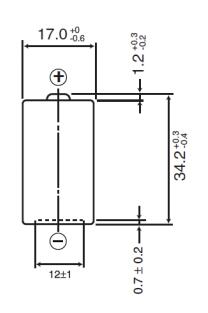
Both the CR123 and the CR123A batteries are small and powerful. Because of their modest size in relation to the power they provide, they are both excellent choices for compact devices that consume a lot of power, such as high-output LED lights.
In general, 123s are longer and thinner than 123As. However, the difference in either direction is less than 0.55 mm. Each manufacturer's measurements are frequently somewhat different, making it difficult to distinguish between the two.
The nominal voltage of both conventional 123s and 123As is 3 volts. Their standard loaded voltage is between 2 and 2.5 volts.
In basic terms, considering their compact size, both cells have a tremendous ability to push electric current through the device.
The voltage difference between the two battery types is usually insignificant.
When stored at temperatures below 60°C, both batteries have a shelf life of up to 10 years before being used.
They are both long-lasting when used in your gadgets. The actual lifespan is determined by the device and its maker. In an alarm system, for example, they can last up to five years.
Lithium is a hazardous substance to come into touch with, especially if it comes into contact with the skin. Furthermore, excessive voltage may cause gadget damage.
PTC (Pressure, Temperature, Current) protection is built into both the 123s and 123As, and it disconnects the circuit if the current becomes too high.
With a Lithium and Manganese dioxide (LiMnO2) chemical system, both types of batteries use a lithium-based salt as an electrolyte. On both types of cells, the cathode (positive terminal) is made of heat-treated manganese dioxide.
The chemical system functions in the same way, resulting in a high energy density per mass (280 Wh/kg) and volume (580 Wh/litre).
In conclusion, the letter A is the only significant distinction between the two. When it comes to functionality, performance, longevity, and chemistry, the two are practically identical.
Both batteries can power high-performance equipment, such as digital cameras with flashes and high-tech LED torches, which require high-power discharges on occasion.