ATTENTION: Due to increased demand and order volume, processing time may take an additional 1-3 business days.
HomeCommunitySubjectHow LM324 Comparator Applied in a Circuit?

How LM324 Comparator Applied in a Circuit?

Linear - Amplifiers - Instrumentation, OP Amps, Buffer Amps 14-SOIC (0.154, 3.90mm Width) General Purpose 5V 0°C~70°C LM324 1.27mm IC OPAMP GP 1.3MHZ 14SO

123

Oct 11, 2021

Dominic Temple

Top 4 LM324 awesome diy electronics projects, 4 useful diy circuits


Linear - Amplifiers - Instrumentation, OP Amps, Buffer Amps 14-SOIC (0.154, 3.90mm Width) General Purpose 5V 0°C~70°C LM324 1.27mm IC OPAMP GP 1.3MHZ 14SO

The LM324 operational amplifier IC can be worked as a comparator. On a single chip, this IC contains four independent operational amplifiers. In this article, we'll look at the widely used LM 324 IC. We'll look at the pin configuration, key features, and technical specs, and then we'll look at examples of the most basic application circuits that use the LM324.
LM324J

2188In Stock
Min.: 1 Mult.: 1
Quantity Unit Price Ext. Price
1+ $20.9367$20.94
10+ $19.75161$197.52
100+ $18.63359$1863.36
500+ $17.57886$8789.43
1000+ $16.58383$16583.83
Unit Price:$20.9367
Subtotal: $20.94
Looking for a better price? Want a lower wholesale price? Please send an RFQ, and we will respond immediately.
Quick Links

What is LM324 Comparator?

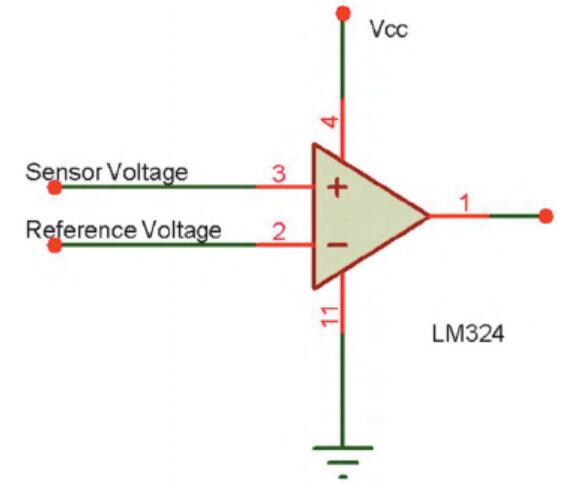
The LM324 comparator circuit consists of sensor voltage, reference voltage, Vcc, ground, and output pins. The LM324 operational amplifier IC can be worked as a comparator. On a single chip, this IC contains four independent operational amplifiers. This is a Low Power Quad Operational Amplifier with good stability and bandwidth that was designed to operate over a wide range of voltages from a single power supply.

The quad amplifier can run at supply voltages as low as 3.0 V and as high as 3.2 V, with quiescent currents roughly a quarter of the MC174's.

LM324 Circuit

LM324 Comparator Pinout

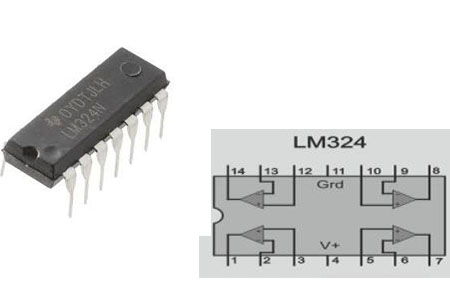
The pin configuration of the IC LM324 is shown below, along with a description of each pin's function.

LM324 Comparator Pinout


Pin No. The function of the   Pin
1 The output of   the first comparator
2 Inverting input of   the first comparator
3 The non-inverting input   of the first comparator
4 Supply voltage 5V
5 The non-inverting input   of the second comparator
6 Inverting input of   the second comparator
7 The output of   the second comparator
8 The output of   the third comparator
9 Inverting input of   the third comparator
10 The non-inverting input   of the third comparator
11 Ground
12 The non-inverting input   of the fourth comparator
13 Inverting input of   the fourth comparator
14 The output of   the fourth comparator

LM324 Comparator Features

  • It can operate from 3 V to 30 V single power supply.

  • It can operate from +/- 1.5 V to +/- 15 V for dual supply.

  • It has bandwidth up to 1.3 MHz

  • The large voltage gain of 100 dB

  • 4 independent amplifiers

  • Some of the variants are short circuit protected at the output.

  • Rue differential input stages

  • Very low current consumption: 375 uA.

  • Low input bias current: 20 nA.

LM324 Electronics Characteristics

  • Input offset voltage: typical: 2 mV, maximum: 7 mV.

  • Input offset current typical: 2 nA, maximum: 20 nA.

  • Input bias current typical: 20 nA, maximum: 100 nA.

  • Large signal voltage gain ( Vcc = 15 v, RL, = 2 kohm, Vo = 1.4 V to 11.4 V): min: 50 V/mV, max: 100 V/mV.

  • Slew rate (Vcc = 15 V, VI = 0.5 V to 3 V, RL = 2 Kohm, CL = 100pF, unity gain) typical: 0.4 V/uS

  • Output current source [Vid = 1 V] (Vcc = 15 V, VO = 2V): minimum: 20 mA, Typical: 40 mA, Maximum: 70 mA.

  • Output sink current [Vid = -1 V] (Vcc = 15 V, VO = 2V) Minimum: 10mA, Typical: 20 mA.

  • High Level Output Voltage (Vcc = 30 V, RL = 2 K ohm) minimum: 26 V, Typical: 27 V.

  • High Level Output Voltage (Vcc = 5 V, RL = 2 K ohm) minimum: 3 V.

  • Low Level Output Voltage (RL = 10 k Ohm) Typical: 5 mV, Maximum: 20mV.

  • Total harmonic distortion (f = 1 kHz, Av = 20 dB, RL = 2 kΩ, VO = 2 Vpp, CL = 100 pF, VCC = 30 V) typical: 0.015 %.

  • Gain Bandwidth Product (VCC = 30 V, f = 100 kHz, Vin = 10 mV, RL = 2 kΩ, CL = 100 pF) Typical : 1.3 MHz.

M324 Comparator Advantages

  • The LM324 is utilized as a comparator as well as an op-amp.

  • The LM324 is an electronic voltage amplifier with a high gain.


LM324 Comparator Applications

  • The LM324 comparator is generally used in the line following robot

  • The applications of the conventional op-amp can easily be implemented by using the LM324

  • The LM324 is applicable for oscillators, amplifiers, rectifiers, comparators, etc.

How to Apply LM324 in a Circuit?

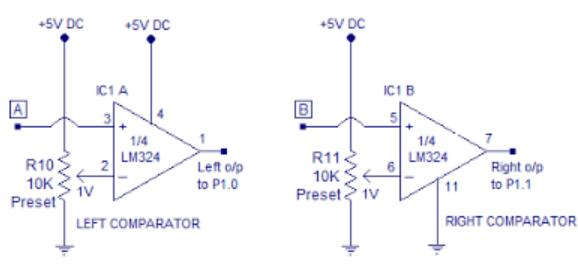
The voltage comparator is shown in the following schematic. The LM324 comparator and two 10K ohm resistors are required for this circuit. The two inputs, input A and input B come from the line sensor circuit's output, and the two resistors are utilized to establish the voltage reference so that the optimal digital output may be produced.

Comparator Circuit Using LM324


We can see that Node A and Node B are connected to the non-inverting inputs of the left and right comparators in the aforementioned circuit. The left comparator's output is connected to Microcontroller P1.0, while the right comparator's output is connected to Microcontroller P1.1. The non-inverting mode is used by both comparators.

How does LM324 Comparator Work?

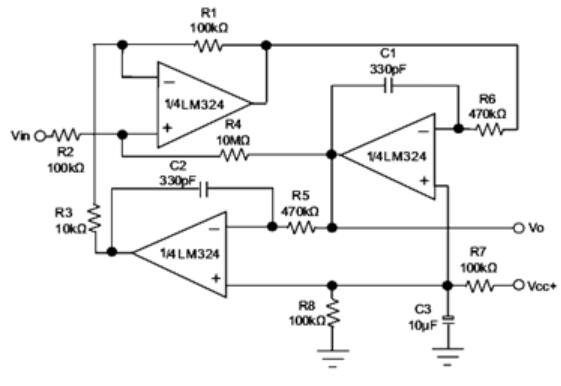
The LM324 comparator circuit is made up of three LM324 comparators as well as other components such as resistors, capacitors, and ground. The following circuit demonstrates the operation of this comparator in easy steps.

Working of LM324 Comparator

When a voltage smaller than the op-inverting amp's voltage is applied to the non-inverting terminal, the output becomes zero, indicating that no current flows. We already know that "+ > – = 1" when "+ > – = 1". The '+' sign denotes a non-inverting terminal, while the '-' sign denotes an inverting terminal.

The output will be high if the non-inverting voltage is greater than the inverting voltage.

This LM324 output is internally coupled to resistance and has some internal structure, which distinguishes it from other comparators.

It is internally pulled up; therefore there is no need for a power supply resistor connection.

Frequently Asked Questions

What is LM324 used for?
By using this IC, the conventional op-amp applications can be implemented very simply. This IC can be used as oscillators, rectifiers, amplifiers, comparators, etc.
What is the gain of LM324?
It operates from a single positive power supply of 3 to 32V, and can also operate from a split supply of ± 1.5 to ±16V like typical Op-Amp. 1MHz unity-gain bandwidth. Open-loop gain of 100x.
What is the meaning of LM in LM324?
The prefix LM stands for linear monolithic, referring to the analog components integrated onto a single piece of silicon.
When the power is applied to the non-inverting terminal which is less than the inverting voltage of the op-amp then the output becomes zero which means there is no current flow. If the non-inverting voltage is greater than the inverting voltage then the output will be high.
FAQ
What is LM324 used for?
By using this IC, the conventional op-amp applications can be implemented very simply. This IC can be used as oscillators, rectifiers, amplifiers, comparators, etc.
What is the gain of LM324?
It operates from a single positive power supply of 3 to 32V, and can also operate from a split supply of ± 1.5 to ±16V like typical Op-Amp. 1MHz unity-gain bandwidth. Open-loop gain of 100x.
What is the meaning of LM in LM324?
The prefix LM stands for linear monolithic, referring to the analog components integrated onto a single piece of silicon.
When the power is applied to the non-inverting terminal which is less than the inverting voltage of the op-amp then the output becomes zero which means there is no current flow. If the non-inverting voltage is greater than the inverting voltage then the output will be high.

TAGS

Share