ATTENTION: Due to increased demand and order volume, processing time may take an additional 1-3 business days.
HomeCommunitySubjectIRS2092S Audio Amplifier: Schematic, Datasheet Pdf, Typical Application Circuit

IRS2092S Audio Amplifier: Schematic, Datasheet Pdf, Typical Application Circuit

Linear - Amplifiers - Audio 16-SOIC (0.154, 3.90mm Width) 10V~18V Depop, Short-Circuit Protection -40°C~125°C TA 1.27mm IRS2092SPBF 12V IC AMP AUDIO 500W MONO D 16SOIC

851

Nov 4, 2021

Olivia Harrison

IRS2092 500Watt Class D amplifier


Linear - Amplifiers - Audio 16-SOIC (0.154, 3.90mm Width) 10V~18V Depop, Short-Circuit Protection -40°C~125°C TA 1.27mm IRS2092SPBF 12V IC AMP AUDIO 500W MONO D 16SOIC

The IRS2092S is a high voltage, high-performance Class D audio amplifier driver with a PWM modulator and protection. This post will unlock more details about IRS2092S. There is a huge range of Semiconductors, Capacitors, Resistors and ICs in stock. Welcome RFQ!

IRS2092SPBF

5000In Stock
Min.: 1 Mult.: 1
Price not displayed? Not available to buy online? Please send an RFQ, and we will respond immediately.
Quick Links

IRS2092S Pinout

IRS2092S Pinout


Pin Number

Pin Name

Pin Description

1

VAA

Floating input positive supply

2

GND

Floating input supply return

3

IN-

Analogue inverting input

4

COMP

Phase compensation and comparator input

5

CSD

Shutdown timing capacitor

6

VSS

Floating input negative supply

7

VREF

5V reference voltage to program OCSET pin

8

OCSET

Low side overcurrent threshold setting

9

DT

Deadtime program input

10

COM

Low side supply return

11

LO

Low side output

12

VCC

Low side supply

13

VS

High side floating supply return

14

HO

High side output

15

VB

High side floating supply

16

CSH

High side overcurrent sensing input

IRS2092S CAD Model

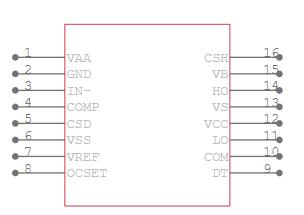
IRS2092S Symbol


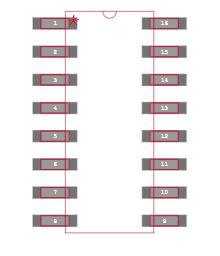
IRS2092S Footprint


IRS2092S 3D Model

IRS2092S Description

The IRS2092S is a high voltage, high-performance Class D audio amplifier driver with a PWM modulator and protection. In conjunction with two external MOSFET and a few external components, a complete Class D audio amplifier with protection can be realized. International Rectifier's proprietary noise isolation technology allows high current gate drive stage and high-speed low noise error amplifier to reside on a single small silicon die.

IRS2092S Feature

 Integrated analogue input Class D audio amplifier driver in a small 16 pin package 

 Floating inputs enable easy half-bridge implementation 

 Programmable bidirectional over-current protection with self-reset function 

 Programmable preset deadtime for improved THD performances 

 Start and stop click noise reduction 

 High noise immunity 

100 V ratings deliver up to 500 W in output power 

 Operates up to 800 kHz  RoHS compliant

IRS2092S Application

 Home theatre systems 

 Mini component stereo systems 

 Powered speaker systems

 General-purpose audio power amplifiers

IRS2092S Schematic

IRS2092S Schematic

IRS2092S Equivalent

The Equivalent for IRS2092S:

  • IRS2093

How to use IRS2092S?

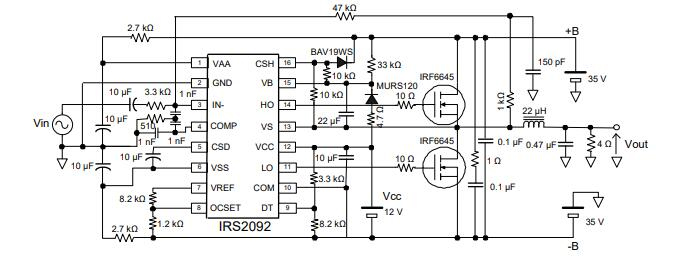
The IRS2092S is a class D amplifier building block that combines all of the components of a class D amplifier into a single IC that only requires a few external components to function. An OTA powers the input stage, which is powered by a +/- supply. On pin 3, this stage performs the main amplification of the input signal. The output is modulated to drive the gates of two N-channel MOSFETs in a half-bridge configuration using a level shifter. To avoid shoot-through and boost efficiency and reduce distortion, the chip also incorporates overcurrent protection and an adjustable dead-time. The image below depicts a typical application circuit.

IRS2092 Typical Application Circuit

Specifications

Infineon Technologies IRS2092SPBF technical specifications, attributes, parameters and parts with similar specifications to Infineon Technologies IRS2092SPBF.

IRS2092SPBF Tech Specifications

Infineon Technologies IRS2092SPBF technical specifications, attributes, parameters and parts with similar specifications to Infineon Technologies IRS2092SPBF.

Product Attribute Attribute Value
Mounting TypeSurface Mount
Package / Case16-SOIC (0.154, 3.90mm Width)
Surface MountYES
Operating Temperature-40°C~125°C TA
PackagingTube
Published2007
Part StatusDiscontinued
Moisture Sensitivity Level (MSL)2 (1 Year)
Number of Terminations16Terminations
ECCN CodeEAR99
TypeClass D
Product Attribute Attribute Value
HTS Code8542.33.00.01
Voltage - Supply10V~18V
Terminal PositionDUAL
Terminal FormGULL WING
Peak Reflow Temperature (Cel)NOT SPECIFIED
Number of Functions1Function
Terminal Pitch1.27mm
Time@Peak Reflow Temperature-Max (s)NOT SPECIFIED
Base Part NumberIRS2092SPBF
JESD-30 CodeR-PDSO-G16
Qualification StatusNot Qualified
Product Attribute Attribute Value
Output Type1-Channel (Mono)
Supply Voltage-Max (Vsup)18V
Power Supplies12V
Supply Voltage-Min (Vsup)10V
Number of Channels2Channels
Bandwidth20 kHz
FeaturesDepop, Short-Circuit Protection
Length9.89mm
Height Seated (Max)1.75mm
Width3.905mm
RoHS StatusROHS3 Compliant
0 Products View Similar

IRS2092S Package

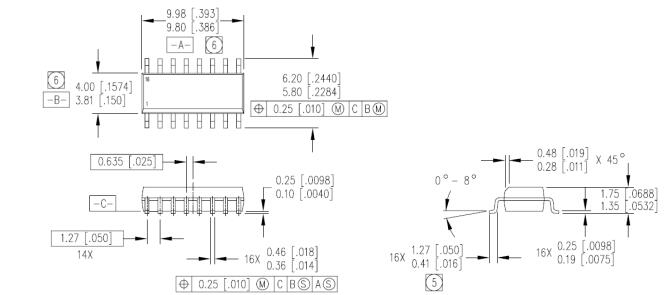
IRS2092S Package

IRS2092S Manufacturer

On April 1st, 1999, Siemens Semiconductors became Infineon Technologies. A dynamic more flexible company geared towards success in the competitive, ever-changing world of microelectronics. Infineon is a leading global designer, manufacturer and supplier of a broad range of semiconductors used in various microelectronic applications. Infineon's product portfolio consists of logic products, including digital, mixed-signal, and analogue integrated circuits, as well as discrete semiconductor products.

Datasheet PDF

Download datasheets and manufacturer documentation for Infineon Technologies IRS2092SPBF.

IRS2092SPBF Documents

Download datasheets and manufacturer documentation for IRS2092SPBF

Frequently Asked Questions

How does the irs2092(s) work?
Combined with two external MOSFETs and a few external components, the IRS2092(S) forms a complete Class D amplifier with dual over current, and shoot-through protection, as well as UVLO protection for the three bias supplies. The versatile structure of the analogue input section with an error amplifier and a PWM comparator
Is there a bus pumping effect with the irs2092?
Note there is no bus pumping effect when operating the amplifier in mono full-bridged mode. Thanks to the International rectifier there are now many Class D amplifier modules based on the IRS2092 available at a very modest cost. This gives the DIY'er great performance for the cost.
What is the damping factor of the irs2092s?
The IRS2092S reference design damping factor is rated at 120 @1kHz & 4 ohm. 3. Bus pumping in half-bridge stereo mode (IRS2092). Most common at low-frequency input signals. This puts energy back into the supply rails.
Why is my irs2092 not reaching full power?
The IRS2092 reference design is made for 1 VRMS full-scale input signal. This is usually too much for most sources, and as a result, full power is reached too soon. 2. Solution change the voltage gain of the amplifier.
FAQ
How does the irs2092(s) work?
Combined with two external MOSFETs and a few external components, the IRS2092(S) forms a complete Class D amplifier with dual over current, and shoot-through protection, as well as UVLO protection for the three bias supplies. The versatile structure of the analogue input section with an error amplifier and a PWM comparator
Is there a bus pumping effect with the irs2092?
Note there is no bus pumping effect when operating the amplifier in mono full-bridged mode. Thanks to the International rectifier there are now many Class D amplifier modules based on the IRS2092 available at a very modest cost. This gives the DIY'er great performance for the cost.
What is the damping factor of the irs2092s?
The IRS2092S reference design damping factor is rated at 120 @1kHz & 4 ohm. 3. Bus pumping in half-bridge stereo mode (IRS2092). Most common at low-frequency input signals. This puts energy back into the supply rails.
Why is my irs2092 not reaching full power?
The IRS2092 reference design is made for 1 VRMS full-scale input signal. This is usually too much for most sources, and as a result, full power is reached too soon. 2. Solution change the voltage gain of the amplifier.

TAGS

Share