The LIS3DH provides the capability to detect the orientation of the device in space, enabling easy implementation of energy-saving procedures and automatic image rotation for mobile devices. The 4D detection is a subset of the 6D function especially defined to be implemented in mobile devices for portrait and landscape computation. In 4D configuration, the Z-axis position detection is disabled.
The LIS3DH can be programmed to automatically switch to low-power mode upon recognition of a determined event. Once the event condition is over, the device returns back to the preset normal or highresolution mode. To enable this function the desired threshold value must be stored inside the ACT_THS (3Eh) register while the duration value is written inside the ACT_DUR (3Fh) register. When the acceleration falls below the threshold value, the device automatically switches to low-power mode (10 Hz ODR). During this condition, the ODR[3:0] bits and the LPen bit inside CTRL_REG1 (20h) and the HR bit in CTRL_REG4 (23h) are not considered. As soon as the acceleration rises above threshold, the module restores the operating mode and ODRs as determined by the CTRL_REG1 (20h) and CTRL_REG4 (23h) settings.
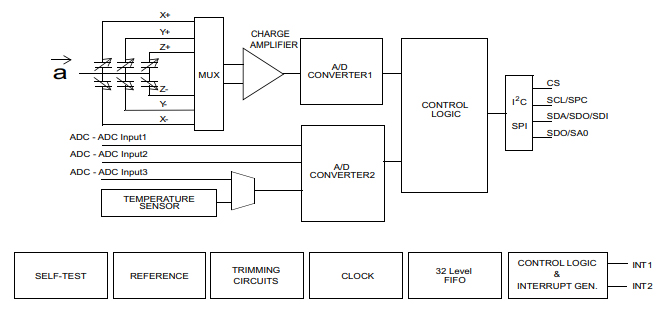
The LIS3DH contains a 10-bit, 32-level FIFO. Buffered output allows 4 operation modes: FIFO, Stream, Stream-to-FIFO and FIFO bypass. When FIFO bypass mode is activated, FIFO is not operating and remains empty. In FIFO mode, measurement data from acceleration detection on the x, y, and z axes are stored in the FIFO buffer.
For more information, please check out the datasheet at the end of this article.