ATTENTION: Due to increased demand and order volume, processing time may take an additional 1-3 business days.
HomeCommunitySubjectLM3915 Dot/Bar Display Driver: Circuit, Price and Application

LM3915 Dot/Bar Display Driver: Circuit, Price and Application

IC DRVR DOT/BAR DISPLAY 18DIP Hello, everyone, hope you are well today. In this post today, I will discuss LM3915 dot/bar display driver.

965

Jul 26, 2021

Phyllis Church

How to make audio level indicator with LM3915 ic - freeform circuit │SimpleCircuits


IC DRVR DOT/BAR DISPLAY 18DIP

Hello, everyone, hope you are well today. In this post today, I will discuss LM3915 dot/bar display driver. Just stay with me for a while as I will walk you through LM3915 circuit, price, application and so on. Let's start right now.

LM3915N-1

280In Stock
Min.: 1 Mult.: 1
Price not displayed? Not available to buy online? Please send an RFQ, and we will respond immediately.
Quick Links

LM3915 Description

LM3915 is a monolithic integrated circuit that can sense analog voltage levels and drive ten LEDs, LCDs or vacuum fluorescent displays, providing a logarithmic 3 dB/step analog display. One pin changes the display from a bar graph to a moving point display. The LED current drive is adjustable and programmable without current limiting resistors. The entire display system can use a single power supply as low as 3V or as high as 25V.


The IC contains an adjustable voltage reference and an accurate ten-step voltage divider. The high mA impedance input buffer accepts signals as low as ground and as high as 1.5V from the positive power supply. In addition, it does not require protection for ±35V input. The input buffer drives 10 independent comparators referenced to precision dividers. The accuracy is usually better than 1 dB.


The 3 dB/step display of LM3915 is suitable for signals with a wide dynamic range, such as audio level, power, light intensity or vibration. Audio applications include voltage average or peak level indicators, power meters, and RF signal strength meters. Replacing traditional meters with LED bar graphs can achieve a faster response, more robust display, and high visibility, while retaining the ease of interpretation of the analog display.


LM3915 is very easy to apply. In addition to the ten LEDs, the 1.2V full-scale meter requires only one resistor. The other resistor can set the full scale in any range from 1.2V to 12V, regardless of the power supply voltage. Only a potentiometer can easily control the LED brightness.


The LM3915 is very versatile. The outputs can drive LCDs, vacuum fluorescents and incandescent bulbs as well as LEDs of any color. Multiple devices can be cascaded for a dot or bar mode display with a range of 60 or 90 dB. LM3915s can also be cascaded with LM3914s for a linear/log display or with LM3916s for an extended-range VU meter.


LM3915 is very versatile. The output can drive LCDs, vacuum fluorescent lamps and incandescent bulbs, as well as LEDs of any color. Multiple devices can be cascaded to display in dot or bar mode, with a range of 60 or 90 dB. LM3915s can also be cascaded with LM3914s to achieve linear/logarithmic display, or cascaded with LM3916s to achieve extended range VU meters.

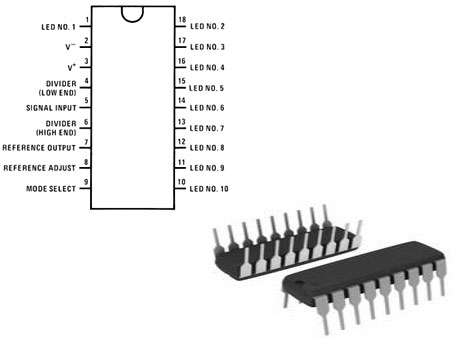
 

LM3915 Pinout

LM3915 CAD Model

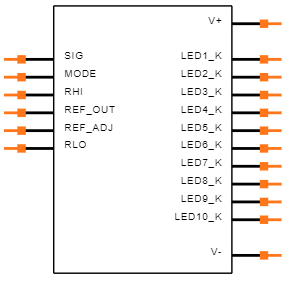
Symbol


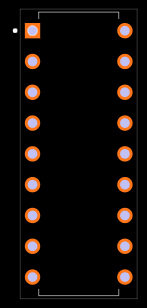
Footprint


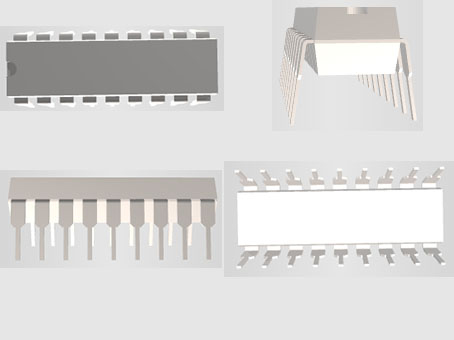
3D Model

LM3915 Features

• 3 dB/step, 30 dB range

• Drive LED, LCD or vacuum fluorescent lamp

• The user can select the bar or dot display mode from the outside

• Display that can be expanded to 90 dB

• 1.2V to 12V internal reference voltage

• Use a single power supply from 3V to 25V

• Input ground

• The output current can be programmed from 1 mA to 30

• Input can withstand ±35V without damage or wrong output

• The output adopts current regulation and open collector

• Direct drive TTL or CMOS

• The internal 10-step voltage divider is floating and can refer to a wide voltage range

• The rated operating temperature range of LM3915 is 0°C to 70°C. LM3915N-1 is available in 18-pin PDIP package.

Specifications

Texas Instruments LM3915N-1 technical specifications, attributes, parameters and parts with similar specifications to Texas Instruments LM3915N-1.

LM3915N-1 Tech Specifications

Texas Instruments LM3915N-1 technical specifications, attributes, parameters and parts with similar specifications to Texas Instruments LM3915N-1.

Product Attribute Attribute Value
MountThrough Hole
Mounting TypeThrough Hole
Package / Case18-DIP (0.300, 7.62mm)
Number of Pins18Pins
Operating Temperature0°C~70°C
PackagingTube
JESD-609 Codee0
Pbfree Codeno
Part StatusObsolete
Moisture Sensitivity Level (MSL)1 (Unlimited)
Number of Terminations18Terminations
ECCN CodeEAR99
Terminal FinishTin/Lead (Sn/Pb)
Additional FeatureSELECTABLE DOT MODE
Max Power Dissipation1.365W
Product Attribute Attribute Value
Voltage - Supply3V~25V
Terminal PositionDUAL
Number of Functions1Function
Terminal Pitch2.54mm
Base Part NumberLM3915
Pin Count18
Number of Outputs10Outputs
Output Voltage1.28V
ConfigurationDot/Bar Display
Number of Circuits1Circuit
Operating Supply Current6.1mA
Nominal Supply Current9.2mA
Power Dissipation1.365W
Output Current30mA
Max Supply Current9.2mA
Product Attribute Attribute Value
Max Output Voltage1.34V
Min Input Voltage3V
Max Input Voltage25V
Display TypeLED, LCD, Vacuum Fluorescent (VF)
Interface IC TypeLED DISPLAY DRIVER
Number of Segments10Segments
Multiplexed Display CapabilityNO
Display ModeBAR GRAPH
Digits or Characters10 Steps
Height3.3mm
Length22.86mm
Width6.35mm
REACH SVHCNo SVHC
Radiation HardeningNo
RoHS StatusNon-RoHS Compliant
0 Products View Similar

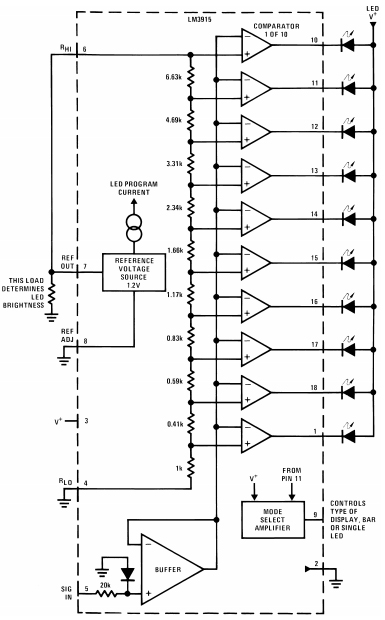
LM3915 Block Diagram

Where to use LM3915?

The LM3915 is an audio controlled LED driver IC, meaning it can control (turn on or off) 10 LED lights based on an analog input voltage of the audio signal. As we know the voltage value of an audio signal varies based on the amplitude of the signal, this amplitude is directly proportional to the loudness of the audio signal. Thus by making the LEDs glow with respect to the amplitude of the audio signal will help us visualize the audio signal.  This IC eliminates the need for microcontroller and programming and also reduces the hardware required to control 10 LEDs.


The analog input voltage of the audio signal can vary from 1.2V to 12V and the LED current can be limited by simply using a resistor divider network on pin 7 (Ref Out). The IC increments the LED by one step for every 3dB rise in Audio signal, thus for 10 LEDs the IC can monitor upto 30dB audio signal. Further the IC can also be cascaded to monitor upto 90dB of audio signal by using 30 LEDs.


Since the LEDs can be controlled without any flickering and flawlessly with equal brightness these ICs are commonly used in visual alarms and other metering/monitoring applications.  So, if you are looking for an IC to driver your bar LED lights or other sequence of 10 LED then this IC might be of interest to you.

How to use LM3915?

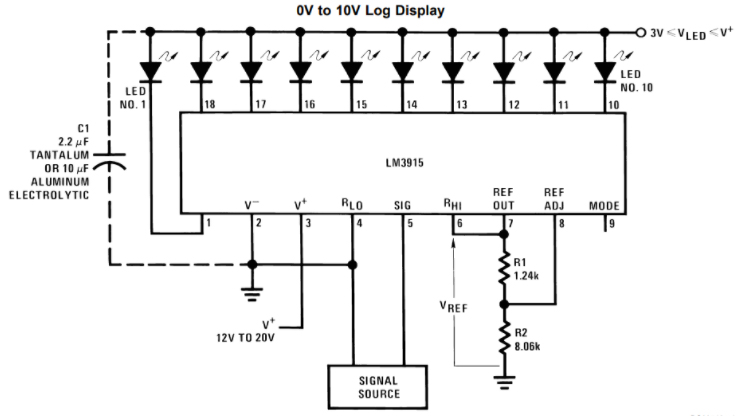
The LM3915 can be easily operated with very little additional components. The complete working of the IC and how do use it is discussed in the video linked at the bottom of this page. A sample application circuit from the LM3915 datasheet is given below.

As you can see we only require the LEDs and two resistors as additional component to use this IC. The IC can operate between 3V to 25V. The Audio signal maximum voltage can be as high as 12V or as low as 1.2V. Based on this voltage, the reference voltage has to be set in the circuit using the resistors R1 and R2. Let’s assume that the maximum voltage level from our audio signal is 3.6V and the minimum voltage is 0V. In this case, the pin RHI and REF OUT should be supplied with 3.6V and the pin RLO should be supplied with 0V. The IC also allows the designer to set the required current that should flow through LED. Both the LED current and the reference voltage can be set with the Resistor R1 and R2 using the below formulae.

LM3915 Circuit

Output Circuit

Low Cost Circuit for 60 dB Display

Improved Circuit for 60 dB Display


LM3915 Applications

■ Audio Visualization Circuit

■ Crude battery indicator

■ Low-cost monitoring equipment

■ Digital meter

■ Electronic display

■ Fade in and fade out bar

LM3915 Manufacturer

Texas Instruments Incorporated (TI) is an American technology company headquartered in Dallas, Texas, that designs and manufactures semiconductors and various integrated circuits, which it sells to electronics designers and manufacturers globally.[6] It is one of the top 10 semiconductor companies worldwide based on sales volume.The company's focus is on developing analog chips and embedded processors, which account for more than 80% of its revenue.TI also produces TI digital light processing technology and education technology products including calculators, microcontrollers and multi-core processors. The company holds 45,000 patents worldwide as of 2016.

Datasheet PDF

Download datasheets and manufacturer documentation for Texas Instruments LM3915N-1.

LM3915N-1 Documents

Download datasheets and manufacturer documentation for LM3915N-1

Frequently Asked Questions

1.What chip is LM3915? What is the role of it?
LM3915 is a 10-light level indicator control chip with high sensitivity. The input volume (sensitivity) can also be adjusted with a 50K resistor. The function of LM3915 is actually an integrated circuit that controls 10 LED lights to turn on and off through the input audio, and it has double rows of 18 pins.
2.Can the LM3915 audio input terminal be directly connected to the output terminal of the voice control circuit?
The input terminal is for audio input, and the output terminal is for audio output. If it is LM3915, the audio output terminal can be directly connected to the input terminal of the voice control circuit.
3.What is the difference between LM3915 and LM3915N-1?
There is no difference in pin arrangement and electrical functions between the two types of chips. The only difference is the packaging.
4.What can be used instead of LM3915?
LM3915 is a ten-segment LED display drive circuit, which can be replaced by ECG1509.
5.Can LM3915 chips be used in circuits in parallel?
No, it can not. LM3915 is a level indicator chip. The input level value is different, and the number of LED lights is different. According to this feature, it is usually used as an audio level indicator, which flashes with the music. LM3915 is a 10-segment indicator. If you need to increase it to 20-segment, you can use two 3915 cascades, but not in parallel. The output of the first chip can be output to the input of the second chip.
FAQ
1.What chip is LM3915? What is the role of it?
LM3915 is a 10-light level indicator control chip with high sensitivity. The input volume (sensitivity) can also be adjusted with a 50K resistor. The function of LM3915 is actually an integrated circuit that controls 10 LED lights to turn on and off through the input audio, and it has double rows of 18 pins.
2.Can the LM3915 audio input terminal be directly connected to the output terminal of the voice control circuit?
The input terminal is for audio input, and the output terminal is for audio output. If it is LM3915, the audio output terminal can be directly connected to the input terminal of the voice control circuit.
3.What is the difference between LM3915 and LM3915N-1?
There is no difference in pin arrangement and electrical functions between the two types of chips. The only difference is the packaging.
4.What can be used instead of LM3915?
LM3915 is a ten-segment LED display drive circuit, which can be replaced by ECG1509.
5.Can LM3915 chips be used in circuits in parallel?
No, it can not. LM3915 is a level indicator chip. The input level value is different, and the number of LED lights is different. According to this feature, it is usually used as an audio level indicator, which flashes with the music. LM3915 is a 10-segment indicator. If you need to increase it to 20-segment, you can use two 3915 cascades, but not in parallel. The output of the first chip can be output to the input of the second chip.

TAGS

Share