ATTENTION: Due to increased demand and order volume, processing time may take an additional 1-3 business days.
HomeCommunitySubjectLPC1769 Microcontroller: Pinout, Datasheet and Programming

LPC1769 Microcontroller: Pinout, Datasheet and Programming

MCU 32-bit LPC1700 ARM Cortex M3 RISC 512KB Flash 3.3V 100-Pin LQFP Tray The LPC1769 is an ARM Cortex-M3-based microcontroller for embedded applications featuring a high level of integration and low power consumption.

1876

Sep 12, 2021

Rae Marner

FreeRTOS on NXP LPC1769 MCU: Getting Started


MCU 32-bit LPC1700 ARM Cortex M3 RISC 512KB Flash 3.3V 100-Pin LQFP Tray

The LPC1769 is an ARM Cortex-M3-based microcontroller for embedded applications featuring a high level of integration and low power consumption. This article mainly covers datasheet, pinout, board, schematics, and more details about LPC1769. Furthermore, there is a huge range of semiconductors, capacitors, resistors, and Ics in stock. Welcome RFQ!
LPC1769FBD100,551

1In Stock
Min.: 1 Mult.: 1
Price not displayed? Not available to buy online? Please send an RFQ, and we will respond immediately.
Quick Links

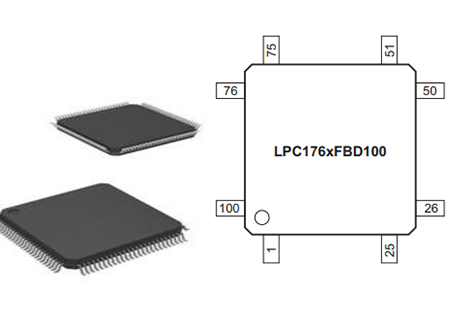
LPC1769 Pinout

LPC1769 CAD Model

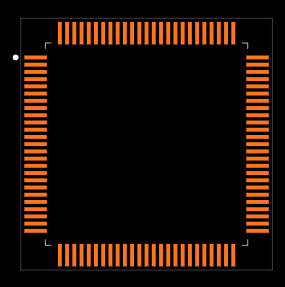
LPC1769 footprint.png

Footprint


lpc1769 3d model.png

3D Model

What is LPC1769?

The LPC1769 is a Cortex®-M3 microcontroller for embedded applications featuring a high level of integration and low power consumption at frequencies of 120 MHz. The Arm Cortex-M3 is a next-generation core that offers system enhancements such as enhanced debug features and a higher level of support block integration.

Specifications

NXP USA Inc. LPC1769FBD100,551 technical specifications, attributes, parameters and parts with similar specifications to NXP USA Inc. LPC1769FBD100,551.

LPC1769FBD100,551 Tech Specifications

NXP USA Inc. LPC1769FBD100,551 technical specifications, attributes, parameters and parts with similar specifications to NXP USA Inc. LPC1769FBD100,551.

Product Attribute Attribute Value
Factory Lead Time12 Weeks
Mounting TypeSurface Mount
Package / Case100-LQFP
Surface MountYES
Data ConvertersA/D 8x12b; D/A 1x10b
Number of I/Os70I/Os
ROM(word)524288
Operating Temperature-40°C~85°C TA
PackagingTray
SeriesLPC17xx
Published2007
JESD-609 Codee3
Part StatusActive
Moisture Sensitivity Level (MSL)3 (168 Hours)
Number of Terminations100Terminations
ECCN CodeEAR99
Terminal FinishTin (Sn)
HTS Code8542.31.00.01
Product Attribute Attribute Value
Terminal PositionQUAD
Terminal FormGULL WING
Peak Reflow Temperature (Cel)260
Supply Voltage3.3V
Terminal Pitch0.5mm
Time@Peak Reflow Temperature-Max (s)NOT SPECIFIED
Base Part NumberLPC1769
Pin Count100
JESD-30 CodeS-PQFP-G100
Qualification StatusNot Qualified
Supply Voltage-Max (Vsup)3.6V
Power Supplies3.3V
Supply Voltage-Min (Vsup)2.4V
Oscillator TypeInternal
Speed120MHz
RAM Size64K x 8
Voltage - Supply (Vcc/Vdd)2.4V~3.6V
uPs/uCs/Peripheral ICs TypeMICROCONTROLLER, RISC
Product Attribute Attribute Value
Core ProcessorARM® Cortex®-M3
PeripheralsBrown-out Detect/Reset, DMA, I2S, Motor Control PWM, POR, PWM, WDT
Clock Frequency25MHz
Program Memory TypeFLASH
Core Size32-Bit
Program Memory Size512KB 512K x 8
ConnectivityCANbus, Ethernet, I2C, IrDA, Microwire, SPI, SSI, UART/USART, USB OTG
Bit Size32
Has ADCYES
DMA ChannelsYES
PWM ChannelsYES
DAC ChannelsYES
Length14mm
Height Seated (Max)1.6mm
Width14mm
RoHS StatusROHS3 Compliant
0 Products View Similar

LPC1769 Features and Benefits

  • Arm Cortex-M3 processor, running at frequencies of up to 100 MHz or of up to 120 MHz. A Memory Protection Unit (MPU) supporting eight regions is included.

  • Arm Cortex-M3 built-in Nested Vectored Interrupt Controller (NVIC).


LPC1769 Applications

  • eMetering 

  • Alarm systems

  • Lighting 

  • White goods

  • Industrial networking 

  • Motor control


LPC1769 Application Circuit

The maximum allowable voltage on the VBUS pin is 3.6 V. One method is to use a voltage divider to connect the VBUS pin to the VBUS on the USB connector.

The voltage divider ratio should be such that the VBUS pin will be greater than 0.7VDD to indicate a logic HIGH while below the 3.6 V allowable maximum voltages.


Use the following operating conditions:

VBUSmax = 5.25 V

VDD = 3.6 V

The voltage divider would need to provide a reduction of 3.6 V/5.25 V or ~0.686 V.


LPC1769 Application Circuit

How to program LPC1769?

Getting started with the ARM Cortex M3

  • Setting up of Programming and debugging Environment

  • Install the Driver of CoLinkEx

  • Install the plugin and integrate with Keil MDK

  • Register Configuration (lpc17xx.h)

  • Create a project using Keil uvision4 for LPC1769 Microcontroller

  • PINSEL: GPIO Pins Select Register

  • FIODIR: Fast GPIO Direction Control Register.

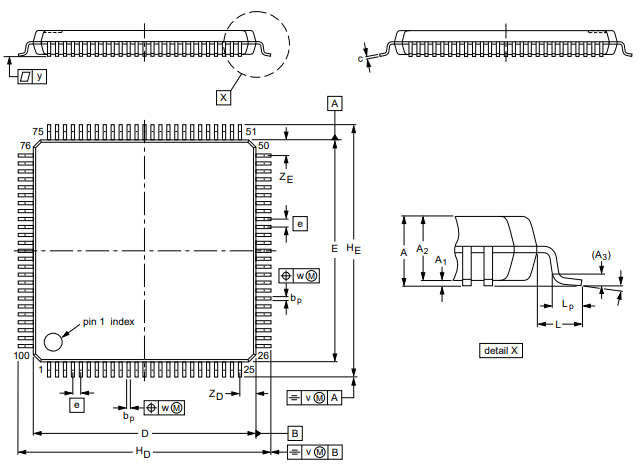
LPC1769 Package Outlines

LPC1769 Manufacturer

NXP Semiconductors N.V. is a Dutch semiconductor manufacturer with headquarters in Eindhoven, Netherlands that focuses on the automotive industry. The company employs approximately 31,000 people in more than 35 countries, including 11,200 engineers in 33 countries.


Datasheet PDF

Download datasheets and manufacturer documentation for NXP USA Inc. LPC1769FBD100,551.

LPC1769FBD100,551 Documents

Download datasheets and manufacturer documentation for LPC1769FBD100,551

Frequently Asked Questions

What is LPC1769 used for?
The LPC1769 is an ARM Cortex-M3-based microcontroller for embedded applications featuring a high level of integration and low power consumption. The Arm Cortex-M3 is a next-generation core that offers system enhancements such as enhanced debug features and a higher level of support block integration.
What is the difference between LPC1769 and LPC1768?
The only difference is the working frequency: LPC1768 @ 100 MHz LPC1769 @ 120 MHz
How does LPC1769 connect to GPRS equipment?
Such as the power pin should be connected to what power supply to connect to the power supply, and then use the corresponding IO port to control the GPRS module.
FAQ
What is LPC1769 used for?
The LPC1769 is an ARM Cortex-M3-based microcontroller for embedded applications featuring a high level of integration and low power consumption. The Arm Cortex-M3 is a next-generation core that offers system enhancements such as enhanced debug features and a higher level of support block integration.
What is the difference between LPC1769 and LPC1768?
The only difference is the working frequency: LPC1768 @ 100 MHz LPC1769 @ 120 MHz
How does LPC1769 connect to GPRS equipment?
Such as the power pin should be connected to what power supply to connect to the power supply, and then use the corresponding IO port to control the GPRS module.

TAGS

Share