ATTENTION: Due to increased demand and order volume, processing time may take an additional 1-3 business days.
HomeCommunitySubjectMAX30100 Heart-Rate Sensor IC : Specification, Pinout and Datasheet

MAX30100 Heart-Rate Sensor IC : Specification, Pinout and Datasheet

Pulse Oximeter and Heart-Rate Sensor IC 14-Pin OLGA Hi, fellas. Welcome back to the new post today. MAX30100 is a Pulse Oximeter and Heart-Rate Sensor IC which is used to check the health of a person with any condition that affects blood oxygen levels.

280

Sep 11, 2021

Andy Jefferson

Blood Oxygen & Heart Rate Measurement with MAX30100/02 Pulse Oximeter & Arduino


Pulse Oximeter and Heart-Rate Sensor IC 14-Pin OLGA

Hi, fellas. Welcome back to the new post today. MAX30100 is a Pulse Oximeter and Heart-Rate Sensor IC which is used to check the health of a person with any condition that affects blood oxygen levels. This article mainly introduces specification, pinout, datasheet, and other detailed information about Maxim Integrated MAX30100.
MAX30100EFD

6250In Stock
Min.: 1 Mult.: 1
Price not displayed? Not available to buy online? Please send an RFQ, and we will respond immediately.
Quick Links

MAX30100 Description

MAX30100 is a Pulse Oximeter and Heart-Rate Sensor IC which is used to check the health of a person with any condition that affects blood oxygen levels, such as Heart Attack, Heart failure, Lungs Cancer Asthma, etc. 


The MAX30100 operates from 1.8V and 3.3V power supplies and can be powered down through software with negligible standby current, permitting the power supply to remain connected at all times. 


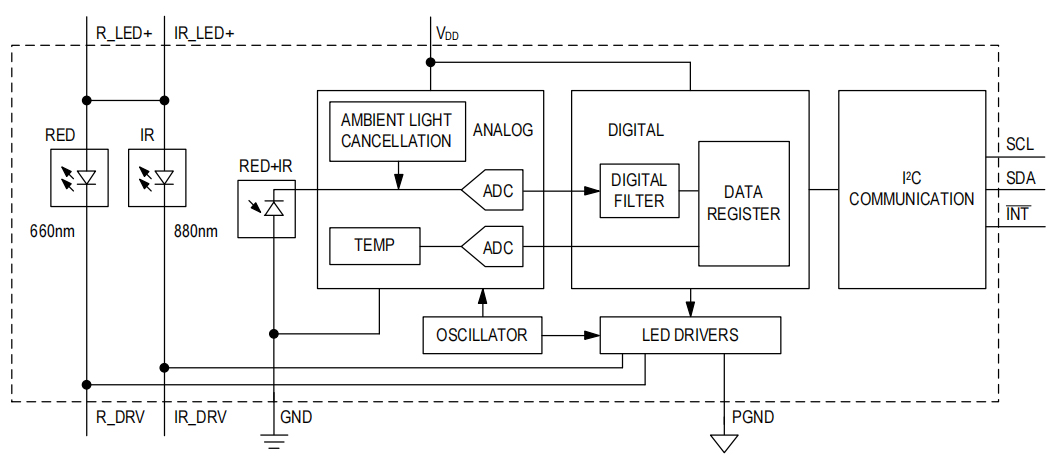
The sensor comprises two Light Emitting Diodes, a photodetector, and a series of low noise signal processing devices to detect heart rate and to perform pulse oximetry.

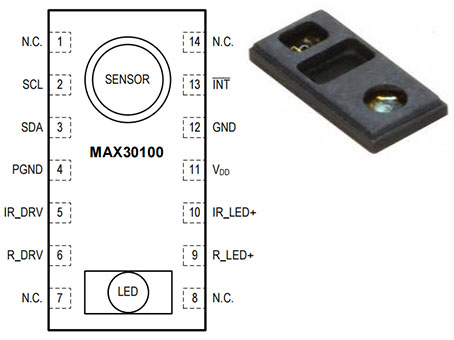
MAX30100 Pinout


Pin Number Pin Name Description
1,7,8,14 N.C. No Connection. Connect to PCB Pad for Mechanical Stability.
2 SCL I2C Clock Input
3 SDA I2C Clock Data, Bidirectional (Open-Drain)
4 PGND Power Ground of the LED Driver Blocks
5 IR_DRV IR LED Cathode and LED Driver Connection Point. Leave floating in the circuit.
6 R_DRV Red LED Cathode and LED Driver Connection Point. Leave floating in the circuit.
9 R_LED+ Power Supply (Anode Connection) for Red LED. Bypass to PGND for best performance.  Connected to IR_LED+ internally.
10 IR_LED+ Power Supply (Anode Connection) for IR LED. Bypass to PGND for best performance. Connected to R_LED+ internally
11 VDD Analog Power Supply Input. Bypass to GND for best performance.
12 GND Analog Ground
13 INT Active-Low Interrupt (Open-Drain)

MAX30100 Features

●Operating Voltage - 1.8V to 3.3V

●Input Current - 20mA

●Integrated Ambient Light Cancellation

●High Sample Rate Capability

●Fast Data Output Capability


Specifications

Maxim Integrated MAX30100EFD+ technical specifications, attributes, parameters and parts with similar specifications to Maxim Integrated MAX30100EFD+.

MAX30100EFD Tech Specifications

Maxim Integrated MAX30100EFD technical specifications, attributes, parameters and parts with similar specifications to Maxim Integrated MAX30100EFD .

Product Attribute Attribute Value
Factory Lead Time6 Weeks
MountSurface Mount
Number of Pins14Pins
PackagingTray
Published2015
Product Attribute Attribute Value
Part StatusObsolete
Moisture Sensitivity Level (MSL)3 (168 Hours)
Max Operating Temperature85°C
Min Operating Temperature-40°C
Output TypeAnalog
Product Attribute Attribute Value
Max Supply Voltage2V
Min Supply Voltage1.7V
Sensor TypeOximeter/Heart Rate
REACH SVHCUnknown
RoHS StatusROHS3 Compliant
0 Products View Similar

MAX30100 Functional Diagram

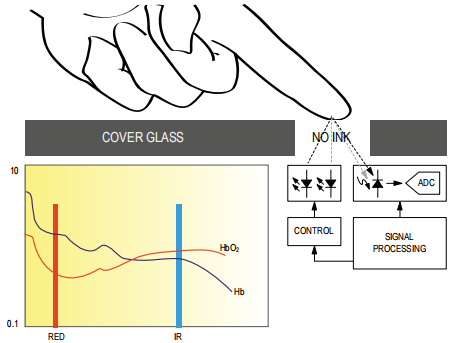
MAX30100 System Block Diagram

System Block Diagram

As the system block diagram is shown, there should be a small distance between the sensor and finger.

MAX30100 Advantages

● Complete Pulse Oximeter and Heart-Rate Sensor Solution Simplifies Design

• Integrated LEDs, Photo Sensor, and High-Performance Analog Front -End

• Tiny 5.6mm x 2.8mm x 1.2mm 14-Pin Optically Enhanced System-in-Package

● Ultra-Low-Power Operation Increases Battery Life for Wearable Devices

• Programmable Sample Rate and LED Current for Power Savings

• Ultra-Low Shutdown Current (0.7µA, typ)

● Advanced Functionality Improves Measurement Performance

• High SNR Provides Robust Motion Artifact Resilience

• Integrated Ambient Light Cancellation

• High Sample Rate Capability

• Fast Data Output Capability

MAX30100 Arduino

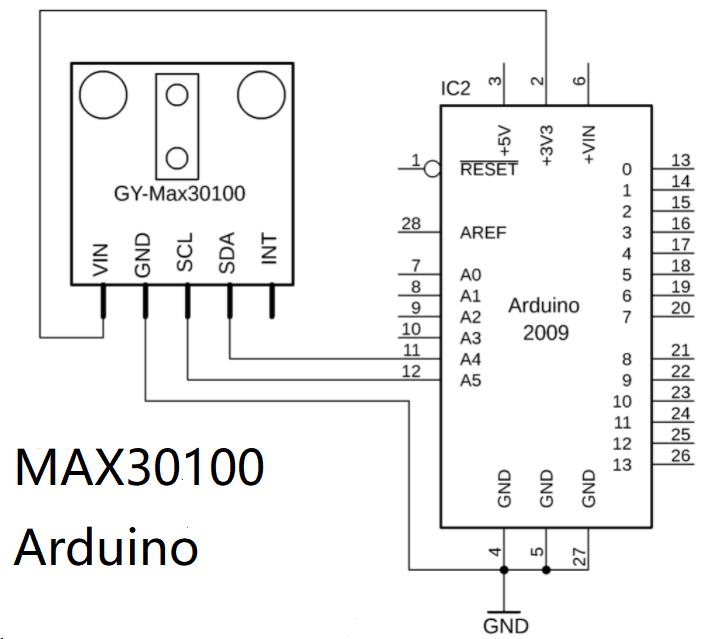
Interfacing Max30100 Pulse Oximeter Sensor with Arduino Circuit Diagram

First, let's start with a very basic circuit diagram. As you can see the VIN and GND pins of the Max30100 sensor are connected with the Arduino’s 3.3v and GND pins. The SCL pin is connected with the Analog pin A5, SDA pin is connected with the Analog pin A4. While the INT pin is not connected.


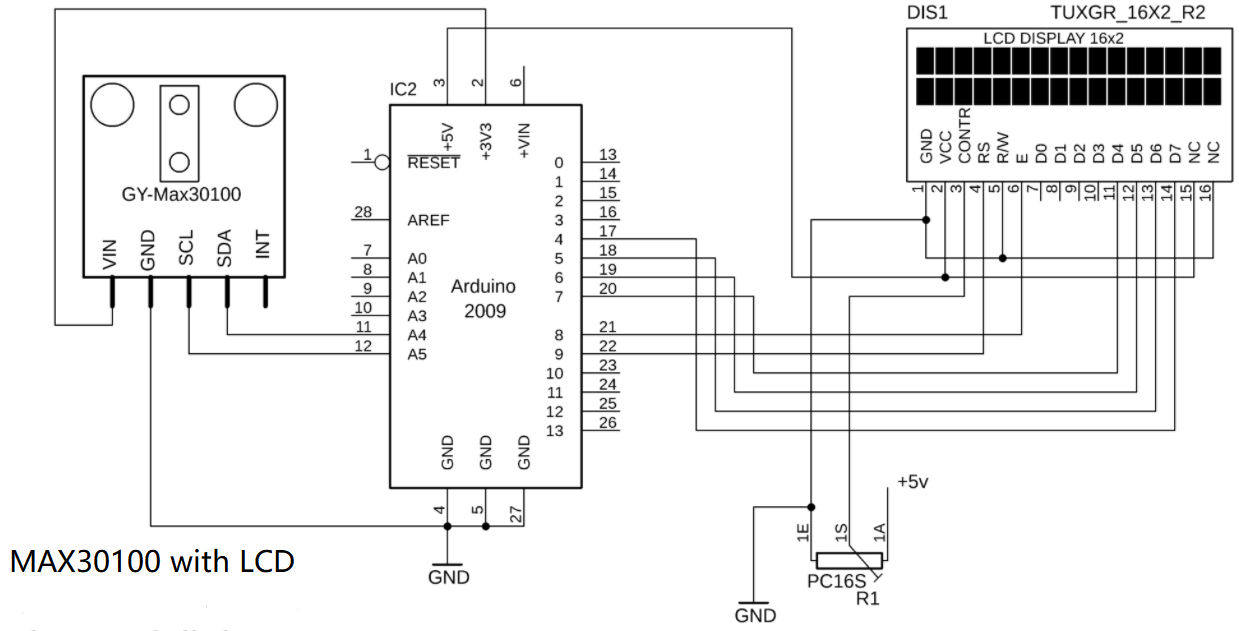
Interfacing Max30100 Pulse Oximeter Sensor and 16×2 LCD with Arduino Circuit Diagram

This is the modified circuit diagram. The max30100 pulse Oximeter sensor connection with the Arduino remains the same. This time I added a 16×2 LCD. As you can see, pin number 1 and pin number 16 are connected with the Arduino’s ground. Pin number 2 and pin number 15 are connected with the Arduino’s 5 volts. Pin number 3 is the contrast pin and is connected with the middle leg of the potentiometer this is used for the LCD contrast adjustment.

The RS pin of the LCD is connected with the Arduino’s pin number 9, the R/W pin is connected with the ground, Enable pin is connected with the Arduino’s pin number 8. Pins D4 to D7 of the 16X2 LCD is connected with the Arduino’s pins 7, 6, 5, and 4.

MAX30100 Applications

-Used in medical oxygen measurement devices

-Used in wearable devices

-Used in fitness assistant systems


MAX30100 Manufacturer

Maxim Integrated, a subsidiary of Analog Devices, designs, manufactures and sells analog and mixed-signal integrated circuits for the automotive, industrial, communications, consumer, and computing markets. Maxim's product portfolio includes power and battery management ICs, sensors, analog ICs, interface ICs, communication solutions, digital ICs, embedded security, and microcontrollers. The company is headquartered in San Jose, California, with design centers, manufacturing facilities, and sales offices around the world.

Datasheet PDF

Download datasheets and manufacturer documentation for Maxim Integrated MAX30100EFD+.

MAX30100EFD Documents

Download datasheets and manufacturer documentation for MAX30100EFD

Frequently Asked Questions

1.How to connect the MAX30100 chip to the MCU?
You only need to connect to the I2C interface, if the microcontroller does not have an I2C interface, you can use IO to simulate an I2C.
2.What electronic component is MX30100?
MAX30100 is a sensor chip that can collect heart rate, blood oxygen temperature, and the communication serial port uses I2C. MAX30100 is a sensor that can read heart rate and blood oxygen. The communication method is through IIC. Its working principle is to get the ADC value of heart rate through infrared LED light.
3.Will the red LED light up when the MAX30100 is powered on?
It is not appropriate to use 12V voltage to directly bring 4 red LED lights. It is easy to cause damage to one or several of the four LED lights, so it will not light up. Because the forward voltage drop of a general red LED light-emitting tube is only about 2.2V
FAQ
1.How to connect the MAX30100 chip to the MCU?
You only need to connect to the I2C interface, if the microcontroller does not have an I2C interface, you can use IO to simulate an I2C.
2.What electronic component is MX30100?
MAX30100 is a sensor chip that can collect heart rate, blood oxygen temperature, and the communication serial port uses I2C. MAX30100 is a sensor that can read heart rate and blood oxygen. The communication method is through IIC. Its working principle is to get the ADC value of heart rate through infrared LED light.
3.Will the red LED light up when the MAX30100 is powered on?
It is not appropriate to use 12V voltage to directly bring 4 red LED lights. It is easy to cause damage to one or several of the four LED lights, so it will not light up. Because the forward voltage drop of a general red LED light-emitting tube is only about 2.2V

TAGS

Share