ATTENTION: Due to increased demand and order volume, processing time may take an additional 1-3 business days.
HomeCommunitySubjectMAX31856 Digital Converter: Datasheet, Pinout and Schematic

MAX31856 Digital Converter: Datasheet, Pinout and Schematic

IC CONV THERMOCOUPLE 14TSSOP The MAX31856 is a precision thermocouple to digital converter with linearization.

268

Aug 10, 2021

Joyce Veblen

How to Measure Temperature with a Thermocouple Using the MAX31856


IC CONV THERMOCOUPLE 14TSSOP

The MAX31856 is a precision thermocouple to digital converter with linearization. This article enforces datasheet, pinout, schematic, applications, and other details about MAX31856.

MAX31856MUD

147In Stock
Min.: 1 Mult.: 1
Quantity Unit Price Ext. Price
1+ $7.06093$7.06
10+ $6.66125$66.61
100+ $6.2842$628.42
500+ $5.92849$2964.25
1000+ $5.59292$5592.92
Unit Price:$7.06093
Subtotal: $7.06
Looking for a better price? Want a lower wholesale price? Please send an RFQ, and we will respond immediately.
Quick Links

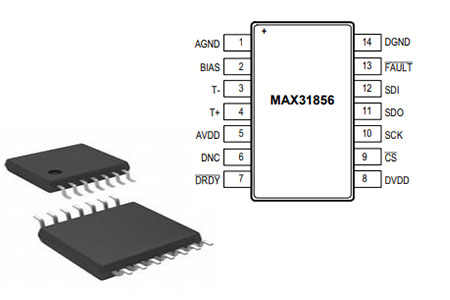
MAX31856 Pinout

MAX31856 Description

The MAX31856 performs cold-junction compensation and digitizes the signal from any type of thermocouple. The output data is formatted in degrees Celsius. This converter resolves temperatures to 0.0078125°C, allows readings as high as +1800°C and as low as -210°C (depending on thermocouple type), and exhibits thermocouple voltage measurement accuracy of ±0.15%. The thermocouple inputs are protected against overvoltage conditions up to ±45V.

MAX31856 CAD Model

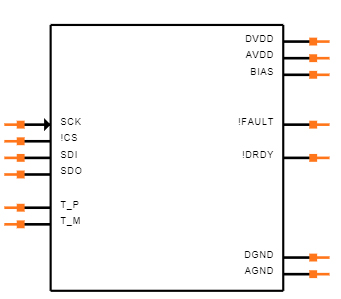
Symbol


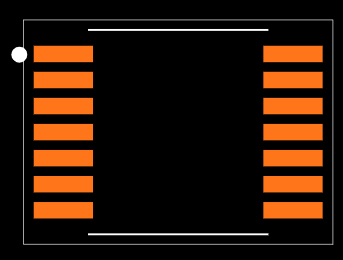
Footprint

Specifications

Maxim Integrated MAX31856MUD+ technical specifications, attributes, parameters and parts with similar specifications to Maxim Integrated MAX31856MUD+.

MAX31856MUD Tech Specifications

Maxim Integrated MAX31856MUD technical specifications, attributes, parameters and parts with similar specifications to Maxim Integrated MAX31856MUD .

Product Attribute Attribute Value
Factory Lead Time10 Weeks
MountSurface Mount
Mounting TypeSurface Mount
Package / Case14-TSSOP (0.173, 4.40mm Width)
Number of Pins14Pins
Operating Temperature-55°C~125°C
PackagingTube
Published2015
Part StatusActive
Moisture Sensitivity Level (MSL)1 (Unlimited)
Number of Terminations14Terminations
Product Attribute Attribute Value
TypeThermocouple to Digital Converter
HTS Code8542.39.00.01
Terminal PositionDUAL
Terminal FormGULL WING
Number of Functions1Function
Supply Voltage3.3V
Terminal Pitch0.65mm
Base Part NumberMAX31856
Qualification StatusNot Qualified
Output TypeDigital
InterfaceSPI
Product Attribute Attribute Value
Max Supply Voltage3.6V
Min Supply Voltage3V
Operating Supply Current1.2mA
Input TypeThermocouple
Length5mm
Height Seated (Max)1.1mm
Width4.4mm
REACH SVHCUnknown
RoHS StatusROHS3 Compliant
0 Products View Similar

MAX31856 Benefits and Features

  • Provides High-Accuracy Thermocouple Temperature Readings

  1. Includes Automatic Linearization Correction for 8 Thermocouple Types

  2. ±0.15% (max, -20°C to +85°C) Thermocouple FullScale and Linearity Error

  3. 19-Bit, 0.0078125°C Thermocouple Temperature Resolution

  • Internal Cold-Junction Compensation Minimizes System Components

  1. ±0.7°C (max, -20°C to +85°C) Cold-Junction Accuracy

  • ±45V Input Protection Provides Robust System Performance

  • Simplifies System Fault Management and Troubleshooting

  1. Detects Open Thermocouples

  2. Over- and Undertemperature Fault Detection

  • 50Hz/60Hz Noise Rejection Filtering Improves System Performance

  • 14-Pin TSSOP Package


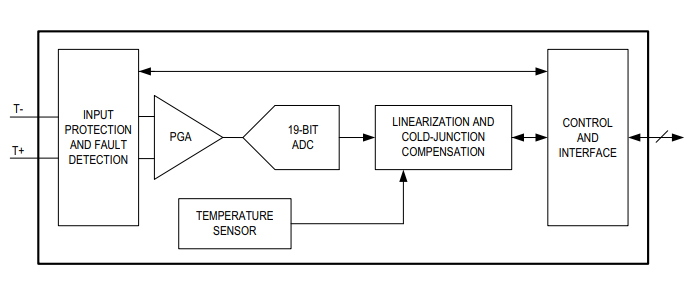
MAX31856 Block Diagram

The MAX31856 is a sophisticated thermocouple-to-digital converter with a built-in 19-bit analog-to-digital converter (ADC). Internal functions include correction for thermocouple nonlinearity, input protection, cold-junction compensation sensing and correction, a digital controller, an SPI-compatible interface, and associated control logic.

MAX31856 Applications

  • Temperature Controllers

  • Industrial Ovens, Furnaces, and Environmental

  • Chambers

  • Industrial Equipment

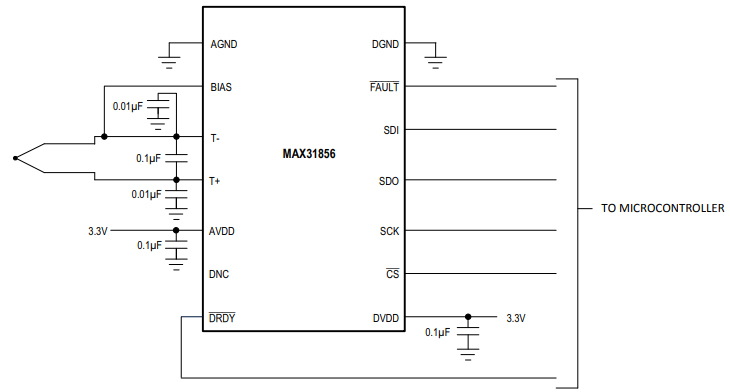
MAX31856 Application Circuit

MAX31856 Manufacturer

The market is evolving. The rules are changing. To keep your time to market short, you need integration at every level—from silicon to the supply chain. Count on Maxim Integrated to help you overcome design and architectural challenges, with integrated solutions for the industrial, medical, consumer, automotive, energy, computing, and communications realms. Maxim Integrated is also your source for power, interface, and even digital products that work in the analog world. And they’re glad to support you with reference designs, tools, technical documents, packaging, and more. We invite you to explore their latest analog integration offerings.

 

Datasheet PDF

Download datasheets and manufacturer documentation for Maxim Integrated MAX31856MUD+.

MAX31856MUD Documents

Download datasheets and manufacturer documentation for MAX31856MUD

Frequently Asked Questions

What is MAX31856?
The MAX31856 performs cold-junction compensation and digitizes the signal from any type of thermocouple. This converter resolves temperatures to 0.0078125°C, allows readings as high as +1800°C and as low as -210°C (depending on thermocouple type), and exhibits thermocouple voltage measurement accuracy of ±0.15%.
How does MAX31856 work?
The MAX31856 performs cold-junction compensation and digitizes the signal from any type of thermocouple. The output data is formatted in degrees Celsius. ... A SPI-compatible interface allows the selection of thermocouple type and setup of the conversion and fault detection processes.
FAQ
What is MAX31856?
The MAX31856 performs cold-junction compensation and digitizes the signal from any type of thermocouple. This converter resolves temperatures to 0.0078125°C, allows readings as high as +1800°C and as low as -210°C (depending on thermocouple type), and exhibits thermocouple voltage measurement accuracy of ±0.15%.
How does MAX31856 work?
The MAX31856 performs cold-junction compensation and digitizes the signal from any type of thermocouple. The output data is formatted in degrees Celsius. ... A SPI-compatible interface allows the selection of thermocouple type and setup of the conversion and fault detection processes.

TAGS

Share