Theory of Operation
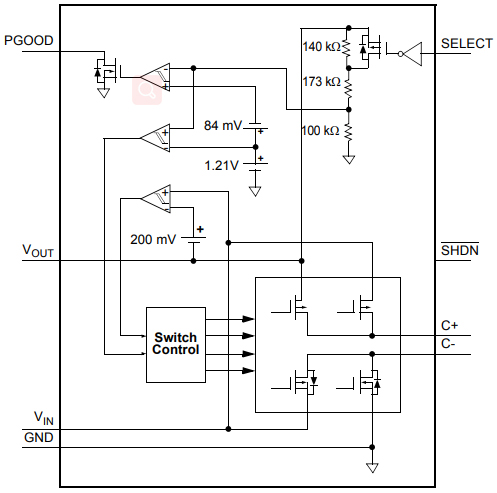
The MCP1252 and MCP1253 family of devices employ a switched capacitor charge pump to buck or boost an input supply voltage (VIN) to a regulated output voltage. The regulation control is hysteretic, otherwise referred to as a bang-bang control. The output is regulated around a fixed reference with some hysteresis. As a result, typically 50 mV of peak-to-peak ripple will be observed at the output independent of load current. The frequency of the output ripple, however, will be influenced heavily by the load current and output capacitance. The maximum frequency that will be observed is equal to the internal oscillator frequency. The devices automatically transition between buck or boost operation. This provides a low-cost, compact and simple solution for step-down/step-up DC/DC conversion. This is especially true for battery-operated applications that require a fixed output above or below the input.
Power Efficiency
The power efficiency is determined by the mode of operation. In boost mode, the efficiency is approximately half of a linear regulator. In buck mode, the efficiency is approximately equal to that of a linear regulator. The following formulas can be used to approximate the power efficiency with any significant amount of output current. At light loads, the quiescent current of the device must be taken into consideration.
Soft-Start and Short-Circuit Protection
The MCP1252 and MCP1253 feature foldback shortcircuit protection. This circuitry provides an internal soft-start function by limiting in-rush current during startup and also limits the output current to 200 mA (typical) if the output is shorted to GND. The internal soft-start circuitry requires approximately 300 µsec, typical with a 5V output, from either initial power-up or release from shutdown for the output voltage to be in regulation.
Thermal Shutdown
The MCP1252 and MCP1253 feature thermal shutdown with temperature hysteresis. When the die temperature exceeds 160°C, typically, the device shuts down. When the die cools by 15°C, typically, the device automatically turns back on. If high die temperature is caused by output overload and the load is not removed, the device will turn on and off, resulting in a pulse output.