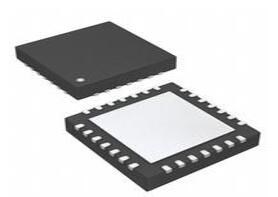
MICROCHIP MCP25625-E/ML. CAN TRANSCEIVER, 1MBPS, 1 TX/RX, QFN-28
The MCP25625 is a complete, cost-effective and small footprint CAN solution that can be easily added to a microcontroller with an available SPI interface.

MICROCHIP MCP25625-E/ML. CAN TRANSCEIVER, 1MBPS, 1 TX/RX, QFN-28 The MCP25625 is a complete, cost-effective and small footprint CAN solution that can be easily added to a microcontroller with an available SPI interface.
1567
Sep 16, 2021
Ralap Boswell
MICROCHIP MCP25625-E/ML. CAN TRANSCEIVER, 1MBPS, 1 TX/RX, QFN-28
The MCP25625 is a complete, cost-effective and small footprint CAN solution that can be easily added to a microcontroller with an available SPI interface.
MCP25625-E/ML
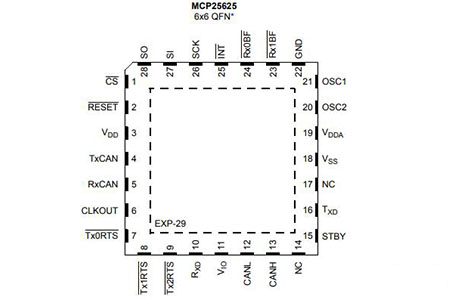
The MCP25625 is a complete, cost-effective and small footprint CAN solution that can be easily added to a microcontroller with an available SPI interface.
The MCP25625 interfaces directly with microcontrollers operating at 2.7V to 5.5V; there are no external level shifters required. In addition, the MCP25625 connects directly to the physical CAN bus, supporting all requirements for CAN high-speed transceivers.
The MCP25625 meets the automotive requirements for high-speed (up to 1 Mb/s), low quiescent current, Electromagnetic Compatibility (EMC) and Electrostatic Discharge (ESD).
Microchip Technology MCP25625-E/ML technical specifications, attributes, parameters and parts with similar specifications to Microchip Technology MCP25625-E/ML.
Microchip Technology MCP25625-E/ML technical specifications, attributes, parameters and parts with similar specifications to Microchip Technology MCP25625-E/ML.
| Product Attribute | Attribute Value | |
|---|---|---|
| Factory Lead Time | 16 Weeks | |
| Contact Plating | Tin | |
| Mount | Surface Mount | |
| Mounting Type | Surface Mount | |
| Package / Case | 28-VQFN Exposed Pad | |
| Number of Pins | 28Pins | |
| Weight | 70.788759mg | |
| Current - Supply (Nom) | 5mA | |
| Usage Level | Automotive grade | |
| Operating Temperature | -40°C~125°C | |
| Packaging | Tube | |
| Published | 2013 | |
| JESD-609 Code | e3 | |
| Part Status | Active | |
| Moisture Sensitivity Level (MSL) | 3 (168 Hours) |
| Product Attribute | Attribute Value | |
|---|---|---|
| Number of Terminations | 28Terminations | |
| Type | Transceiver | |
| Voltage - Supply | 5V | |
| Terminal Position | QUAD | |
| Terminal Form | NO LEAD | |
| Peak Reflow Temperature (Cel) | 260 | |
| Number of Functions | 1Function | |
| Terminal Pitch | 0.65mm | |
| Time@Peak Reflow Temperature-Max (s) | 40 | |
| Base Part Number | MCP25625 | |
| Current - Supply (Max) | 70mA | |
| Interface | CAN | |
| Propagation Delay | 125 ns | |
| Current - Supply | 70mA | |
| Data Rate | 1 Mbps |
| Product Attribute | Attribute Value | |
|---|---|---|
| Protocol | CANbus | |
| Number of Drivers/Receivers | 1/1Drivers/Receiver | |
| Receiver Hysteresis | 200mV | |
| Number of Transceivers | 1Transceiver | |
| Max Junction Temperature (Tj) | 150°C | |
| Ambient Temperature Range High | 125°C | |
| Number of Receive Buffers | 2Receive Buffers | |
| Number of Transmit Buffers | 3Transmit Buffers | |
| Height | 1mm | |
| Length | 6mm | |
| Width | 6mm | |
| REACH SVHC | No SVHC | |
| RoHS Status | ROHS3 Compliant | |
| Lead Free | Lead Free |
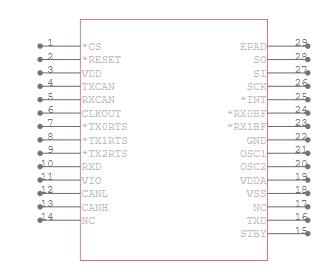
MCP25625 Symbol
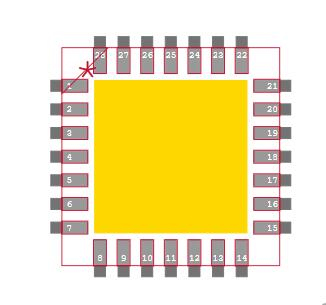
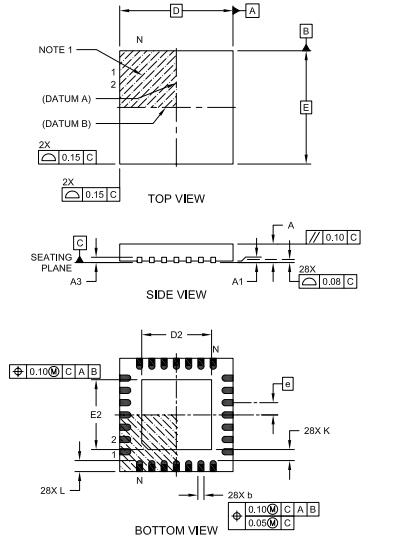
MCP25625 Footprint
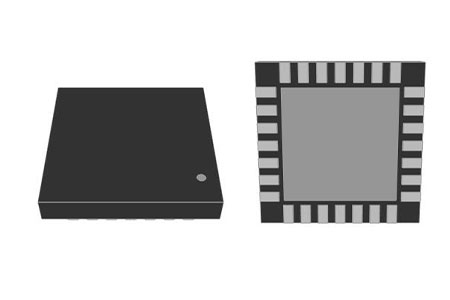
MCP25625 3D Model
• Stand-Alone CAN 2.0B Controller with Integrated CAN Transceiver and Serial Peripheral Interface (SPI)
• Up to 1 Mb/s Operation
• Very Low Standby Current (10 µA, typical)
• Up to 10 MHz SPI Clock Speed
• Interfaces Directly with Microcontrollers with 2.7V to 5.5V I/Os
• Available in SSOP-28L and 6x6 QFN-28L
• Temperature Ranges:
- Extended (E): -40°C to +125°C
Automotive
Communications & Networking
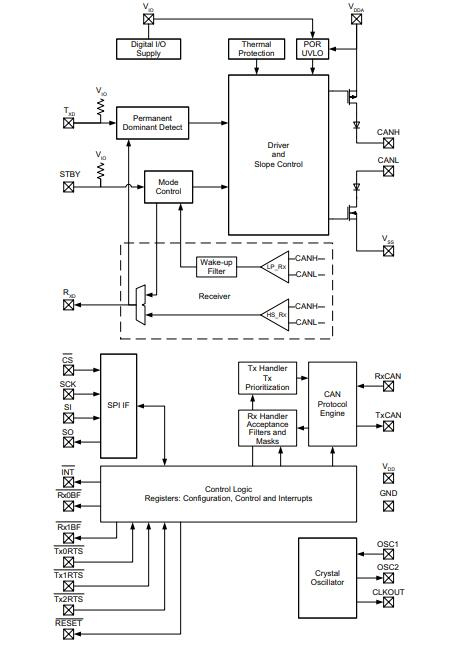
MCP25625 Block Diagram
The circuit shows an example of a typical application of the MCP25625 below. In this example, the microcontroller operates at 3.3V. VDDA supplies the CAN transceiver and must be connected to 5V. VDD, VIO of the MCP25625 are connected to the VDD of the microcontroller.
The digital supply can range from 2.7V to 5.5V. Therefore, the I/O of the MCP25625 is connected directly to the microcontroller, no level shifters are required.
The TXD and RDX pins of the CAN transceiver must be externally connected to the TxCAN and Rx pins of the CAN controller.
The SPI interface is used to configure and control the CAN controller.
The INT pin of the MCP25625 signals an interrupts to the microcontroller. Interrupts need to be cleared by the microcontroller through SPI.
The usage of RxnBF and TxnRTS is optional since the functions of these pins can be accessed through SPI. The RESET pin can optionally be pulled up to the VDD of the MCP25625 using a 10 k resistor. The CLKOUT pin provides the clock to the microcontroller.
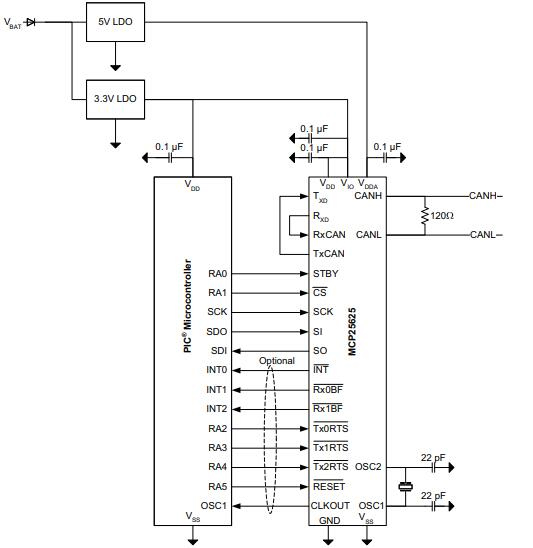
MCP25625 Typical Application Circuit
Microchip Technology Inc., is a leader that provides microcontroller and analogue semiconductors. The microchip was headquartered in Chandler, Arizona. We are dedicated to offering low-risk product development, reducing total system cost and accelerating time to market. We mainly serve different fields of customers applications around the world. To provide prominent technical support along with reliable delivery and quality is our goal.
Download datasheets and manufacturer documentation for Microchip Technology MCP25625-E/ML.
Download datasheets and manufacturer documentation for MCP25625-E/ML
TAGS
Comments