ATTENTION: Due to increased demand and order volume, processing time may take an additional 1-3 business days.
HomeCommunitySubjectMPXV7002DP Integrated Silicon: Features, Pinout, and Datasheet [Video&FAQ]

MPXV7002DP Integrated Silicon: Features, Pinout, and Datasheet [Video&FAQ]

Pressure Sensors, Transducers FREESCALE SEMICONDUCTOR MPXV7002DP. IC, PRESSURE SENSOR, -2 TO 2KPA, 1351-01

1045

Nov 27, 2021

Tammy Piers

2017 05 30 NXP MPXV7002DP Pressure Transducer Water Level


Pressure Sensors, Transducers FREESCALE SEMICONDUCTOR MPXV7002DP. IC, PRESSURE SENSOR, -2 TO 2KPA, 1351-01

MPXV7002DP is an Integrated Silicon Pressure Sensor On-Chip Signal Conditioned, Temperature Compensated and Calibrated. This article mainly introduces features, pinout, datasheet and other detailed information about NXP Semiconductors MPXV7002DP.
MPXV7002DP

715In Stock
Min.: 1 Mult.: 1
Quantity Unit Price Ext. Price
1+ $19.31089$19.31
10+ $18.21782$182.18
100+ $17.18663$1718.66
500+ $16.2138$8106.9
1000+ $15.29604$15296.04
Unit Price:$19.31089
Subtotal: $19.31
Looking for a better price? Want a lower wholesale price? Please send an RFQ, and we will respond immediately.
Quick Links

MPXV7002DP Description

The MPXV7002DP series piezoresistive transducers are cutting-edge monolithic silicon pressure sensors that are ideal for use with a microcontroller or microprocessor with A/D inputs in a variety of applications. This transducer uses advanced micromachining techniques, thin-film metallization, and bipolar processing to generate a precise, high-level analog output signal proportional to the applied pressure.

MPXV7002DP Pinout

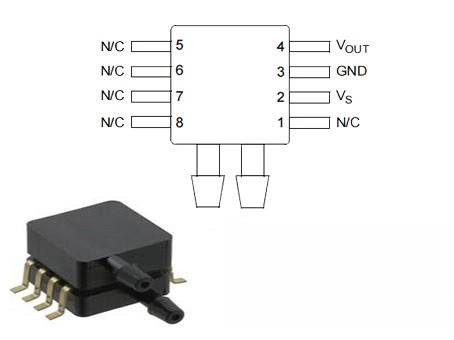
The following figure shows the Pinout of MPXV7002DP.


Pin Number Pin Name Description
1 n.c. —[1]
2 Vs Supply voltage
3 GND Ground
4 Vout Voltage output
5 n.c. —[1]
6 n.c. —[1]
7 n.c. —[1]
8 n.c. —[1]

[1] Internal device connection. Do not connect to external circuitry or ground


MPXV7002BP CAD Model

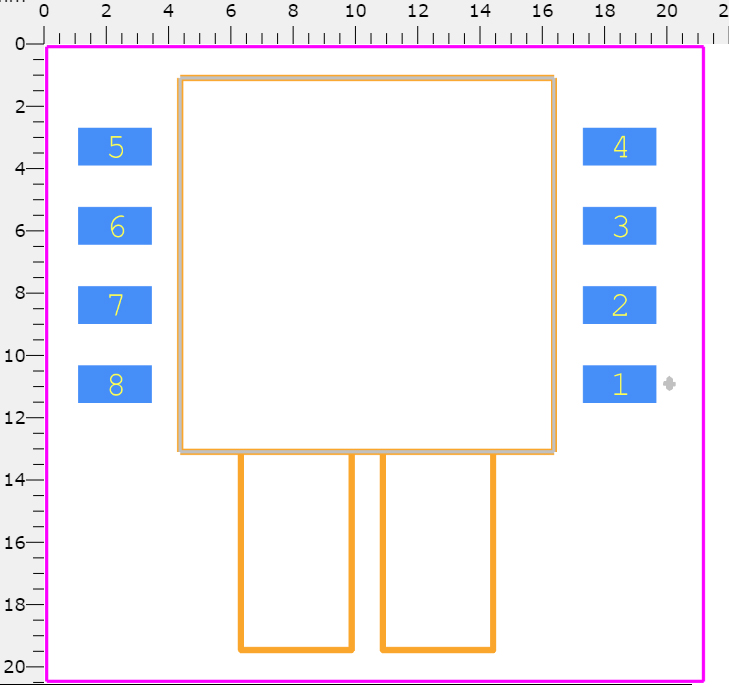
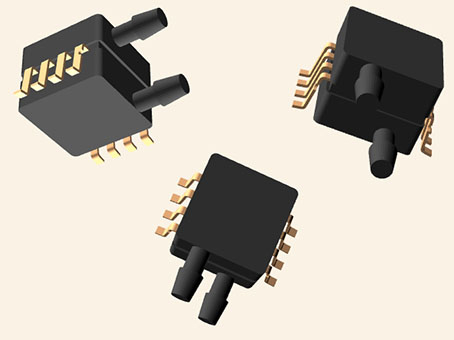
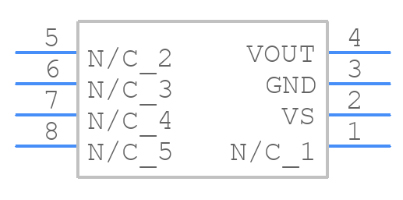
The followings are MPXV7002DP Symbol, Footprint and 3D Model.

Symbol

Footprint

3D Model

MPXV7002DP Features

• 2.5% Typical Error over +10°C to +60°C with Auto Zero

• 6.25% Maximum Error over +10°C to +60°C without Auto Zero

• Ideally Suited for Microprocessor or Microcontroller-Based Systems

• Thermoplastic (PPS) Surface Mount Package

• Temperature Compensated over +10° to +60°C

• Patented Silicon Shear Stress-Strain Gauge

• Available in Differential and Gauge Configurations

Specifications

NXP USA Inc. MPXV7002DP technical specifications, attributes, parameters and parts with similar specifications to NXP USA Inc. MPXV7002DP.

MPXV7002DP Tech Specifications

NXP USA Inc. MPXV7002DP technical specifications, attributes, parameters and parts with similar specifications to NXP USA Inc. MPXV7002DP.

Product Attribute Attribute Value
Factory Lead Time12 Weeks
Package / Case8-BSOP (0.475, 12.06mm Width) Dual Ports, Same Side
Surface MountYES
Mounting FeatureSURFACE MOUNT
Operating Temperature10°C~60°C
SeriesMPXV7002
Published2004
Part StatusActive
Moisture Sensitivity Level (MSL)Not Applicable
ECCN CodeEAR99
ApplicationsBoard Mount
HTS Code8542.39.00.01
Product Attribute Attribute Value
Voltage - Supply4.75V~5.25V
Output0.5 V ~ 4.5 V
Termination StyleGull Wing
Body Length or Diameter12.06mm
Body Breadth12.06 mm
Output TypeAnalog Voltage
Accuracy±5%
Response Time1000 µs
Operating Pressure±0.29PSI (±2kPa)
Pressure TypeDifferential
Port StyleBarbed
Port SizeMale - 0.13 3.3mm Tube Dual
Product Attribute Attribute Value
Linearity6.25 %
Maximum Pressure±10.88PSI (±75kPa)
Sensors/Transducers TypePRESSURE SENSOR,PEIZORESISTIVE
HousingPLASTIC
Pressure Range-Max0.29 Psi
Offset-Nom2.50V
FeaturesTemperature Compensated
Sensitivity (mV/V)1000 mV/V
Body Height9.65mm
RoHS StatusROHS3 Compliant
0 Products View Similar

MPXV7002DP Functional Block Diagram

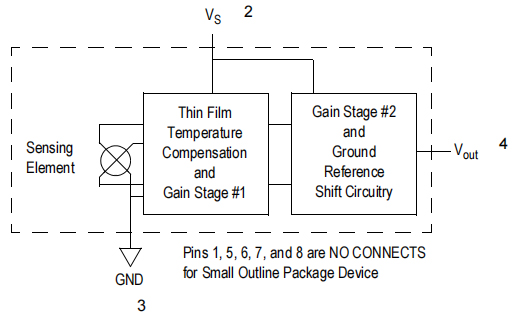
The following figure shows a block diagram of the internal circuitry integrated on a pressure sensor chip of MPXV7002DP.

Integrated Pressure Sensor Schematic

MPXV7002DP Alternatives

Part Number Description Manufacturer
MPXV7002DPT1SENSORS/TRANSDUCERS DIFFERENTIAL, PEIZORESISTIVE PRESSURE SENSOR, -.29-0.29Psi, 6.25%, 2.50-4.50V, SQUARE, SURFACE MOUNT NXP Semiconductors

MPXV7002DP Applications

• Hospital beds

• HVAC

• Respiratory systems

• Process control

• Sensing & Instrumentation

• Automotive

MPXV7002DP Package

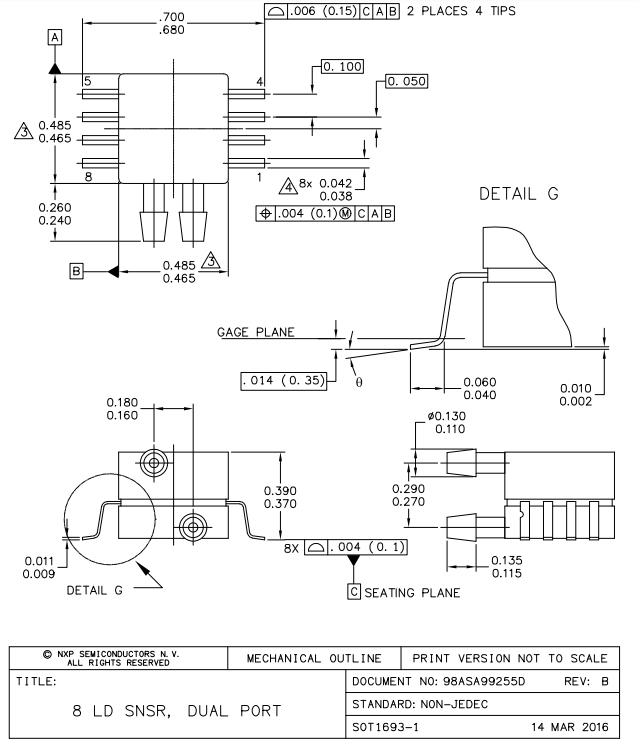
The following figure is the Package of MPXV7002DP.

Package

MPXV7002DP Manufacturer

NXP Semiconductors N.V., headquartered in Eindhoven, Netherlands, is a Dutch multinational semiconductor manufacturer specializing in the automotive industry. The company employs about 31,000 people in over 35 locations, including 11,200 engineers in 33 countries.

Datasheet PDF

Download datasheets and manufacturer documentation for NXP USA Inc. MPXV7002DP.

MPXV7002DP Documents

Download datasheets and manufacturer documentation for MPXV7002DP

PCN Packaging
12NC 27/Nov/2016
Datasheets
MPXV7002 Series
Environmental Information
NXP RoHS3 Cert

Frequently Asked Questions

How to connect the pressure sensor MPXV7002DP with the AD acquisition port of the single-chip microcomputer?
The output of MPXV7002DP can be connected to the input of AD.
What are the characteristics of diffused silicon pressure sensors?
Compared with other types of sensors, the diffusion silicon pressure sensor has the following characteristics: 1. Suitable for making small-scale sensors. The piezoresistive effect of the force-sensitive resistor of the silicon chip has no dead zone in the low range near the zero point, and the range of the pressure sensor can be as small as several Kpa. 2. High output sensitivity. The sensitivity factor of silicon strain resistance is 50 to 100 times higher than that of a metal strain gauge, so the sensitivity of the corresponding sensor is very high, and the general range output is about 100mv. Therefore, there are no special requirements for the interface circuit, and it is more convenient to use. 3. High precision. Since the sensing, sensitive conversion and detection of the sensor are realized by the same component, there is no intermediate conversion link, and the repeatability and hysteresis error are small. Since the monocrystalline silicon itself has high rigidity and small deformation, good linearity is ensured. 4. Since the unisexual deformation of the work is as low as the order of micro-strain, the maximum displacement of the elastic chip is in the order of sub-micron, so there is no wear, no fatigue, no aging, and the life span is as long as 1×10³ pressure cycle, with stable performance and high reliability. 5. Due to the excellent chemical corrosion resistance of silicon, even non-isolated diffused silicon pressure sensors have the ability to adapt to various media to a considerable extent. 6. Since the chip adopts an integrated process and has no transmission parts, it is small in size and light in weight.
What should be paid attention to when using a diffused silicon pressure sensor?
1. Temperature compensation, the diffusion silicon pressure sensor is a semiconductor, and the semiconductor has strong temperature characteristics. Without temperature compensation, the measurement error may be relatively large. 2. The sensing diaphragm of the diffused silicon pressure sensor is only a few tens of silk meters thick and must not be touched. 3. The power supply voltage should be stable. The inside of the sensor is actually a bridge. The fluctuation of the power supply voltage will cause the output of the bridge circuit to change and affect the measurement accuracy. 4. To be used within the rated voltage, overvoltage will cause damage to the sensor. 5. Do not short-circuit the output.
FAQ
How to connect the pressure sensor MPXV7002DP with the AD acquisition port of the single-chip microcomputer?
The output of MPXV7002DP can be connected to the input of AD.
What are the characteristics of diffused silicon pressure sensors?
Compared with other types of sensors, the diffusion silicon pressure sensor has the following characteristics: 1. Suitable for making small-scale sensors. The piezoresistive effect of the force-sensitive resistor of the silicon chip has no dead zone in the low range near the zero point, and the range of the pressure sensor can be as small as several Kpa. 2. High output sensitivity. The sensitivity factor of silicon strain resistance is 50 to 100 times higher than that of a metal strain gauge, so the sensitivity of the corresponding sensor is very high, and the general range output is about 100mv. Therefore, there are no special requirements for the interface circuit, and it is more convenient to use. 3. High precision. Since the sensing, sensitive conversion and detection of the sensor are realized by the same component, there is no intermediate conversion link, and the repeatability and hysteresis error are small. Since the monocrystalline silicon itself has high rigidity and small deformation, good linearity is ensured. 4. Since the unisexual deformation of the work is as low as the order of micro-strain, the maximum displacement of the elastic chip is in the order of sub-micron, so there is no wear, no fatigue, no aging, and the life span is as long as 1×10³ pressure cycle, with stable performance and high reliability. 5. Due to the excellent chemical corrosion resistance of silicon, even non-isolated diffused silicon pressure sensors have the ability to adapt to various media to a considerable extent. 6. Since the chip adopts an integrated process and has no transmission parts, it is small in size and light in weight.
What should be paid attention to when using a diffused silicon pressure sensor?
1. Temperature compensation, the diffusion silicon pressure sensor is a semiconductor, and the semiconductor has strong temperature characteristics. Without temperature compensation, the measurement error may be relatively large. 2. The sensing diaphragm of the diffused silicon pressure sensor is only a few tens of silk meters thick and must not be touched. 3. The power supply voltage should be stable. The inside of the sensor is actually a bridge. The fluctuation of the power supply voltage will cause the output of the bridge circuit to change and affect the measurement accuracy. 4. To be used within the rated voltage, overvoltage will cause damage to the sensor. 5. Do not short-circuit the output.

TAGS

Share