ATTENTION: Due to increased demand and order volume, processing time may take an additional 1-3 business days.
HomeCommunitySubjectNE556 Dual Timer IC: Circuit, Pinout and Datasheet

NE556 Dual Timer IC: Circuit, Pinout and Datasheet

STMICROELECTRONICS - NE556N - IC, TIMER DUAL, DIP14, 556 NE556 is a General Purpose Dual Bopolar Timers IC.This article mainly introduce its circuit,

499

Jun 29, 2021

Jason Maxwell

NE556 Sequential Timer Circuit


STMICROELECTRONICS - NE556N - IC, TIMER DUAL, DIP14, 556

NE556 is a General Purpose Dual Bopolar Timers IC.This article mainly introduce its circuit, pinout, datasheet and other detailed information about STMicroelectronics NE556.

NE556N

25In Stock
Min.: 1 Mult.: 1
Price not displayed? Not available to buy online? Please send an RFQ, and we will respond immediately.
Quick Links

NE556 Description

The NE556 dual single-chip timing circuit is a highly stable controller that can generate accurate Time delay or oscillation. In delay mode Operation, time is precisely controlled An external resistor and capacitor. For stability Runs as an oscillator with accurate free-running frequency and duty cycle Controlled by two external resistors and one capacitor. The circuit may be triggered and reset on falling Waveform, the output structure can be source or The current can reach 200mA.


NE556 Pinout

NE556 has total 14 pins, seven on right and seven on the left side of the base. 

NE556 Pinout is shown in the figure given below.

NE556 Features

The NE556 Timer IC has the following features:

■ Low closing time

■ Maximum operating frequency greater than 500kHz

■ From microseconds to hour

■ In stable and monostable mode

■ High output current tank source or absorb 200mA

■ Adjustable duty cycle

■ TTL compatible

■ 0.005% temperature stability PER°C

Specifications

STMicroelectronics NE556N technical specifications, attributes, parameters and parts with similar specifications to STMicroelectronics NE556N.

NE556N Tech Specifications

STMicroelectronics NE556N technical specifications, attributes, parameters and parts with similar specifications to STMicroelectronics NE556N.

Product Attribute Attribute Value
MountThrough Hole
Mounting TypeThrough Hole
Package / Case14-DIP (0.300, 7.62mm)
Number of Pins14Pins
Weight1.620005g
Operating Temperature0°C~70°C
PackagingTube
JESD-609 Codee4
Part StatusObsolete
Moisture Sensitivity Level (MSL)1 (Unlimited)
Number of Terminations14Terminations
ECCN CodeEAR99
Type555 Type, Timer/Oscillator (Dual)
Product Attribute Attribute Value
Terminal FinishNickel/Palladium/Gold (Ni/Pd/Au)
Voltage - Supply4.5V~16V
Number of Functions2Functions
Supply Voltage5V
Current Rating20A
Frequency500kHz
Base Part NumberNE556
Pin Count14
Supply Voltage-Max (Vsup)16V
Power Supplies5/15V
Supply Voltage-Min (Vsup)4.5V
Number of Channels2Channels
Operating Supply Current20mA
Product Attribute Attribute Value
Nominal Supply Current20mA
Output Current200mA
Quiescent Current4mA
High Level Output Current-200mA
Low Level Output Current200mA
Height3.3mm
Length19.05mm
Width6.35mm
REACH SVHCNo SVHC
Radiation HardeningNo
RoHS StatusROHS3 Compliant
Lead FreeLead Free
0 Products View Similar

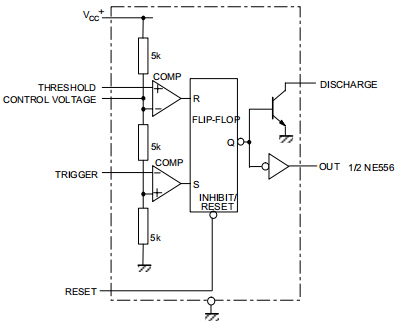
NE556 Block Diagram

Having a look at its block diagram, we can better understand NE556's working principle.

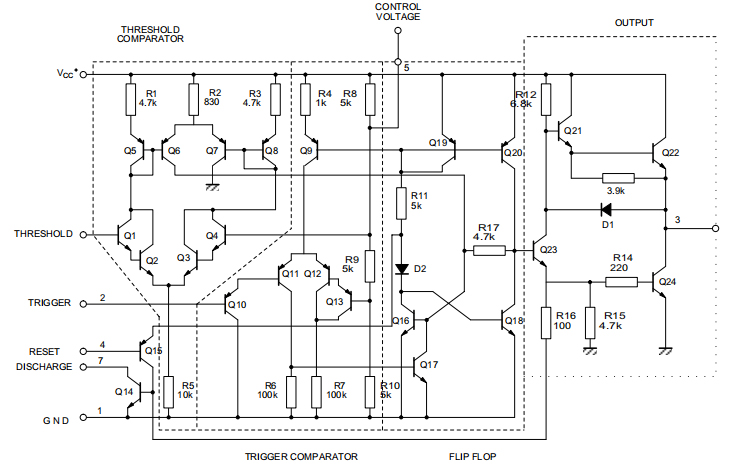
NE556 Schematic Diagram

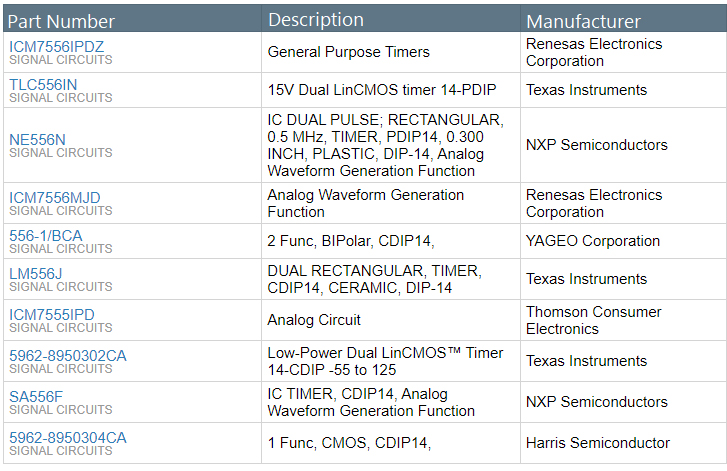
NE556 Alternatives

Where to use NE556

The NE556 IC is the dual version of NE555 IC, meaning the NE556 has two timers inside it. As we know 555 ICs have been used for a long time now due to their reliable properties and applications. The NE556 can also be used for all those application additionally since this works with CMOS technology we can have two timers inside a single package with improved characteristics.

So if you are looking for a modern replacement for the 555 Timer IC then NE556 might be the right choice for you.

How to use NE556

Application wise both NE555 and NE556 are one and the same, so if you want to know the basic of the Timer IC then read through the NE555 page. Since the NE556 is a 14-pin dual timer package there are two sets of all the timer pins (Threshold, Out, Trigger, Control Voltage, Discharge) and both the timer share the same Vcc and ground pins.

Timer IC’s are the most commonly used ICs for timing and Pulse generation applications. They can adopt itself into various applications due to its different operating modes. They are very simple to understand and if we take a look at the components present inside as shown below.

There are three resistors of value 5K, which gives this IC it’s iconic name “555 Timer”. It has dual comparators and flip-flop which will make this IC operated in three different modes such as Astable, Monostable and Bistable(Schimitt) Mode.  

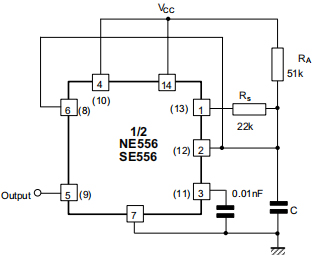
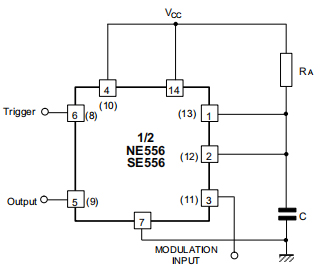
NE556 Typical Application

50% DUTY CYCLE OSCILLATOR


ASTABLE OPERATION


MONOSTABLE OPERATION


PULSE WIDTH MODULATOR


TONE BURST GENERATOR


NE556 Applications

Applications play an important role in a device. Ne556 has the following applications.

■  Pulse shaping circuit

■  Tone generator

■  Divider

■  Missing pixel

■  detectorIndustrial control

■  Touch toe encoder


NE556 Manufacturer

STMicroelectronics is a global independent semiconductor company and is a leader in developing and delivering semiconductor solutions across the spectrum of microelectronics applications. An unrivaled combination of silicon and system expertise, manufacturing strength, Intellectual Property (IP) portfolio and strategic partners positions the Company at the forefront of System-on-Chip (SoC) technology and its products play a key role in enabling today's convergence trends.

Datasheet PDF

Download datasheets and manufacturer documentation for STMicroelectronics NE556N.

NE556N Documents

Download datasheets and manufacturer documentation for NE556N

Frequently Asked Questions

1.What is the working principle of NE556?
NE556=NE555 X 2 is a dual time base integrated circuit. There are two 555 time base circuits inside NE556, because they are packaged in one chip, they can get better consistency. In addition, NE556 is a bipolar circuit with a large output drive capability, the output current can reach 200MA, and the operating frequency range can reach 01001Hz~500kHz.
2.If I use NE556 as a single delay circuit, what should I do with the rest of the pins?
The unused feet can completely ignore it.
3.How to test the quality of NE556 in the circuit, only have the digital meter?
Use DC5V power supply, after a resistance attenuation, a button, connect one end of the optocoupler input, the other end is grounded, one end of the optocoupler output end is connected to +5V via a pull-up resistor, the other end is connected to the LED display, and LED- is grounded.
4.How to call NE556 in multisim10?
NE556 is a dual-channel timer, while 555 is a single-channel timer. There is no NE556 in multisim10, so two 555 timers can be used instead of one NE556.
5.What’s the difference between the dual time base integrated chip LM556 and NE556?
There are subtle differences. If used as an oscillator, NE is more stable than LM.
FAQ
1.What is the working principle of NE556?
NE556=NE555 X 2 is a dual time base integrated circuit. There are two 555 time base circuits inside NE556, because they are packaged in one chip, they can get better consistency. In addition, NE556 is a bipolar circuit with a large output drive capability, the output current can reach 200MA, and the operating frequency range can reach 01001Hz~500kHz.
2.If I use NE556 as a single delay circuit, what should I do with the rest of the pins?
The unused feet can completely ignore it.
3.How to test the quality of NE556 in the circuit, only have the digital meter?
Use DC5V power supply, after a resistance attenuation, a button, connect one end of the optocoupler input, the other end is grounded, one end of the optocoupler output end is connected to +5V via a pull-up resistor, the other end is connected to the LED display, and LED- is grounded.
4.How to call NE556 in multisim10?
NE556 is a dual-channel timer, while 555 is a single-channel timer. There is no NE556 in multisim10, so two 555 timers can be used instead of one NE556.
5.What’s the difference between the dual time base integrated chip LM556 and NE556?
There are subtle differences. If used as an oscillator, NE is more stable than LM.

TAGS

Share