ATTENTION: Due to increased demand and order volume, processing time may take an additional 1-3 business days.
HomeCommunitySubjectNRF51822 Multiprotocol Bluetooth: Schematic, Pinout, and Datasheet

NRF51822 Multiprotocol Bluetooth: Schematic, Pinout, and Datasheet

RF Transceiver ICs Bluetooth v4.0 SMART SOC 2Mbps 3V 48-Pin QFN EP For ULP wireless applications, the nRF51822 is a capable multiprotocol single-chip solution.

184

Nov 15, 2021

Poppy Alfred

Programming Bluetooth LE with nRF51822 (Arduino IDE BLE400)


RF Transceiver ICs Bluetooth v4.0 SMART SOC 2Mbps 3V 48-Pin QFN EP

For ULP wireless applications, the nRF51822 is a capable multiprotocol single-chip solution. It has Nordic's latest best-in-class performance radio transceiver, as well as an ARM® Cortex™ M0 CPU, 256kB/128kB flash memory, and 32kB/16kB RAM memory. This article mainly introduces schematic, pinout, datasheet and other detailed information about Nordic Semiconductor ASA NRF51822.
NRF51822-QFAA-R

12828In Stock
Min.: 1 Mult.: 1
Quantity Unit Price Ext. Price
1+ $6.10682$6.11
10+ $5.76115$57.61
100+ $5.43505$543.51
500+ $5.12741$2563.71
1000+ $4.83718$4837.18
Unit Price:$6.10682
Subtotal: $6.11
Looking for a better price? Want a lower wholesale price? Please send an RFQ, and we will respond immediately.
Quick Links

NRF51822 Description

ULP wireless System-on-Chip 

For ULP wireless applications, the nRF51822 is a capable multiprotocol single chip solution. It has Nordic's latest best-in-class performance radio transceiver, as well as an ARM® Cortex™ M0 CPU, 256kB/128kB flash memory, and 32kB/16kB RAM memory. Bluetooth® low energy (previously known as  Bluetooth Smart ) and 2.4 GHz protocol stacks are supported by the nRF51822.

Lower power and higher performance

The nRF51822 is equipped with a 32-bit ARM Cortex  M0 MCU with a large amount of flash memory  (256kB/128kB overall, with 40kB-180kB available for program development). When compared to 8/16-bit platforms, code density and execution speed are significantly higher. The PPI system provides a 16-channel bus for direct and autonomous system peripheral communication without the need for CPU  intervention. This results in predictable latency periods for peripheral-to-peripheral interaction, as well as power savings by leaving the CPU  inactive. The device has two global power modes: ON/OFF, however, all system blocks and peripherals have unique power management controls, allowing for automatic RUN/IDLE switching for system blocks based only on those required/not required to complete certain tasks.

The performance of the nRF51822 is based on the new radio. The radio supports Bluetooth low energy and is backwards compatible with Nordic Semiconductor's nRF24L Series products. The output power can now be scaled in 4dB increments from a maximum of +4dBm to -20dBm. Sensitivity is improved at every level, with sensitivity levels ranging from -96 to -85dBm (depending on data rate), with -93dBm for Bluetooth low energy.

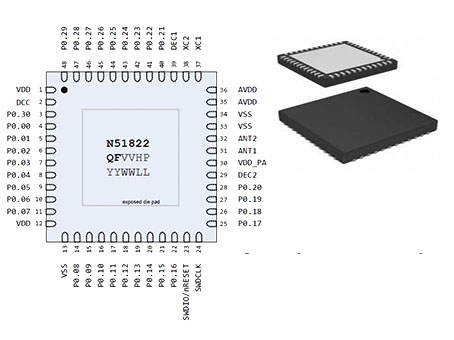
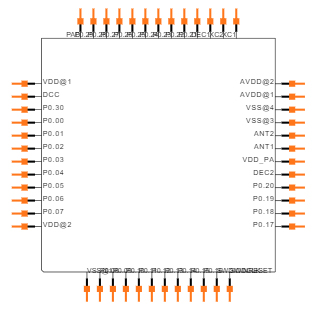
NRF51822 Pinout

NRF51822 CAD Model

Symbol

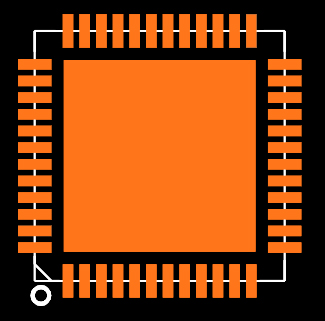
Footprint

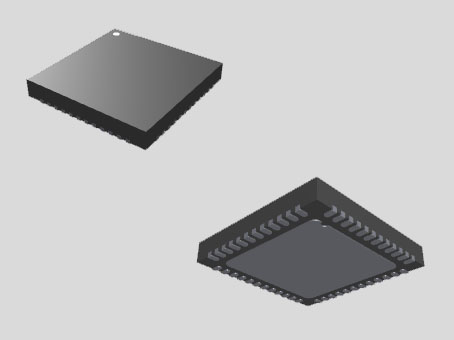
3D Model

NRF51822 Features

• Multiprotocol 2.4GHz radio

• 32-bit ARM Cortex M0 processor

• 256kB/128kB flash and 32kB/16kB RAM

• Software stacks available as downloads

• Pin compatible with other nRF51 Series devices

• Application development independent from protocol stack

• Fully on-air compatible with nRF24L Series

• Programmable output power from +4dBm to -20dBm

• RSSI

• RAM mapped FIFOs using EasyDMA

• Dynamic on air payload length up to 256 Bytes

• Flexible and configurable 31 pin GPIO

• Programmable Peripheral Interface – PPI

• Simple ON/OFF global power modes

• Full set of digital interfaces including: SPI/2-wire/UART

• 10-bit ADC

• 128-bit AES ECB/CCM/AAR co-processor

• Quadrature demodulator

• Low cost external crystal 16MHz ± 40ppm

• Low power 16MHz crystal and RC oscillators

• Ultra low power 32kHz crystal and RC oscillators

• Wide supply voltage range (1.8 V to 3.6 V)

• On-chip DC/DC buck converter

• Individual power management for all peripherals

• Package options: 48-pin 6x6 QFN/WLCSP, Thin-CSP

Specifications

Nordic Semiconductor ASA NRF51822-QFAA-R technical specifications, attributes, parameters and parts with similar specifications to Nordic Semiconductor ASA NRF51822-QFAA-R.

NRF51822-QFAA-R Tech Specifications

Nordic Semiconductor ASA NRF51822-QFAA-R technical specifications, attributes, parameters and parts with similar specifications to Nordic Semiconductor ASA NRF51822-QFAA-R.

Product Attribute Attribute Value
Factory Lead Time20 Weeks
Mounting TypeSurface Mount
Package / Case48-VFQFN Exposed Pad
Surface MountYES
Number of Pins48Pins
Operating Temperature-25°C~75°C
PackagingTape & Reel (TR)
Published2007
Part StatusActive
Moisture Sensitivity Level (MSL)3 (168 Hours)
Number of Terminations48Terminations
TypeTxRx + MCU
HTS Code8542.39.00.01
Product Attribute Attribute Value
Voltage - Supply1.8V~3.6V
Terminal PositionQUAD
Number of Functions1Function
Supply Voltage1.8V
Terminal Pitch0.4mm
Frequency2.4GHz
Operating Supply Voltage3.6V
InterfaceI2C, SPI, UART
Memory Size256kB Flash 16kB RAM
RAM Size16kB
Data Bus Width32b
ProtocolBluetooth v4.0
Core ArchitectureARM
Product Attribute Attribute Value
Power - Output4dBm
RF Family/StandardBluetooth, General ISM > 1GHz
Data Rate (Max)2Mbps
Serial InterfacesI2C, SPI, UART
Current - Receiving9.7mA~13.4mA
Current - Transmitting4.7mA~16mA
ModulationGFSK
Sensitivity (dBm)-96 dBm
GPIO32
Length6mm
Height Seated (Max)0.95mm
Radiation HardeningNo
RoHS StatusROHS3 Compliant
0 Products View Similar

NRF51822 Schematic

NRF51822 Layout

NRF51822 Applications

• Bluetooth low energy applications

• Wearables

• Beacons

• Appcessories

• Computer peripherals

• CE remote controls for TV, STB and media systems

• Proximity and security alert tags

• Sports- and fitness sensors

• Healthcare and lifestyle sensors

• Game controllers for computers

• Toys and Electronic games

• Domestic/Industrial control and data-acquisition

• Intelligent domestic appliances

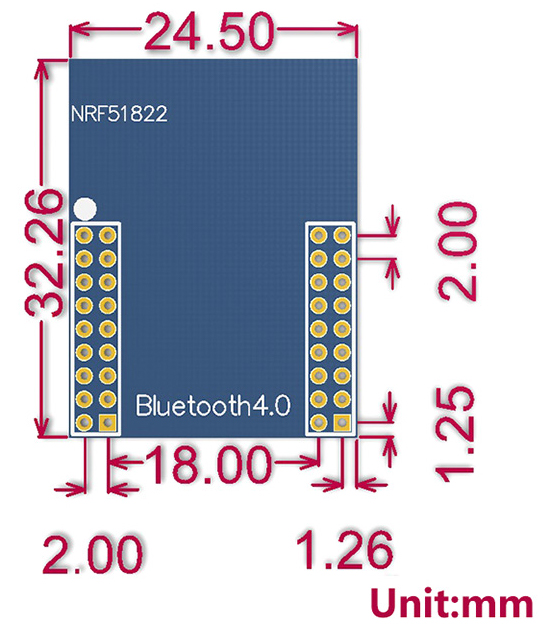
NRF51822 Dimension

NRF51822 Manufacturer

Nordic Semiconductor is a fabless semiconductor business that focuses on short-range wireless and low-power cellular  IoT  applications. Nordic developed Bluetooth Low Energy, a widely used wireless technology, and pioneered ultra-low-power wireless. The company's award-winning Bluetooth LE solutions have propelled it to the top of the industry, and  ANT+ , Thread, and  Zigbee  products round out the offering. Nordic's reputation is built on providing cutting-edge wireless technology and development tools that protect designers from the complexities of RF. This philosophy is carried over to Nordic's newest technology, cellular IoT. This  NB-IoT  and  LTE-M  solution, which was launched in 2018 after four years of research, uses cellular infrastructure to extend the IoT.

Datasheet PDF

NRF51822-QFAA-R Documents

Download datasheets and manufacturer documentation for NRF51822-QFAA-R

Frequently Asked Questions

1.What is the reason that NRF51822 Bluetooth is easy to disconnect?
(1)Weak signal, resulting in disconnection: poor antenna matching, low transmit power, and poor sensitivity lead to weak signal; weak signal caused by the too-long distance between transceiver modules; weak signal caused by the shielding of the antenna receiving equipment. (2)The amount of transmitted data is large and the data flow is high, and the program may run away and cause disconnection. (3)There are a large number of other wireless signals in the Bluetooth frequency band (2.4 frequency band), which may cause crosstalk and cause disconnection. The chip used in SKYLAB's Bluetooth module is nRF51822.
2.Is NRF51822 Bluetooth 4.0 or low power consumption?
NRF51822 (128kB) will bring the same industry's first multi-protocol wireless capability and a 32-bit ARM Cortex-M0 processor optimized for ultra-low power wireless applications, bringing -92.5dB RX sensitivity to Bluetooth low energy mode It can bring up to +4dBm output power for all modes, increase the link budget by up to 9.5dBm compared with the original industry-leading Nordic chip and bring a peak current of less than 10mA for the 3V battery, which can extend the battery life. Months or years (depending on the application). Like the existing nRF51822, the new nRF51822 128kB is also 100% compatible with Nordic's existing nRF24L series IC (integrated circuit or chip) in the air.
3.How to do NRF51822 I/O mapping?
For example, if your IO port is to be a UART serial port, you only need to set the PSEL (pin selection) register of the UART to this IO port. Each peripheral module such as SPI, ADC, etc. will have a register for IO port selection, and the setting can achieve the mapping effect you want.
FAQ
1.What is the reason that NRF51822 Bluetooth is easy to disconnect?
(1)Weak signal, resulting in disconnection: poor antenna matching, low transmit power, and poor sensitivity lead to weak signal; weak signal caused by the too-long distance between transceiver modules; weak signal caused by the shielding of the antenna receiving equipment. (2)The amount of transmitted data is large and the data flow is high, and the program may run away and cause disconnection. (3)There are a large number of other wireless signals in the Bluetooth frequency band (2.4 frequency band), which may cause crosstalk and cause disconnection. The chip used in SKYLAB's Bluetooth module is nRF51822.
2.Is NRF51822 Bluetooth 4.0 or low power consumption?
NRF51822 (128kB) will bring the same industry's first multi-protocol wireless capability and a 32-bit ARM Cortex-M0 processor optimized for ultra-low power wireless applications, bringing -92.5dB RX sensitivity to Bluetooth low energy mode It can bring up to +4dBm output power for all modes, increase the link budget by up to 9.5dBm compared with the original industry-leading Nordic chip and bring a peak current of less than 10mA for the 3V battery, which can extend the battery life. Months or years (depending on the application). Like the existing nRF51822, the new nRF51822 128kB is also 100% compatible with Nordic's existing nRF24L series IC (integrated circuit or chip) in the air.
3.How to do NRF51822 I/O mapping?
For example, if your IO port is to be a UART serial port, you only need to set the PSEL (pin selection) register of the UART to this IO port. Each peripheral module such as SPI, ADC, etc. will have a register for IO port selection, and the setting can achieve the mapping effect you want.

TAGS

Share