ATTENTION: Due to increased demand and order volume, processing time may take an additional 1-3 business days.
HomeCommunitySubjectPIC16F676 Microcontroller: Features, Pinout, and Datasheet

PIC16F676 Microcontroller: Features, Pinout, and Datasheet

Embedded - Microcontrollers A/D 8x10b 14-SOIC (0.154, 3.90mm Width) 1.8kB Brown-out Detect/Reset, POR, WDT -40°C~125°C TA 2V~5.5V PIC? 16F MICROCONTROLLER, RISC PIC16F676 20MHz MCU 8-bit PIC16 PIC RISC 1.75KB Flash 2.5V/3.3V/5V 14-Pin SOIC N T/R

188

Oct 24, 2021

Cora Arnold

Make Digital Volt Meter Using PIC16F676 Microchip & 7 Segment Display | Get Circuit Diagram & Code


Embedded - Microcontrollers A/D 8x10b 14-SOIC (0.154, 3.90mm Width) 1.8kB Brown-out Detect/Reset, POR, WDT -40°C~125°C TA 2V~5.5V PIC® 16F MICROCONTROLLER, RISC PIC16F676 20MHz MCU 8-bit PIC16 PIC RISC 1.75KB Flash 2.5V/3.3V/5V 14-Pin SOIC N T/R

PIC16F676 is a MICROCHIP TECHNOLOGY microcontroller from the 'PIC16F' series which has developed this 8-bit CMOS PIC microcontroller based on Flash. This article mainly introduces features, pinout, datasheet and other detailed information about Microchip Technology PIC16F676.


PIC16F676T-E/SL

43In Stock
Min.: 1 Mult.: 1
Quantity Unit Price Ext. Price
1+ $2.8778$2.88
10+ $2.71491$27.15
100+ $2.56123$256.12
500+ $2.41626$1208.13
1000+ $2.27949$2279.49
Unit Price:$2.8778
Subtotal: $2.88
Looking for a better price? Want a lower wholesale price? Please send an RFQ, and we will respond immediately.
Quick Links

PIC16F676 Description

PIC16F676 is a MICROCHIP TECHNOLOGY microcontroller from the 'PIC16F' series which has developed this 8-bit CMOS PIC microcontroller based on Flash. It has a 14-pin interface and a high-performance RISC CPU, making it an excellent choice for a wide range of electronic applications, including embedded systems and industrial automation. This little chip has everything you'll need to create customized student projects. 


Although memory space and pin count are limited when compared to other PIC controllers, flash-based technology allows this device to communicate with external devices. It's popular with amateurs and engineers because of its features, low cost, and tiny size.

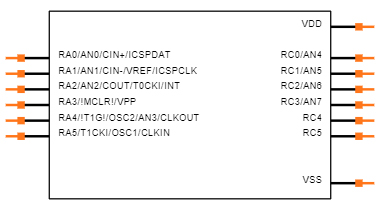
PIC16F676 Pinout

Pinout


Pin Number Pin Name Function Description
13 RA0/AN0/CIN+/ICSPDAT RA0 Bidirectional I/O w/ programmable pull-up and interrupt-on-change.
AN0 AN0 AN — A/D Channel 0 input.
CIN+ CIN+ AN Comparator input.
ICSPDAT Serial Programming Data I/O.
12 RA1/AN1/CIN-/VREF/ICSPCLK RA1 Bidirectional I/O w/ programmable pull-up and interrupt-on-change.
AN1 A/D Channel 1 input.
CIN- Comparator input.
VREF External Voltage reference.
ICSPCLK Serial Programming Clock.
11 RA2/AN2/COUT/T0CKI/INT RA2 Bidirectional I/O w/ programmable pull-up and interrupt-on-change.
AN2 A/D Channel 2 input.
COUT Comparator output.
T0CKI Timer0 clock input.
INT External Interrupt.
4 RA3/MCLR/VPP RA3 Input port with interrupt-on-change.
MCLR Master Clear.
VPP Programming voltage.
3 RA4/T1G/AN3/OSC2/CLKOUT RA4 Bidirectional I/O w/ programmable pull-up and interrupt-on-change.
T1G Timer1 gate.
AN3 A/D Channel 3 input.
OSC2 Crystal/Resonator.
CLKOUT FOSC/4 output.
2 RA5/T1CKI/OSC1/CLKIN RA5 Bidirectional I/O w/ programmable pull-up and interrupt-on-change.
T1CKI Timer1 clock.
OSC1 Crystal/Resonator.
CLKIN External clock input/RC oscillator connection.
10 RC0/AN4 RC0 Bidirectional I/O.
AN4 A/D Channel 4 input.
9 RC1/AN5 RC1 Bidirectional I/O.
AN5 A/D Channel 5 input.
8 RC2/AN6 RC2 Bidirectional I/O.
AN6 A/D Channel 6 input.
7 RC3/AN7 RC3 Bidirectional I/O.
AN7 A/D Channel 7 input.
6 RC4 RC4 Bidirectional I/O.
5 RC5 RC5 Bidirectional I/O.
14 VSS VSS Ground reference.
1 VDD VDD Positive supply.

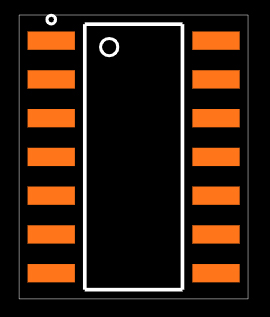
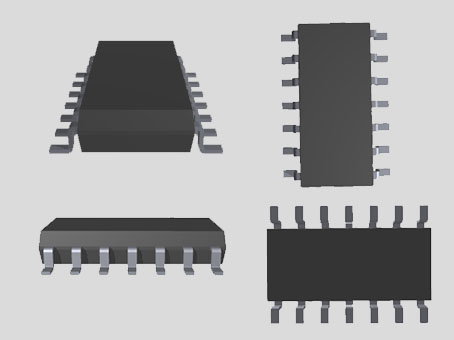
PIC16F676 CAD Model

Symbol

Footprint

3D Model

PIC16F676 Features

(1) High-Performance RISC CPU

• Only 35 Instructions to Learn

- All single-cycle instructions except branches

• Operating Speed:

- DC – 20 MHz oscillator/clock input

- DC – 200 ns instruction cycle

• Interrupt Capability

• 8-level Deep Hardware Stack

• Direct, Indirect, and Relative Addressing modes

(2) Special Microcontroller Features

• Internal and External Oscillator Options

- Precision Internal 4 MHz oscillator factory calibrated to ±1%

- External Oscillator support for crystals and resonators

- 5 μs wake-up from Sleep, 3.0V, typical

• Power-Saving Sleep mode

• Wide Operating Voltage Range – 2.0V to 5.5V

• Industrial and Extended Temperature Range

• Low-Power Power-on Reset (POR)

• Power-up Timer (PWRT) and Oscillator Start-up Timer (OST)

• Brown-out Detect (BOD)

• Watchdog Timer (WDT) with Independent Oscillator for Reliable Operation

• Multiplexed MCLR/Input-pin

• Interrupt-on-Pin Change

• Individual Programmable Weak Pull-ups

• Programmable Code Protection

• High Endurance Flash/EEPROM cell

- 100,000 write Flash endurance

- 1,000,000 write EEPROM endurance

- Flash/data EEPROM retention: > 40 years

(3) Low-Power Features

• Standby Current

- 1 nA @ 2.0V, typical

• Operating Current

- 8.5 μA @ 32 kHz, 2.0V, typical

- 100 μA @ 1 MHz, 2.0V, typical

• Watchdog Timer Current

- 300 nA @ 2.0V, typical

• Timer1 Oscillator Current

- 4 μA @ 32 kHz, 2.0V, typical

(4) Peripheral Features

• 12 I/O Pins with Individual Direction Control

• High Current Sink/Source for Direct LED Drive

• Analog Comparator module with:

- One analog comparator

- Programmable on-chip comparator voltage reference (CVREF) module

- Programmable input multiplexing from device inputs

- Comparator output is externally accessible

• Analog-to-Digital Converter module (PIC16F676)

- 10-bit resolution

- Programmable 8-channel input

- Voltage reference input

• Timer0: 8-bit Timer/Counter with 8-bit Programmable Prescaler

• Enhanced Timer1

- 16-bit timer/counter with Prescaler

- External Gate Input mode

- Option to use OSC1 and OSC2 in LP mode as Timer1 oscillator, if INTOSC mode selected

• In-Circuit Serial ProgrammingTM (ICSPTM) via two pins

Specifications

PIC16F676T-E/SL Tech Specifications

Microchip Technology PIC16F676T-E/SL technical specifications, attributes, parameters and parts with similar specifications to Microchip Technology PIC16F676T-E/SL.

Product Attribute Attribute Value
Factory Lead Time8 Weeks
MountSurface Mount
Mounting TypeSurface Mount
Package / Case14-SOIC (0.154, 3.90mm Width)
Number of Pins14Pins
Data ConvertersA/D 8x10b
Number of I/Os12I/Os
Watchdog TimersYes
Operating Temperature-40°C~125°C TA
PackagingTape & Reel (TR)
SeriesPIC® 16F
Published2003
JESD-609 Codee3
Pbfree Codeyes
Part StatusActive
Moisture Sensitivity Level (MSL)1 (Unlimited)
Number of Terminations14Terminations
ECCN CodeEAR99
Terminal FinishMatte Tin (Sn)
Max Power Dissipation800mW
Product Attribute Attribute Value
Terminal PositionDUAL
Terminal FormGULL WING
Peak Reflow Temperature (Cel)260
Supply Voltage5V
Frequency20MHz
Time@Peak Reflow Temperature-Max (s)40
Base Part NumberPIC16F676
Pin Count14
Supply Voltage-Max (Vsup)5.5V
Supply Voltage-Min (Vsup)4.5V
InterfaceRS-232, USB
Memory Size1.8kB
Oscillator TypeInternal
RAM Size64 x 8
Voltage - Supply (Vcc/Vdd)2V~5.5V
uPs/uCs/Peripheral ICs TypeMICROCONTROLLER, RISC
Core ProcessorPIC
PeripheralsBrown-out Detect/Reset, POR, WDT
Program Memory TypeFLASH
Core Size8-Bit
Product Attribute Attribute Value
Program Memory Size1.75KB 1K x 14
Supply Current-Max3mA
Bit Size8
Access Time20 μs
Has ADCYES
DMA ChannelsNO
Data Bus Width8b
PWM ChannelsNO
DAC ChannelsNO
Number of Timers/Counters2Timers/Counters
EEPROM Size128 x 8
On Chip Program ROM Width14
CPU FamilyPIC
Length8.65mm
Height Seated (Max)1.75mm
Radiation HardeningNo
RoHS StatusROHS3 Compliant
Lead FreeLead Free
0 Products View Similar

How to use PIC16F676 Microcontroller

Digital Voltmeter with 3-Digit Output by PIC16F676

The device is built with a PIC16F676 for reading analog signals like voltage and a 7-segment LED to display the 3-digit output.

Since most PIC microcontrollers have either an 8-bit or 10-bit analog to digital converter module, the PIC16F676 has 10-bits 8 channels in terms of hardware. Only one channel is utilized to measure input voltages in this project, with the remaining pins being used for digital I/O. The voltage input is handled by a voltage divider made up of R1 and R2. VR1, which is connected in parallel with R2, adjusts the proper display of full-scale voltage. The divided input voltage from AN3 will provide the analog input.

The digital output RA0-RA2 turns on/off the digits in the scan display process. The RC0-RC5 and RA5 drive the 7-segment display, which will be decoded by software utilizing the CCS C compiler to program. The input voltage on RA3 is transformed to a 7-segment code. The timer is programmed to interrupt every 5 ms while scanning all digits at 66 Hz frequency. This means that only one digit is turned on every 5 milliseconds.

PIC16F676 Functional Block Diagram

Functional Block Diagram


PIC16F676 Alternatives

Part Number Description Manufacturer
PIC16F676-E/SLGMICROCONTROLLERS AND PROCESSORS 8-BIT, FLASH, 20 MHz, RISC MICROCONTROLLER, PDSO14, 3.90 MM, LEAD FREE, PLASTIC, SOIC-14 Microchip Technology Inc
PIC16F676T-E/PMICROCONTROLLERS AND PROCESSORS 8-BIT, FLASH, 20 MHz, RISC MICROCONTROLLER, PDIP14, 0.300 INCH, LEAD FREE, PLASTIC, DIP-14 Microchip Technology Inc
PIC16F676T-I/SLGMICROCONTROLLERS AND PROCESSORS 8-BIT, FLASH, 20 MHz, RISC MICROCONTROLLER, PDSO14, 3.90 MM, LEAD FREE, PLASTIC, SOIC-14 Microchip Technology Inc
PIC16F676T-I/SLVAOMICROCONTROLLERS AND PROCESSORS RISC Microcontroller, 8-Bit, FLASH, 20MHz, CMOS, PDSO14 Microchip Technology Inc
PIC16F676T-E/SLMICROCONTROLLERS AND PROCESSORS 8-BIT, FLASH, 20 MHz, RISC MICROCONTROLLER, PDSO14, 3.90 MM, LEAD FREE, PLASTIC, SOIC-14 Microchip Technology Inc
PIC16F676T-I/PMICROCONTROLLERS AND PROCESSORS 8-BIT, FLASH, 20 MHz, RISC MICROCONTROLLER, PDIP14, 0.300 INCH, LEAD FREE, PLASTIC, DIP-14 Microchip Technology Inc
PIC16F676-I/SLMICROCONTROLLERS AND PROCESSORS 8-BIT, FLASH, 20 MHz, RISC MICROCONTROLLER, PDSO14, 3.90 MM, LEAD FREE, PLASTIC, SOIC-14 Microchip Technology Inc
PIC16F676-I/SLVAOMICROCONTROLLERS AND PROCESSORS RISC Microcontroller, 8-Bit, FLASH, 20MHz, CMOS, PDSO14 Microchip Technology Inc
PIC16F676-E/PMICROCONTROLLERS AND PROCESSORS 8-BIT, FLASH, 20 MHz, RISC MICROCONTROLLER, PDIP14, 0.300 INCH, LEAD FREE, PLASTIC, DIP-14 Microchip Technology Inc
PIC16F676-I/PMICROCONTROLLERS AND PROCESSORS 8-BIT, FLASH, 20 MHz, RISC MICROCONTROLLER, PDIP14, 0.300 INCH, LEAD FREE, PLASTIC, DIP-14 Microchip Technology Inc


PIC16F676 Applications

• Prototyping Custom Circuits

• GPS and Security Systems

• Central Heating Projects

• Student Projects for Sensor Interfacing and Motor Controlling

• Used in Home and Industrial Automation

• Embedded System


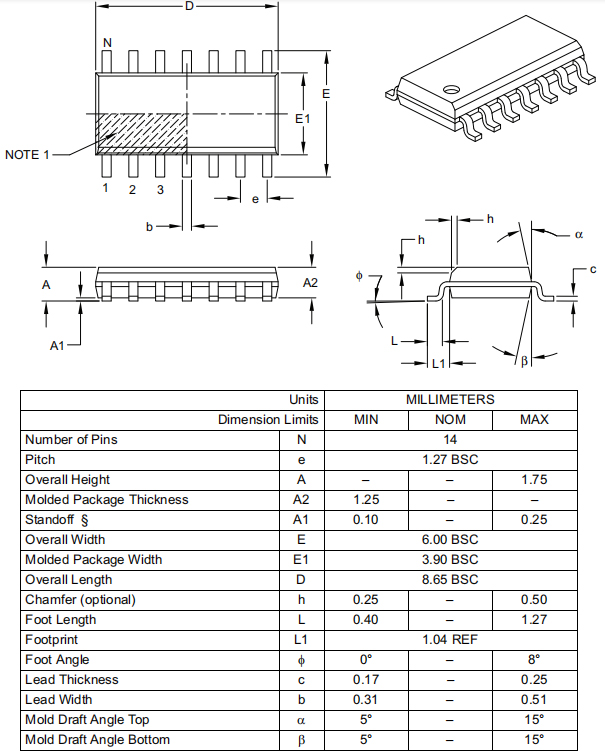
PIC16F676 Package

PIC16F676 Manufacturer

Microchip Technology Incorporated is a leading manufacturer of smart, networked, and secure embedded control solutions. Customers may create optimal designs using the company's simple development tools and broad product choices, which reduce risk while lowering overall system costs and time to market. The company's technologies are used by over 120,000 clients in the industrial, automotive, consumer, aerospace and defense, communications, and computing sectors. Microchip, based in Chandler, Arizona, offers outstanding technical support as well as dependable delivery and quality.

Datasheet PDF

Download datasheets and manufacturer documentation for Microchip Technology PIC16F676T-E/SL.

PIC16F676T-E/SL Documents

Download datasheets and manufacturer documentation for PIC16F676T-E/SL

Frequently Asked Questions

1.What is the difference between PIC16F676-I/SL and PIC16F676-I/P?
The package is different, SL stands for SOP and P stands for DIP.
2.PIC16F676 single-chip microcomputer is powered by 5V voltage, internal crystal oscillator, and the configuration bit is set to internal crystal oscillator. Why does the single-chip microcomputer not work?
You look at your fuse configuration. Maybe the configuration is wrong. Try to change the reset circuit to an internal reset, or you may use an external reset, and the hardware on your board is useless.
FAQ
1.What is the difference between PIC16F676-I/SL and PIC16F676-I/P?
The package is different, SL stands for SOP and P stands for DIP.
2.PIC16F676 single-chip microcomputer is powered by 5V voltage, internal crystal oscillator, and the configuration bit is set to internal crystal oscillator. Why does the single-chip microcomputer not work?
You look at your fuse configuration. Maybe the configuration is wrong. Try to change the reset circuit to an internal reset, or you may use an external reset, and the hardware on your board is useless.

TAGS

Share