ATTENTION: Due to increased demand and order volume, processing time may take an additional 1-3 business days.
HomeCommunitySubjectPIC16F688 Microcontroller: Circuit, Pinout, and Datasheet

PIC16F688 Microcontroller: Circuit, Pinout, and Datasheet

Embedded - Microcontrollers A/D 8x10b 14-DIP (0.300, 7.62mm) 7kB Brown-out Detect/Reset, POR, WDT -40°C~85°C TA 2V~5.5V PIC? 16F MICROCONTROLLER, RISC PIC16F688 20MHz IC MCU 8BIT 7KB FLASH 14DIP

2544

Oct 18, 2021

Susie Lytton

FFT Audio spectrum analyzer (PIC16F688)


Embedded - Microcontrollers A/D 8x10b 14-DIP (0.300, 7.62mm) 7kB Brown-out Detect/Reset, POR, WDT -40°C~85°C TA 2V~5.5V PIC® 16F MICROCONTROLLER, RISC PIC16F688 20MHz IC MCU 8BIT 7KB FLASH 14DIP

PIC16F688 is a 14-Pin Flash-Based, 8-Bit CMOS Microcontrollers with nanoWatt Technology. This article mainly introduces circuit, pinout, datasheet and other information about Microchip Technology PIC16F688.

PIC16F688-I/P

2000In Stock
Min.: 1 Mult.: 1
Quantity Unit Price Ext. Price
1+ $2.31951$2.32
10+ $2.18822$21.88
100+ $2.06436$206.44
500+ $1.94751$973.76
1000+ $1.83727$1837.27
Unit Price:$2.31951
Subtotal: $2.32
Looking for a better price? Want a lower wholesale price? Please send an RFQ, and we will respond immediately.
Quick Links

PIC16F688 Description

The PIC16F688 Flash microcontroller combines the benefits of the well-known mid-range x14 architecture with standardized features such as a 2.0-5.5 volt working voltage range, on-board EEPROM Data Memory, and nanoWatt Technology. Up to 8 channels of 10-bit A/D, an analog comparator module with programmable on-chip voltage reference, and an Enhanced USART (EUSART) peripheral that supports communications protocols such as RS232/485 and the LIN protocol are among the standard analog peripherals.

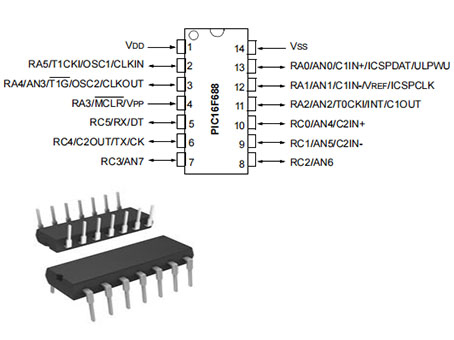
PIC16F688 Pinout

PIC16F688 CAD Model

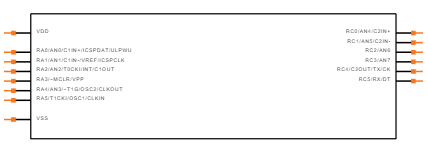
Symbol

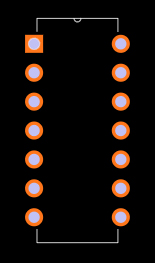
Footprint

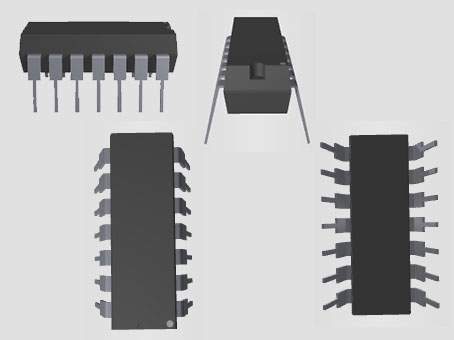
3D Model

PIC16F688 Features

(1) High-Performance RISC CPU

• Only 35 Instructions to Learn

- All single-cycle instructions except branches

• Speed of operation:

- Oscillator/clock input DC – 20 MHz

- DC – instruction cycle of 200 nanoseconds

• The capacity to interrupt

• Deep Hardware Stack with 8 levels

• Addressing modes: direct, indirect, and relative

(2) Special Microcontroller Features

• Precision Internal Oscillator

- Factory calibrated to 1% accuracy - Frequency range adjustable via software 125 kHz to 8 MHz

- Software that can be tweaked

- Start-Up Mode with Two Speeds

- For critical applications, crystal fail detection

- Changing the clock mode during operation energy conservation

• Sleep mode that saves energy

• Wide range of operating voltages (2.0V-5.5V)

• Wide Temperature Range (Industrial and Extended)

• Reset the power (POR)

• Oscillator Start-up and Power-up Timer (PWRT) Set a timer (OST)

• Software Controlled Brown-out Reset (BOR) Option

• Enhanced Low-Current Watchdog Timer (WDT) with an on-chip oscillator (nominal 268 seconds with full Prescaler, software adjustable) and software enable

• Weak Pull-up or Input Only Pin on Multiplexed Master Clear

• High-Endurance • Programmable Code Protection Cell for Flash/EEPROM:

- 100,000 writes in Flash memory - 1,000,000 writes in EEPROM memory

- Retention of Flash/Data EEPROM: > 40 years

(3) Low-Power Features

• Standby Current

- 50 nA @ 2.0V, typical

• Operating Current: Typical: 11μA @ 32 kHz, 2.0V

- Typical 220μA @ 4 MHz, 2.0V

• Current of the Watchdog Timer: 1μA @ 2.0V, typical

(4) Peripheral Features

• 12 I/O Pins, each having its own direction Control:

- Direct LED drive using a high-current source/sink

- Change-on-interrupt pin

- Weak pull-ups that can be programmed individually

- Wake-up with Ultra-Low Power

• Two analog comparators are included in the Analog Comparator module.

- On-chip Voltage Reference (CVREF) module that can be programmed ( percent of VDD)

- Externally accessible comparator inputs and outputs

• Analog-to-Digital Converter (A/D):

- 8 channels and 10-bit resolution

• Timer0: 8-bit Timer/Counter with Programmable Prescaler of 8 bits

• Improved Timer1:

- Prescaler and 16-bit timer/counter

- Timer1 Gate (External) (count enable)

• Enhanced USART Module: Use OSC1 and OSC2 in LP mode as Timer1 oscillators if INTOSC mode is enabled.

- RS-485, RS-232, LIN 2.0/2.1, and J2602 are all supported.

- Automatic Baud Detection

• In-Circuit Serial ProgrammingTM (ICSPTM) via two pins • Auto-wake-up on Start bit

Specifications

Microchip Technology PIC16F688-I/P technical specifications, attributes, parameters and parts with similar specifications to Microchip Technology PIC16F688-I/P.

PIC16F688-I/P Tech Specifications

Microchip Technology PIC16F688-I/P technical specifications, attributes, parameters and parts with similar specifications to Microchip Technology PIC16F688-I/P.

Product Attribute Attribute Value
Factory Lead Time5 Weeks
MountThrough Hole
Mounting TypeThrough Hole
Package / Case14-DIP (0.300, 7.62mm)
Number of Pins14Pins
Data ConvertersA/D 8x10b
Number of I/Os12I/Os
Watchdog TimersYes
Operating Temperature-40°C~85°C TA
PackagingTube
SeriesPIC® 16F
Published2016
JESD-609 Codee3
Pbfree Codeyes
Part StatusActive
Moisture Sensitivity Level (MSL)Not Applicable
Number of Terminations14Terminations
ECCN CodeEAR99
Terminal FinishMatte Tin (Sn)
Max Power Dissipation800mW
Product Attribute Attribute Value
Terminal PositionDUAL
Supply Voltage5V
Frequency20MHz
Base Part NumberPIC16F688
Pin Count14
Supply Voltage-Max (Vsup)5.5V
Supply Voltage-Min (Vsup)4.5V
InterfaceSCI, UART, USART
Memory Size7kB
Oscillator TypeInternal
Nominal Supply Current3.1mA
RAM Size256 x 8
Voltage - Supply (Vcc/Vdd)2V~5.5V
uPs/uCs/Peripheral ICs TypeMICROCONTROLLER, RISC
Core ProcessorPIC
PeripheralsBrown-out Detect/Reset, POR, WDT
Program Memory TypeFLASH
Core Size8-Bit
Program Memory Size7KB 4K x 14
ConnectivityUART/USART
Product Attribute Attribute Value
Bit Size8
Access Time20 μs
Has ADCYES
DMA ChannelsNO
Data Bus Width8b
Number of Timers/Counters2Timers/Counters
Address Bus Width8b
Density56 kb
EEPROM Size256 x 8
CPU FamilyPIC
Number of A/D Converters1A/D Converter
Number of ADC Channels8ADC Channels
Number of PWM Channels0PWM Channel
Height4.953mm
Length19.69mm
Width7.112mm
REACH SVHCNo SVHC
Radiation HardeningNo
RoHS StatusROHS3 Compliant
Lead FreeLead Free
0 Products View Similar

How to use PIC16F688 Microcontroller

We'll start with a simple experiment that turns an LED on and off. While it appears to be a basic project, it is the perfect place to begin because it ensures that we have properly written the software, compiled it, loaded it into the PIC, and built the circuit correctly on the breadboard.

In this lab, we'll attach an LED to one of the PIC16F688's port pins and have it flash constantly for 1 second.We'll start with a simple experiment that turns an LED on and off. While it appears to be a basic project, it is the perfect place to begin because it ensures that we have properly written the software, compiled it, loaded it into the PIC, and built the circuit correctly on the breadboard.

In this lab, we'll attach an LED to one of the PIC16F688's port pins and have it flash constantly for 1 second.

We'll add a light-emitting-diode (LED) to port pin RC0 (10) and a current-limiting resistor (470 Ohm) in series to our basic breadboard setup. The circuit diagram in its entirety is presented below.

Flashing LED circuit

Prototyped circuit on the breadboard

PIC16F688 Functional Block Diagram

Functional Block Diagram

PIC16F688 Alternatives

Part Number Description Manufacturer
PIC16F688-I/MLMICROCONTROLLERS AND PROCESSORS 8-BIT, FLASH, 20 MHz, RISC MICROCONTROLLER, PQCC16, 4 X 4 MM, 0.90 MM HEIGHT, LEAD FREE, PLASTIC, QFN-16 Microchip Technology Inc
PIC16F688T-I/MLVAOMICROCONTROLLERS AND PROCESSORS RISC Microcontroller, 8-Bit, FLASH, 20MHz, CMOS, PQCC16 Microchip Technology Inc

PIC16F688 Applications

• Consumer Electronics

• Embedded Design & Development

• System Monitoring

• Test & Measurement

• Clock & Timing

• Automotive

PIC16F688 Package

PIC16F688 Manufacturer

Microchip Technology Incorporated is a major producer of embedded control solutions that are smart, connected, and secure. Customers can generate optimal designs with its easy-to-use development tools and extensive product selection, which decrease risk while cutting overall system cost and time to market. More than 120,000 customers use the company's solutions in the industrial, automotive, consumer, aerospace and defense, communications, and computing areas. Microchip, based in Chandler, Arizona, provides excellent technical support as well as consistent delivery and quality.


Datasheet PDF

Download datasheets and manufacturer documentation for Microchip Technology PIC16F688-I/P.

PIC16F688-I/P Documents

Download datasheets and manufacturer documentation for PIC16F688-I/P

Frequently Asked Questions

1.Single-chip microcomputer PIC16F688, the assembler that realizes the small light flashes every second?
You can calculate the time used by each instruction in one second, see how many instructions are needed to reach 1S, and then write a loop statement. As for the light, you give it a high or low level at first, then call the delay and change the corresponding level.
2.Regarding the single-chip PIC16F688 problem, why can't the serial communication data be received?
Please check the connection line with the PC, and pay attention to the interface mode. RS232 or RS485 must choose the right converter, if the PC is connected with the USB interface, the driver must be installed.
3.Why can't PIC16F688 read the temperature in DS18B20?
If 18B20 cannot be read, there is a high probability that it is a delay problem, so check if there is any problem with the delay. At that time, there was no problem with the delay value, but the delay function was optimized by the compiler, and the data could not be read. Later, a volatile was added to the delay function variable to solve it.
FAQ
1.Single-chip microcomputer PIC16F688, the assembler that realizes the small light flashes every second?
You can calculate the time used by each instruction in one second, see how many instructions are needed to reach 1S, and then write a loop statement. As for the light, you give it a high or low level at first, then call the delay and change the corresponding level.
2.Regarding the single-chip PIC16F688 problem, why can't the serial communication data be received?
Please check the connection line with the PC, and pay attention to the interface mode. RS232 or RS485 must choose the right converter, if the PC is connected with the USB interface, the driver must be installed.
3.Why can't PIC16F688 read the temperature in DS18B20?
If 18B20 cannot be read, there is a high probability that it is a delay problem, so check if there is any problem with the delay. At that time, there was no problem with the delay value, but the delay function was optimized by the compiler, and the data could not be read. Later, a volatile was added to the delay function variable to solve it.

TAGS

Share