ATTENTION: Due to increased demand and order volume, processing time may take an additional 1-3 business days.
HomeCommunitySubjectSTM8S207C6T6 Microcontroller: Pinout, Datasheet and Features

STM8S207C6T6 Microcontroller: Pinout, Datasheet and Features

8-bit Microcontrollers - MCU Performance LN 8-Bit 24 MHz STM8S MCU

157

Jul 8, 2021

Denise Malachi

STM8S Value Line 8-bit microcontrollers


8-bit Microcontrollers - MCU Performance LN 8-Bit 24 MHz STM8S MCU

STM8S207C6T6 performance line 8-bit microcontrollers offers from 32 to 128 Kbytes Flash program memory. This article mainly introduces its pinout, datasheet, features and other detailed information about STM8S.

STM8S208CBT6

30000In Stock
Min.: 1 Mult.: 1
Quantity Unit Price Ext. Price
1+ $4.30794$4.31
10+ $4.06409$40.64
100+ $3.83405$383.41
500+ $3.61703$1808.52
1000+ $3.41229$3412.29
Unit Price:$4.30794
Subtotal: $4.31
Looking for a better price? Want a lower wholesale price? Please send an RFQ, and we will respond immediately.
Quick Links

TM8S207C6T6 Description

The STM8S207C6T6 performance line 8-bit microcontrollers offers from 32 to 128 Kbytes Flash program memory. It is designed for code efficiency and performance. It contains 6 internal registers which are directly addressable in each execution context, 20 addressing modes including indexed indirect and relative addressing and 80 instructions.

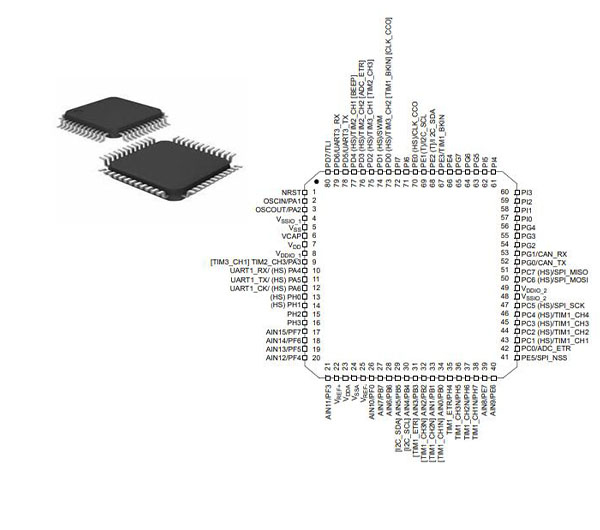
STM8S207C6T6 Pinout

STM8S207C6T6 CAD Model

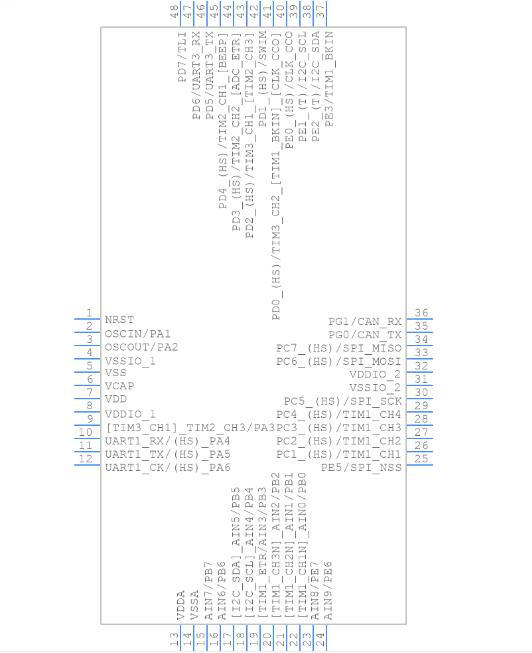
Symbol


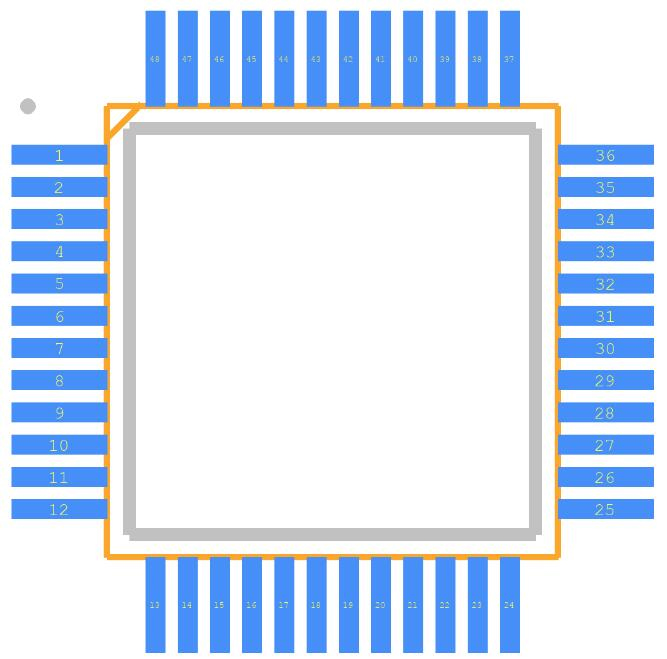
Footprint


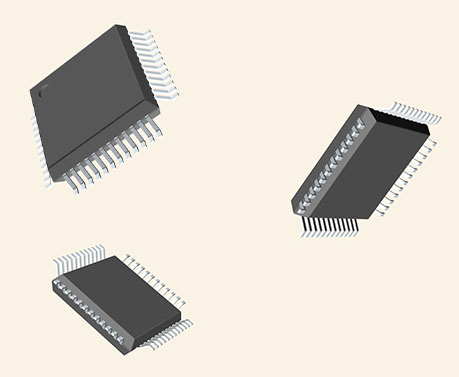
3D Model

STM8S207C6T6 Features

· Core

– Max fCPU: up to 24 MHz, 0 wait states @ fCPU £  16 MHz – Advanced STM8 core with Harvard architecture and 3-stage pipeline

– Extended instruction set – Max 20 MIPS @ 24 MHz 

· Memories

– Program: up to 128 Kbytes Flash; data retention 20 years at 55 °C after 10 kcycles

– Data: up to 2 Kbytes true data EEPROM; endurance 300 kcycles

– RAM: up to 6 Kbytes

· Clock, reset and supply management

– 2.95 to 5.5 V operating voltage

– Low power crystal resonator oscillator

– External clock input

– Internal, user-trimmable 16 MHz RC

– Internal low power 128 kHz RC

– Clock security system with clock monitor

– Wait, active-halt, & halt low power modes

– Peripheral clocks switched off individually

– Permanently active, low consumption power-on and power-down reset

· Interrupt management

– Nested interrupt controller with 32 interrupts

– Up to 37 external interrupts on 6 vectors

· Timers

– 2x 16-bit general purpose timers, with 2+3 CAPCOM channels (IC, OC or PWM)

– Advanced control timer: 16-bit, 4 CAPCOM channels, 3 complementary outputs, deadtime insertion and flexible synchronization

– 8-bit basic timer with 8-bit prescaler

– Auto wakeup timer – Window watchdog, independent watchdog

· Communications interfaces

– High speed 1 Mbit/s active beCAN 2.0B

– UART with clock output for synchronous operation - LIN master mode

– UART with LIN 2.1 compliant, master/slave modes and automatic resynchronization

– SPI interface up to 10 Mbit/s

– I2C interface up to 400 Kbit/s · 10-bit ADC with up to 16 channels · I/Os

– Up to 68 I/Os on an 80-pin package including 18 high sink outputs

– Highly robust I/O design, immune against current injection

– Development support

– Single wire interface module (SWIM) and debug module (DM)

· 96-bit unique ID key for each device

Specifications

STMicroelectronics STM8S208CBT6 technical specifications, attributes, parameters and parts with similar specifications to STMicroelectronics STM8S208CBT6.

STM8S208CBT6 Tech Specifications

STMicroelectronics STM8S208CBT6 technical specifications, attributes, parameters and parts with similar specifications to STMicroelectronics STM8S208CBT6.

Product Attribute Attribute Value
Lifecycle StatusACTIVE (Last Updated: 7 months ago)
Factory Lead Time8 Weeks
MountSurface Mount
Mounting TypeSurface Mount
Package / Case48-LQFP
Number of Pins48Pins
Data ConvertersA/D 10x10b
Number of I/Os38I/Os
Watchdog TimersYes
Operating Temperature-40°C~85°C TA
PackagingTray
SeriesSTM8S
JESD-609 Codee4
Part StatusActive
Moisture Sensitivity Level (MSL)3 (168 Hours)
Number of Terminations48Terminations
Terminal FinishNickel/Palladium/Gold (Ni/Pd/Au)
Max Power Dissipation443mW
Terminal PositionQUAD
Terminal FormGULL WING
Supply Voltage5V
Product Attribute Attribute Value
Terminal Pitch0.5mm
Frequency24MHz
Base Part NumberSTM8S208
Pin Count48
Supply Voltage-Max (Vsup)5.5V
InterfaceCAN, I2C, IrDA, LIN, SPI, UART
Memory Size128kB
Oscillator TypeInternal
RAM Size6K x 8
Voltage - Supply (Vcc/Vdd)2.95V~5.5V
uPs/uCs/Peripheral ICs TypeMICROCONTROLLER
Core ProcessorSTM8
PeripheralsBrown-out Detect/Reset, POR, PWM, WDT
Program Memory TypeFLASH
Core Size8-Bit
Program Memory Size128KB 128K x 8
ConnectivityCANbus, I2C, IrDA, LINbus, SPI, UART/USART
Bit Size8
Has ADCYES
DMA ChannelsNO
Data Bus Width8b
Product Attribute Attribute Value
Number of Timers/Counters4Timers/Counters
EEPROM Size2K x 8
Boundary ScanNO
Low Power ModeYES
Number of A/D Converters1A/D Converter
FormatFIXED-POINT
Integrated CacheNO
Number of UART Channels2UART Channels
Number of ADC Channels10ADC Channels
Max Junction Temperature (Tj)105°C
Number of External Interrupts35External Interrupts
Number of PWM Channels9PWM Channels
Ambient Temperature Range High85°C
Height1.6mm
Length7.2mm
Width7.2mm
Radiation HardeningNo
RoHS StatusROHS3 Compliant
Lead FreeLead Free
0 Products View Similar

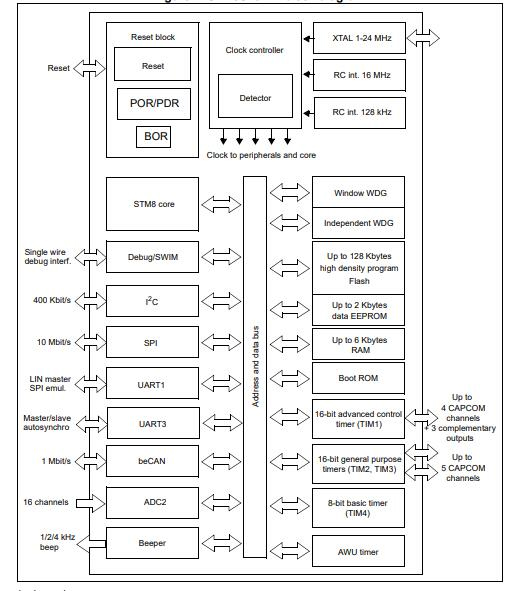
STM8S207C6T6 Block Diagram

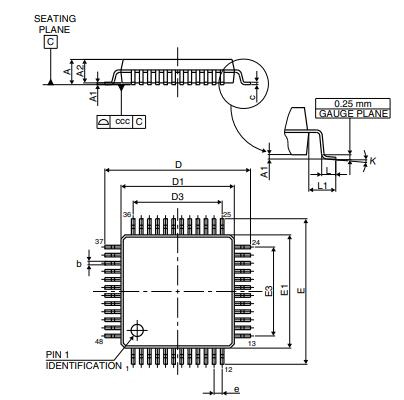
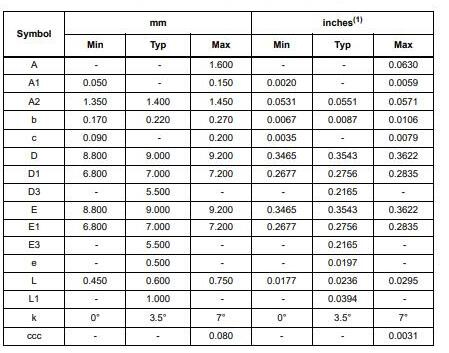
STM8S207C6T6 Package

STM8S207C6T6 Benefit

  • Reduced system cost

    The system cost is reduced thanks to an integrated true data EEPROM for up to 300 k write/erase cycles and a high system integration level with internal clock oscillators, watchdog, and brown-out reset.

  •  Performance robustness

    Device performance is ensured by 20 MIPS at 24 MHz CPU clock frequency and enhanced characteristics which include robust I/O, independent watchdogs (with a separate clock source), and a clock security system.

  •  Short development cycles

    Short development cycles are guaranteed due to application scalability across a common family product architecture with compatible pinout, memory map and modular peripherals. Full documentation is offered with a wide choice of development tools.

  •  Product longevity

    Product longevity is ensured in the STM8S family thanks to their advanced core which is made in a state-of-the art technology for applications with 2.95 V to 5.5 V operating supply.

STM8S207C6T6 Manufacturer

STMicroelectronics is a global independent semiconductor company , which is a leader in developing and delivering semiconductor solutions across the spectrum of microelectronics applications. An unrivaled combination of silicon and system expertise, manufacturing strength, Intellectual Property (IP) portfolio and strategic partners positions the Company at the forefront of System-on-Chip (SoC) technology and its products play a key role in enabling today's convergence trends.


Datasheet PDF

Download datasheets and manufacturer documentation for STMicroelectronics STM8S208CBT6.

STM8S208CBT6 Documents

Download datasheets and manufacturer documentation for STM8S208CBT6

Frequently Asked Questions

Why is there almost not support for STM8S controllers like Arduino (ATMEL328)?
In fact,STM8S series have extensive information and examples in their site. STM8s series also have very cheap development boards(below $10) along with debugger are available. One can not debug using arduino, whereas with STm8s discovery boards one can debug. Compiler editor is fully free. Arduino is only for beginers, whereas STM8s is for Engineers.
What are the differences in working with STM8S and STM32?
The STM8S CPU is a proprietary architecture that maintains the legacy of the previous ST7 core while being a breakthrough in terms of 8-bit CPU efficiency and code density. While the STM32 is built around the industry standard ARM Cortex-M3 32-bit core and benefits from the complete ecosystem of development tools and software solutions associated with ARM processors. They both have 3-stage pipelined execution that minimizes the execution time, a clock speed up to 24 MHz for the STM8S and up to 72 MHz for the STM32 family. Finally, in terms of code density, both have excellent results, owing to the 8-bit CISC instruction set for the STM8S family, and to the 16-bit Thumb-2 RISC instruction set mode introduced by the Cortex core for the STM32 family. The Drhystone MIPS for STM8 is 0.29 DMIPS and for STM32 is 1.22 DMIPS.
FAQ
Why is there almost not support for STM8S controllers like Arduino (ATMEL328)?
In fact,STM8S series have extensive information and examples in their site. STM8s series also have very cheap development boards(below $10) along with debugger are available. One can not debug using arduino, whereas with STm8s discovery boards one can debug. Compiler editor is fully free. Arduino is only for beginers, whereas STM8s is for Engineers.
What are the differences in working with STM8S and STM32?
The STM8S CPU is a proprietary architecture that maintains the legacy of the previous ST7 core while being a breakthrough in terms of 8-bit CPU efficiency and code density. While the STM32 is built around the industry standard ARM Cortex-M3 32-bit core and benefits from the complete ecosystem of development tools and software solutions associated with ARM processors. They both have 3-stage pipelined execution that minimizes the execution time, a clock speed up to 24 MHz for the STM8S and up to 72 MHz for the STM32 family. Finally, in terms of code density, both have excellent results, owing to the 8-bit CISC instruction set for the STM8S family, and to the 16-bit Thumb-2 RISC instruction set mode introduced by the Cortex core for the STM32 family. The Drhystone MIPS for STM8 is 0.29 DMIPS and for STM32 is 1.22 DMIPS.

TAGS

Share