ATTENTION: Due to increased demand and order volume, processing time may take an additional 1-3 business days.
HomeCommunitySubjectTCRT5000 IR Sensor: Datasheet, Pinout and Circuit

TCRT5000 IR Sensor: Datasheet, Pinout and Circuit

VISHAY - TCRT5000L - OPTICAL SENSOR, REFLECTIVE The TCRT5000 is an IR sensor unit. This article enforces datasheet, pinout, circuit, applications, and other details about the TCRT5000 sensor. Furthermore, there is a huge range of semiconductors, capacitors, resistors, and ICs in stock. Welcome RFQ!

535

Sep 24, 2021

Camille Edith

TCRT5000 Sensor IR Infrared Reflective - Arduino Code and Demo


VISHAY - TCRT5000L - OPTICAL SENSOR, REFLECTIVE

The TCRT5000 is an IR sensor unit. This article enforces datasheet, pinout, circuit, applications, and other details about the TCRT5000 sensor. Furthermore, there is a huge range of semiconductors, capacitors, resistors, and ICs in stock. Welcome RFQ!


TCRT5000L

Inquiry
Min.: 1 Mult.: 1
Price not displayed? Not available to buy online? Please send an RFQ, and we will respond immediately.
Quick Links

What is TCRT5000 IR Sensor?

The TCRT5000 is an IR sensor including an infrared emitter and phototransistor in a leaded device that blocks visible light. Two mounting clips are included in the package. The long-lead variant is the TCRT5000L.

TCRT5000 Pinout

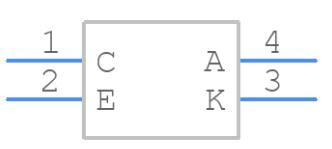
The following is the pinout diagram for the TCRT5000 IR sensor. This sensor has an infrared transmitter and an infrared receiver, totaling four pins, which are explained below.


TCRT5000 Pinout


1 Collector The collector   of the phototransistor is connected to +5V
2 Emitter The emitter of the   phototransistor is grounded through a resistor
3 Anode The Anode of the photodiode is connected to +5V
4 Cathode The Cathode of a photodiode is grounded through a resistor

TCRT5000 CAD Model

TCRT5000 Symbol


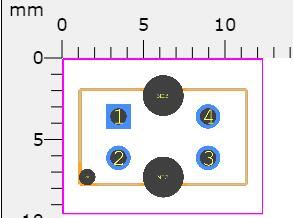
TCRT5000 Footprint

Specifications

Vishay Semiconductor Opto Division TCRT5000L technical specifications, attributes, parameters and parts with similar specifications to Vishay Semiconductor Opto Division TCRT5000L.

TCRT5000L Tech Specifications

Vishay Semiconductor Opto Division TCRT5000L technical specifications, attributes, parameters and parts with similar specifications to Vishay Semiconductor Opto Division TCRT5000L.

Product Attribute Attribute Value
Factory Lead Time32 Weeks
Contact PlatingSilver, Tin
MountThrough Hole
Mounting TypeThrough Hole
Package / CasePCB Mount
Number of Pins4Pins
Collector-Emitter Breakdown Voltage70V
Current-Collector (Ic) (Max)100mA
Number of Elements1 Element
Operating Temperature-25°C~85°C
PackagingTube
Published2009
Part StatusActive
Moisture Sensitivity Level (MSL)1 (Unlimited)
Product Attribute Attribute Value
Max Operating Temperature85°C
Min Operating Temperature-25°C
Voltage - Rated DC1.25V
Max Power Dissipation200mW
Output Voltage70V
Output TypePhototransistor
Number of Channels1Channel
Power Dissipation200mW
Forward Current60mA
Forward Voltage1.25V
Collector Emitter Voltage (VCEO)70V
Max Collector Current100mA
Sensing Distance0.591 (15mm)
Voltage - Collector Emitter Breakdown (Max)70V
Product Attribute Attribute Value
Reverse Breakdown Voltage5V
Sensing MethodReflective
Current - DC Forward (If) (Max)60mA
Input Current60mA
Reverse Voltage (DC)5V
Height7mm
Length10.2mm
Width5.8mm
REACH SVHCNo SVHC
Radiation HardeningNo
RoHS StatusROHS3 Compliant
Lead FreeLead Free
0 Products View Similar

TCRT5000 Features

  • It is available in a leaded package

  • The type of detector used is photo-transistor

  • The Peak operating distance is 2.5 mm.

  • Collector current ranges from 0.2 mm – 15 mm

  • The typical o/p current blow test (IC) is 1 mA.

  • Blocking filter for daylight

  • The wavelength of the emitter is 950 nm

  • Infrared sensor including the o/p of transistor

  • The operating voltage is 5V

  • The forward current of the diode is 60mA

  • Output data is analog/digital

  • The Collector current of the transistor is 100mA

  • Operating temperature ranges from -25°C to +85°C


TCRT5000 Applications

  • Position sensor for shaft encoder

  • Detection of reflective material such as paper, IBM cards, magnetic tapes, etc.

  • Limit switch for mechanical motions in VCR

  • General-purpose - wherever the space is limited

Where to Use TCRT5000

The TCRT5000 is used to detect color and distance in this IR reflecting sensor. It emits infrared light and then checks to see if it receives an echo. Because this sensor can detect whether a surface is white or black, it is commonly employed in line following robots and automatic data logging on utility meters.


How to Use TCRT5000

The IR sensor circuit for the TCRT500 is given below. The IR sensor in this circuit consists of a photodiode and a phototransistor, which act as a transmitter and receiver, respectively.
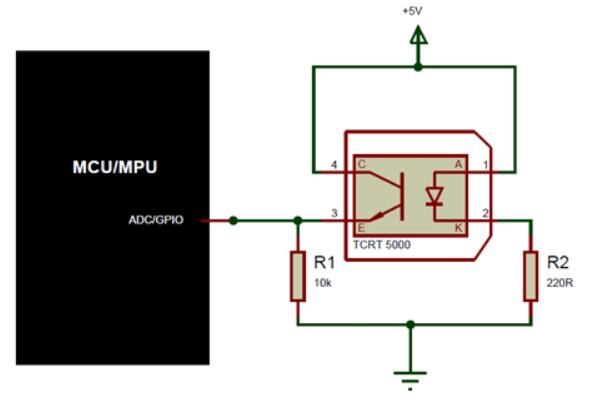
TCRT500 Circuit


A 220R resistor is used to activate the photodiode, while a 10K resistor is used to link the phototransistor to GND. Because the transistor biasing is mostly controlled by the received IR light, the transistor in the circuit does not have a base pin. As a result, the photodiode's infrared light strikes a target and returns to the phototransistor to bias it.

Depending on the application, this IR sensor can be utilized as an analog or digital sensor. The main disadvantages of this sensor are that they are easily affected by environmental variables.

It will not only respond to infrared light utilizing the photodiode, but it will also respond to infrared light from many light sources that are generally available, similar to the phototransistor.

Noise cancellation is usually used within the application to solve this problem. So, using an MCU or MPU's GPIO pin, we can deactivate the photodiode and then verify how much noise the transistor in the sensor is reading before activating the photodiode to calculate the change in values by invalidating the noise present while the photodiode was deactivated.

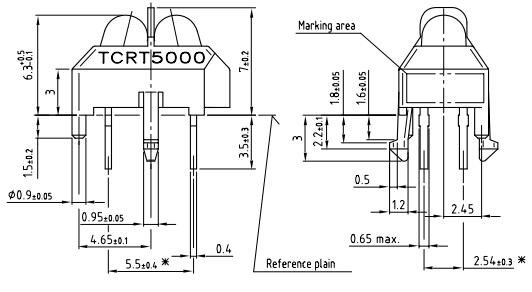
TCRT5000 Package Dimension

TCRT5000 Package Dimension

TCRT5000 Manufacturer

Vishay, an important partner of Digi-Key, serves as a globally recognized manufacturer famous for its discrete semiconductors and passive electronic components. Their discrete semiconductors include diodes, MOSFETs, optoelectronics, etc and their passive components include resistors, inductors, capacitors, etc. These products are widely used for almost all kinds of electronic devices and equipment in the fields of industrial, computing, automotive, telecommunications, military, aerospace, and medical.


Datasheet PDF

Download datasheets and manufacturer documentation for Vishay Semiconductor Opto Division TCRT5000L.

TCRT5000L Documents

Download datasheets and manufacturer documentation for TCRT5000L

Frequently Asked Questions

What is the use of TCRT5000?
You can use the TCRT5000 to check the presence of a physical object such as detecting a coin in a coin sorting device. It can also be used to check the color of something on a black to white scale. This is a principle a line following robot can utilize.
How do I connect a TCRT5000 to Arduino?
In this instructable, basic circuitry for TCRT 5000 IR sensor and its working is discussed. a major focus of this instructable is on making a program that enables it to remove all kinds of ambient noise. So after using this method IR sensor need not be calibrated for different ambiance conditions.
Where can I find information about TCRT5000 working principle?
The TCRT5000 and TCRT5000L are reflective sensors that include an infrared emitter and phototransistor in a leaded package that blocks visible light. The package includes two mounting clips. TCRT5000L is the long lead version. The TCRT5000 (L) has a compact construction where the emitting light source and the detector are arranged in the same direction to sense the presence of an object by using the reflective IR beam from the object. The detector consists of a phototransistor.
How do I connect a TCRT5000 to a Raspberry Pi?
TCRT5000 line followers are super easy to use! You will need two of these to be able to follow a line. Position the line followers next to each other with a slight gap between them. Your line should sit within this gap. The way this works is quite simple. As your robot stays left or right, either the left or right sensor will move over the black line. When this happens, it will trigger that sensor to go low. Knowing which sensor has gone low allows us to move the robot left or right so that the line remains in between the two sensors.
FAQ
What is the use of TCRT5000?
You can use the TCRT5000 to check the presence of a physical object such as detecting a coin in a coin sorting device. It can also be used to check the color of something on a black to white scale. This is a principle a line following robot can utilize.
How do I connect a TCRT5000 to Arduino?
In this instructable, basic circuitry for TCRT 5000 IR sensor and its working is discussed. a major focus of this instructable is on making a program that enables it to remove all kinds of ambient noise. So after using this method IR sensor need not be calibrated for different ambiance conditions.
Where can I find information about TCRT5000 working principle?
The TCRT5000 and TCRT5000L are reflective sensors that include an infrared emitter and phototransistor in a leaded package that blocks visible light. The package includes two mounting clips. TCRT5000L is the long lead version. The TCRT5000 (L) has a compact construction where the emitting light source and the detector are arranged in the same direction to sense the presence of an object by using the reflective IR beam from the object. The detector consists of a phototransistor.
How do I connect a TCRT5000 to a Raspberry Pi?
TCRT5000 line followers are super easy to use! You will need two of these to be able to follow a line. Position the line followers next to each other with a slight gap between them. Your line should sit within this gap. The way this works is quite simple. As your robot stays left or right, either the left or right sensor will move over the black line. When this happens, it will trigger that sensor to go low. Knowing which sensor has gone low allows us to move the robot left or right so that the line remains in between the two sensors.

TAGS

Share