ATTENTION: Due to increased demand and order volume, processing time may take an additional 1-3 business days.
HomeCommunitySubjectTJA1043 High-speed Can Transceiver: Datasheet, Application Hints, Test Circuit

TJA1043 High-speed Can Transceiver: Datasheet, Application Hints, Test Circuit

Interface - Drivers, Receivers, Transceivers 14-SOIC (0.154, 3.90mm Width) 4.5V~5.5V -40°C~150°C 1.27mm Automotive, AEC-Q100 IC CAN TRANSEIVER HS 14SO

259

Oct 29, 2021

Catherine Young

Interface - Drivers, Receivers, Transceivers 14-SOIC (0.154, 3.90mm Width) 4.5V~5.5V -40°C~150°C 1.27mm Automotive, AEC-Q100 IC CAN TRANSEIVER HS 14SO

The TJA1043 high-speed CAN transceiver provides an interface between a Controller Area Network (CAN) protocol controller and the physical two-wire CAN bus. This post will unlock more details about TJA1043. There is a huge range of Semiconductors, Capacitors, Resistors and ICs in stock. Welcome RFQ!
TJA1043T/1J

47500In Stock
Min.: 1 Mult.: 1
Quantity Unit Price Ext. Price
1+ $2.21279$2.21
10+ $2.08754$20.88
100+ $1.96938$196.94
500+ $1.8579$928.95
1000+ $1.75274$1752.74
Unit Price:$2.21279
Subtotal: $2.21
Looking for a better price? Want a lower wholesale price? Please send an RFQ, and we will respond immediately.
Quick Links

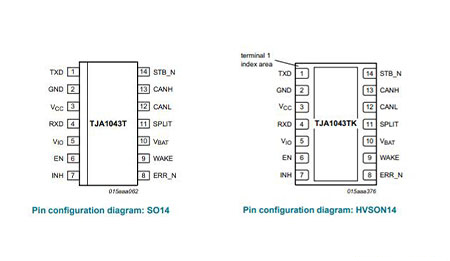
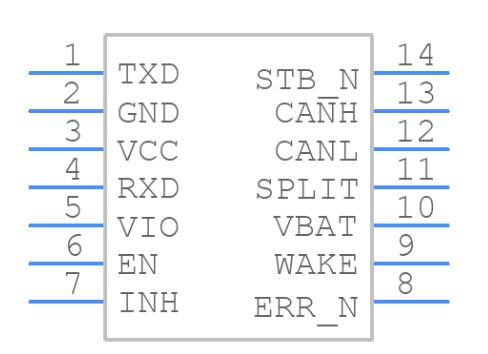
TJA1043 Pinout

TJA1043 Pinout

TJA1043 CAD Model

TJA1043 Symbol

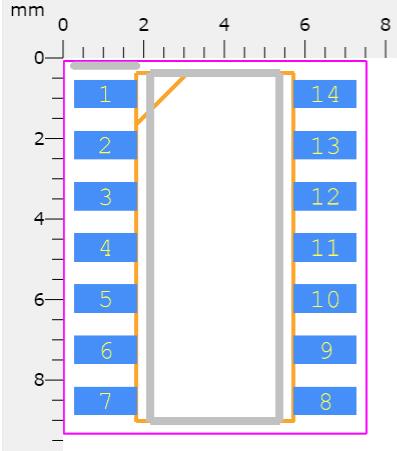
TJA1043 Footprint

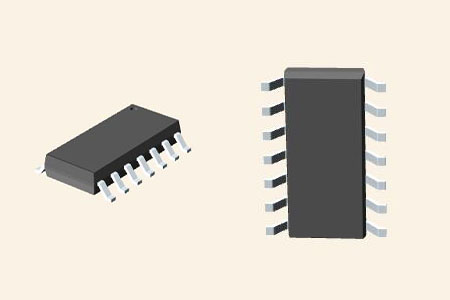
TJA1043 3D Model

TJA1043 Description

The TJA1043 high-speed CAN transceiver provides an interface between a Controller Area Network (CAN) protocol controller and the physical two-wire CAN bus. The transceiver is designed for high-speed CAN applications in the automotive industry, providing differential transmit and receive capability to (a microcontroller with) a CAN protocol controller. The TJA1043 belongs to the third generation of high-speed CAN transceivers from NXP Semiconductors, offering significant improvements over first- and second-generation devices such as the TJA1041A. It offers improved ElectroMagnetic Compatibility (EMC) and ElectroStatic Discharge (ESD) performance, very low power consumption, and passive behaviour when the supply voltage is turned off.

TJA1043 Features

General

  • ISO 11898-2:2016 and SAE J2284-1 to SAE J2284-5 compliant

  • Loop delay symmetry timing enables reliable communication at data rates up to

  • 5 Mbit/s in the CAN FD fast phase

  • Suitable for 12 V and 24 V systems

  • Low Electromagnetic Emission (EME) and high Electromagnetic Immunity (EMI)

  • VIO input allows for direct interfacing with 3 V and 5 V microcontrollers

  • SPLIT voltage output for stabilizing the recessive bus level

  • Listen-only mode for node diagnosis and failure containment

  • Available in SO14 and HVSON14 packages

  • Leadless HVSON14 package (3.0 mm, 5 mm) with improved Automated optical inspection (AOI) capability

  • AEC-Q100 qualified

  • Dark green product (halogen-free and Restriction of Hazardous Substances (RoHS)compliant)


Low-power management

  • Very low current Standby and Sleep modes, with local and remote wake-up

  • Capability to power down the entire node while supporting local, remote and host wake-up

  • Wake-up source recognition

  • Transceiver disengages from the bus (zero loads) when VBAT absent

  • Functional behaviour predictable under all supply conditions


Protection and diagnosis (detection and signalling)

  • High ESD handling capability on the bus pins

  • Bus pins and VBAT protected against transients in automotive environments

  • Transmit Data (TXD) dominant time-out function with a diagnosis

  • TXD-to-RDX short-circuit handler with a diagnosis

  • Thermal protection with a diagnosis

  • Undervoltage detection and recovery on pins VCC, VIO and VBAT

  • Bus line short-circuit diagnosis

  • Bus dominant clamping diagnosis

  • Cold start diagnosis (first battery connection)

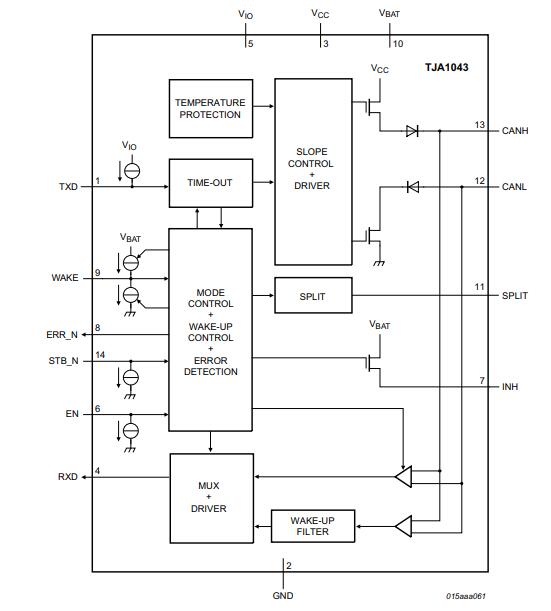
TJA1043 Block Diagram

The TJA1043 is a stand-alone high-speed CAN transceiver with a number of operating modes, fail-safe features and diagnostic features that offer enhanced system reliability and advanced power management. The transceiver combines the functionality of the TJA1041A with improved EMC and ESD capability and quiescent current performance. Improved slope control and high DC handling capability on the bus pins provide additional application flexibility.

TJA1043 Block Diagram

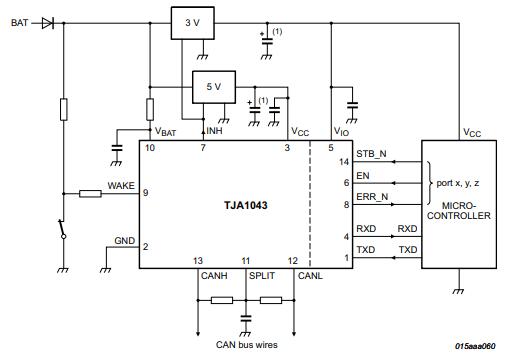
TJA1043 Application Diagram and Application Hints

TJA1043 Application Diagram

Further information on the application of the TJA1043 can be found in NXP application hints AH1014 ‘Application Hints - Standalone high speed CAN transceiver TJA1042/TJA1043/TJA1048/TJA1051’.

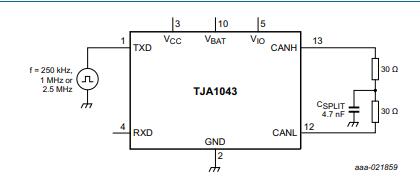
TJA1043 Test Circuit

TJA1043 Test circuit for timing characteristics

TJA1043 Test circuit for measuring transceiver driver symmetry

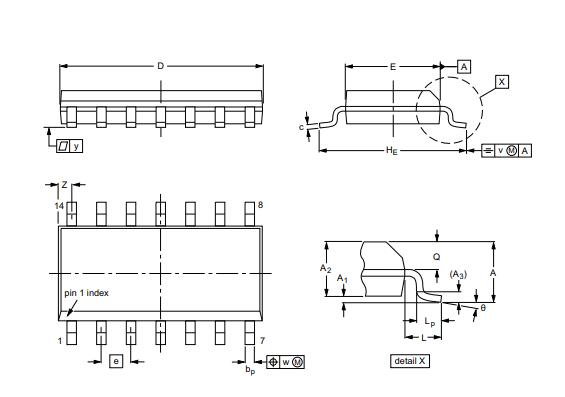
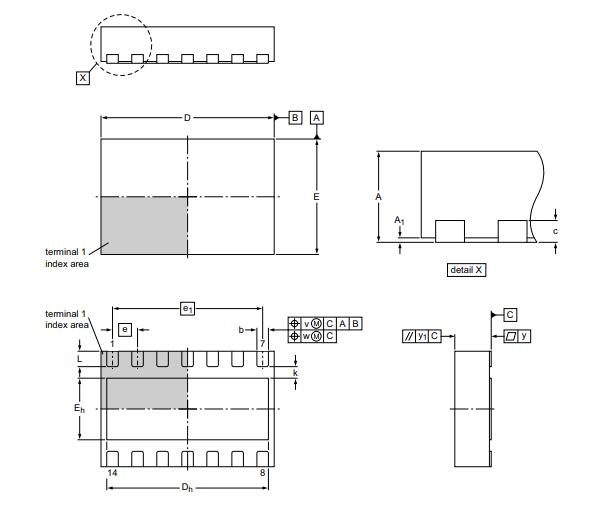
TJA1043 Package

TJA1043 Package


Specifications

TJA1043T/1J Tech Specifications

NXP USA Inc. TJA1043T/1J technical specifications, attributes, parameters and parts with similar specifications to NXP USA Inc. TJA1043T/1J.

Product Attribute Attribute Value
Factory Lead Time6 Weeks
Mounting TypeSurface Mount
Package / Case14-SOIC (0.154, 3.90mm Width)
Surface MountYES
Usage LevelAutomotive grade
Operating Temperature-40°C~150°C
PackagingTape & Reel (TR)
SeriesAutomotive, AEC-Q100
Published2008
Part StatusActive
Moisture Sensitivity Level (MSL)1 (Unlimited)
Product Attribute Attribute Value
Number of Terminations14Terminations
TypeTransceiver
Voltage - Supply4.5V~5.5V
Terminal PositionDUAL
Terminal FormGULL WING
Peak Reflow Temperature (Cel)NOT SPECIFIED
Number of Functions1Function
Supply Voltage5V
Terminal Pitch1.27mm
Time@Peak Reflow Temperature-Max (s)NOT SPECIFIED
Pin Count14
Product Attribute Attribute Value
JESD-30 CodeR-PDSO-G14
Data Rate5Mbps
ProtocolCANbus
Number of Drivers/Receivers1/1Drivers/Receiver
DuplexHalf
Receiver Hysteresis120mV
Length8.65mm
Height Seated (Max)1.75mm
Width3.9mm
RoHS StatusROHS3 Compliant
0 Products View Similar

Datasheet PDF

TJA1043T/1J Documents

Download datasheets and manufacturer documentation for TJA1043T/1J

Datasheets
TJA1043
Environmental Information
NXP RoHS3 Cert
PCN Design/Specification
TJA1043 FD Update 22/Nov/2017

Frequently Asked Questions

What is a TJA1043?
The TJA1043 high-speed CAN transceiver provides an interface between a Controller Area Network (CAN) protocol controller and the physical two-wire CAN bus. The transceiver is designed for high-speed CAN applications in the automotive industry, providing differential transmit and receive capability to (a microcontroller with) a CAN protocol controller. The TJA1043 belongs to the third generation of high-speed CAN transceivers from NXP Semiconductors, offering significant improvements over first- and second-generation devices such as the TJA1041A. It offers improved ElectroMagnetic Compatibility (EMC) and ElectroStatic Discharge (ESD) performance, very low power consumption, and passive behaviour when the supply voltage is turned off.
What can a high speed CAN transceiver do?
The transceiver is designed for high-speed CAN applications in the automotive industry, providing differential transmit and receive capability to (a microcontroller with) a CAN protocol controller.
How many operation mode does TJA1043 have?
The' TJA1043 supports five operating modes below. Control pins STB_ N and EN are used to select the operating mode. Switching between modes allows access to a number of diagnostics flags via pin ERR_ N. 1. Normal mode 2. Listen-only mode 3. Standby mode 4. Go-to-sleep mode 5. Sleep mode
CAN transceivers NXP?
NXP's entire portfolio of CAN transceivers is developed to support 3.3 V and 5 V microcontrollers. Equipped with a dedicated VIO pin, NXP CAN transceivers can interface directly to microcontrollers with supply voltages of 3.3 V and 5 V. VIO and non-VIO variants are available in the same packages.
What is the difference between low speed and high-speed cans?
Typically, a distinction is made between high-speed CAN transceivers and low-speed CAN transceivers. High-speed CAN transceivers support data rates up to 1 Mbit/s. Low-speed CAN transceivers only support data rates up to 125 kbit/s.
FAQ
What is a TJA1043?
The TJA1043 high-speed CAN transceiver provides an interface between a Controller Area Network (CAN) protocol controller and the physical two-wire CAN bus. The transceiver is designed for high-speed CAN applications in the automotive industry, providing differential transmit and receive capability to (a microcontroller with) a CAN protocol controller. The TJA1043 belongs to the third generation of high-speed CAN transceivers from NXP Semiconductors, offering significant improvements over first- and second-generation devices such as the TJA1041A. It offers improved ElectroMagnetic Compatibility (EMC) and ElectroStatic Discharge (ESD) performance, very low power consumption, and passive behaviour when the supply voltage is turned off.
What can a high speed CAN transceiver do?
The transceiver is designed for high-speed CAN applications in the automotive industry, providing differential transmit and receive capability to (a microcontroller with) a CAN protocol controller.
How many operation mode does TJA1043 have?
The' TJA1043 supports five operating modes below. Control pins STB_ N and EN are used to select the operating mode. Switching between modes allows access to a number of diagnostics flags via pin ERR_ N. 1. Normal mode 2. Listen-only mode 3. Standby mode 4. Go-to-sleep mode 5. Sleep mode
CAN transceivers NXP?
NXP's entire portfolio of CAN transceivers is developed to support 3.3 V and 5 V microcontrollers. Equipped with a dedicated VIO pin, NXP CAN transceivers can interface directly to microcontrollers with supply voltages of 3.3 V and 5 V. VIO and non-VIO variants are available in the same packages.
What is the difference between low speed and high-speed cans?
Typically, a distinction is made between high-speed CAN transceivers and low-speed CAN transceivers. High-speed CAN transceivers support data rates up to 1 Mbit/s. Low-speed CAN transceivers only support data rates up to 125 kbit/s.

TAGS

Share