ATTENTION: Due to increased demand and order volume, processing time may take an additional 1-3 business days.
HomeCommunitySubjectTPS1H100AQPWPRQ1 High-Side Power Switch: Features, Pinout, and Datasheet

TPS1H100AQPWPRQ1 High-Side Power Switch: Features, Pinout, and Datasheet

The TPS1H100AQPWPRQ1 is a fully protected high-side power switch with an integrated NMOS power FET and charge pump that is designed to intelligently regulate a variety of resistive, inductive, and capacitive loads.

412

Mar 15, 2022

Glenn Tracy

Transistor as a switch - low side or high side


The TPS1H100AQPWPRQ1 is a fully protected high-side power switch with an integrated NMOS power FET and charge pump that is designed to intelligently regulate a variety of resistive, inductive, and capacitive loads. This article mainly introduces Features, Pinout, Datasheet and other detailed information about Texas Instruments TPS1H100AQPWPRQ1.

TPS1H100AQPWPRQ1

716In Stock
Min.: 1 Mult.: 1
Price not displayed? Not available to buy online? Please send an RFQ, and we will respond immediately.
Quick Links

TPS1H100AQPWPRQ1 Description

The TPS1H100AQPWPRQ1 is a fully protected high-side power switch with an integrated NMOS power FET and charge pump that is designed to intelligently regulate a variety of resistive, inductive, and capacitive loads. It stands out from the competition because of its accurate current sense and programmable current limit capabilities.

It has a single channel and is fully protected. The load may be intelligently controlled thanks to full diagnostics and high-accuracy current-sense features. The overall system's reliability is considerably improved by a programmable current-limit function. When diagnostics are disabled, both versions of the device diagnostic reporting can be set to the high-impedance state for multiplexing the MCU analog or digital interface among devices, and both can be set to the high-impedance state when diagnostics are removed.

The open-drain structure is used for version A of the digital status report. It pulls down to GND when a fault condition arises. To match the microcontroller supply level, a 3.3- or 5-V external pull-up is necessary.

High-accuracy current sensing in version B enables for a stronger real-time monitoring effect and more accurate diagnostics without the need for additional calibration. A current mirror is used to supply 1 / K of the load current, which is reflected on the CS pin as voltage. K remains constant regardless of temperature or supply voltage. The current-sensing function functions normally throughout a broad linear range of 0 to 4 V. By bringing up the voltage of VCS,h, the CS pin can also notify a defect.

For smart high-side power-switch devices, short-circuit reliability is crucial. The purpose of the AEC-Q100-012 standard is to verify the device's reliability when operating in a continuous short-circuit scenario. According to the past cycles, different grade levels are assigned. This device has the highest degree of qualification, Grade A, with a 1 million times short-to-GND certification.

Low-wattage bulbs, LEDs, relays, solenoids, and heaters can all benefit from the TPS1H100AQPWPRQ1 device, which can be utilized as a high-side power switch for a range of resistive, inductive, and capacitive loads.

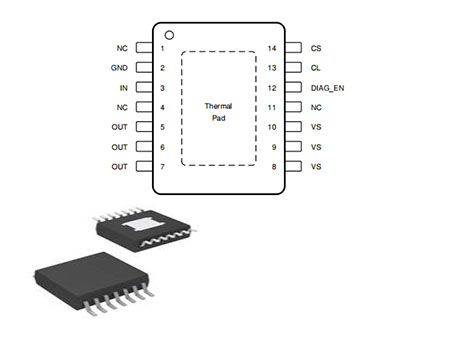
TPS1H100AQPWPRQ1 Pinout

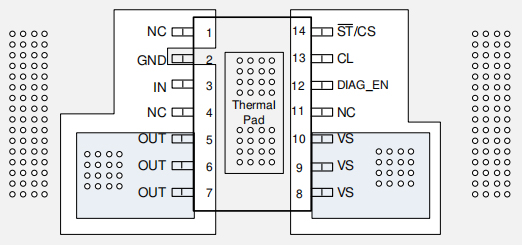
The following figure is TPS1H100AQPWPRQ1 Pinout.

Pinout


Pin Number Pin Name Description
13 CL Programmable current-limit pin. Connect to device GND if external current limit is not used.
14 CS Current-sense output. Leave floating if not used.
12 DIAG_EN Enable and disable pin for diagnostic functions. Connect to device GND if not used.
2 GND Ground pin
3 IN Input control for channel activation
1, 4, 11 NC No-connect pin; leave floating.
5, 6, 7 OUT Output, connected to load (NMOS source)
8, 9, 10 VS Power supply; battery voltage
  Thermal pad Thermal pad. Connect to device GND or leave floating.

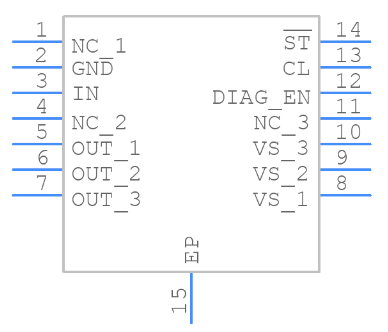
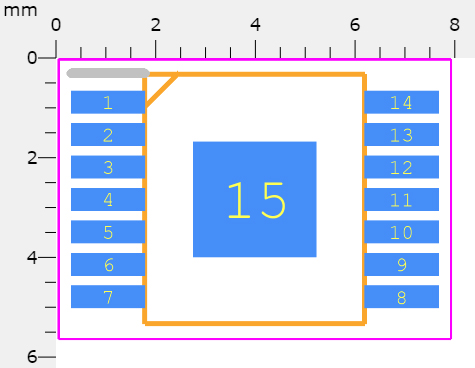
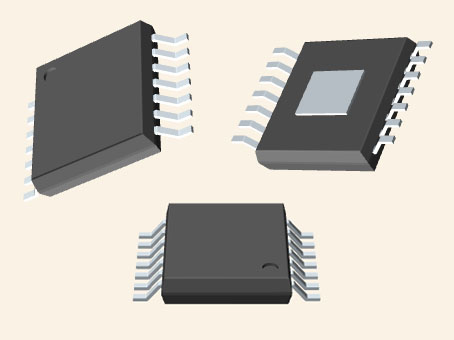
TPS1H100AQPWPRQ1 CAD Model

The TPS1H100AQPWPRQ1 CAD Model is shown as follows.

Symbol

Footprint

3D Model

TPS1H100AQPWPRQ1 Features

• Qualified for automotive applications

• AEC-Q100 Qualified with the following results:

– Device temperature grade 1: –40°C to 125°C ambient operating temperature range

– Device HBM ESD classification level H3A

– Device CDM ESD classification level C4B

• Functional safety capable

– Documentation available to aid functional safety system design

• Single-channel smart high-side power switch with full diagnostics

– Version A: open-drain status output

– Version B: current sense analog output

• Wide operating voltage 3.5 to 40 V • Very-low standby current, <0.5 µA

• Operating junction temperature, –40 to 150°C • Input control, 3.3-V and 5-V logic compatible

• High-accuracy current sense, ±30 mA at 1 A, ±4 mA at 5 mA

• Programmable current limit with external resistor, ±20% at 0.5 A

• Diagnostic enable function for multiplexing of mcu analog or digital interface

• Tested according to AECQ100-12 Grade A, 1 million times Short to GND test

• Electrical transient disturbance immunity certification of ISO7637-2 and ISO16750-2

• Protection

– Overload and short-circuit protection

– Inductive load negative voltage clamp

– Undervoltage lockout ( UVLO ) protection

– Thermal shutdown/swing with self recovery

– Loss of GND, loss of supply protection

– Reverse battery protection with external circuitry

• Diagnostic

– On- and Off-state output open- and short-tobattery detection

– Overload and short to ground detection and current limit

– Thermal shutdown/swing detection

• 14-Pin Thermally-enhanced PWP package

Specifications

TPS1H100AQPWPRQ1 Tech Specifications

Texas Instruments TPS1H100AQPWPRQ1 technical specifications, attributes, parameters and parts with similar specifications to Texas Instruments TPS1H100AQPWPRQ1.

Product Attribute Attribute Value
Lifecycle StatusACTIVE (Last Updated: 5 days ago)
Factory Lead Time8 Weeks
Mounting TypeSurface Mount
Package / Case14-PowerTSSOP (0.173, 4.40mm Width)
Surface MountYES
Number of Pins14Pins
Turn Off Delay Time20 μs
Operating Temperature-40°C~125°C TA
PackagingTape & Reel (TR)
SeriesAutomotive, AEC-Q100
JESD-609 Codee4
Pbfree Codeyes
Part StatusActive
Moisture Sensitivity Level (MSL)3 (168 Hours)
Number of Terminations14Terminations
ECCN CodeEAR99
Terminal FinishNickel/Palladium/Gold (Ni/Pd/Au)
Product Attribute Attribute Value
Terminal PositionDUAL
Terminal FormGULL WING
Number of Functions1Function
Supply Voltage13.5V
Base Part NumberTPS1H100
Number of Outputs1Output
Output TypeN-Channel
Max Output Current4A
Supply Voltage-Max (Vsup)40V
Supply Voltage-Min (Vsup)5V
InterfaceOn/Off
Output ConfigurationHigh Side
Output Current4A
Voltage - Supply (Vcc/Vdd)Not Required
Turn On Delay Time20 μs
Switch TypeGeneral Purpose
Ratio - Input:Output1:1
Product Attribute Attribute Value
Voltage - Load5V~40V
Fault ProtectionCurrent Limiting (Adjustable), Open Load Detect, Over Temperature, UVLO
Number of Drivers1Driver
Turn On Time50 μs
Output Peak Current Limit-Nom7A
Rds On (Typ)80m Ω
Max Junction Temperature (Tj)150°C
Turn Off Time50 μs
Built-in ProtectionsTRANSIENT; OVER CURRENT; THERMAL; UNDER VOLTAGE
Ambient Temperature Range High125°C
FeaturesStatus Flag
Height1.2mm
Length5mm
Width4.4mm
Thickness1mm
RoHS StatusROHS3 Compliant
Lead FreeLead Free
0 Products View Similar

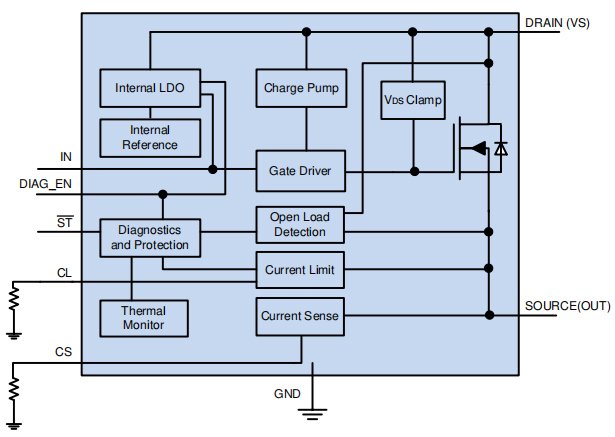
TPS1H100AQPWPRQ1 Functional Block Diagram

The following figure is TPS1H100AQPWPRQ1 Functional Block Diagram.

Functional Block Diagram

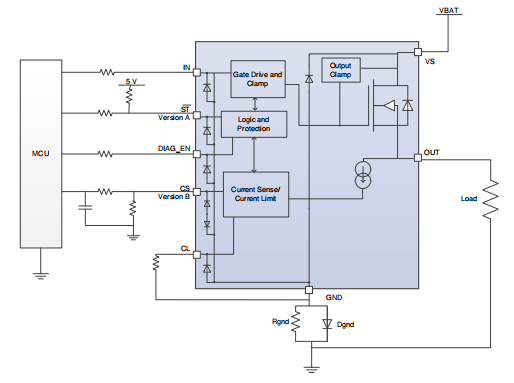
TPS1H100AQPWPRQ1 Typical Application Schematic

The following figure is TPS1H100AQPWPRQ1 Typical Application Schematic.

Typical Application Schematic


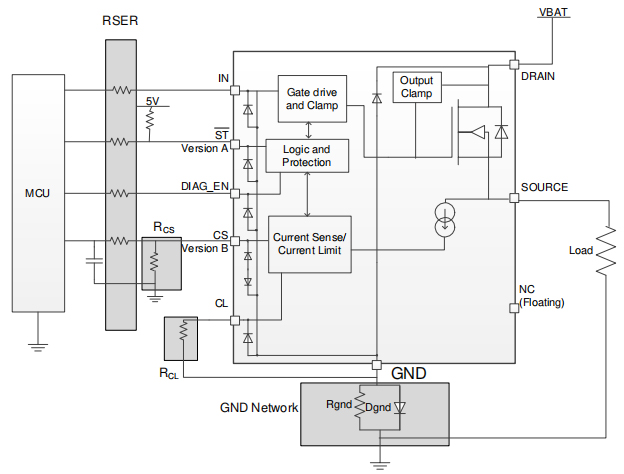
The following figure shows an example of how to design the external circuitry parameters.

Typical Application Circuitry


Design Requirements

• VS range from 9 V to 16 V

• Nominal current of 2 A

• Current sense for fault monitoring

• Expected current limit value of 5 A

• Full diagnostics with 5-V MCU

• Reverse protection with GND network

TPS1H100AQPWPRQ1 Layout

TJ must be less than 150°C to avoid a thermal shutdown. The power dissipation may be significant if the output current is quite high. The thermal impedance of the HTSSOP package is excellent. The  PCB  layout, on the other hand, is critical. A good PCB design can improve heat transfer, which is critical for the device's long-term durability.

• Increase the heat conductivity of the board by increasing the copper covering on the PCB. The copper on the PCB is the primary heatflow channel from the package to the ambient. When there are no heat sinks attached to the PCB on the opposite side of the board from the package, maximum copper is critical.

• To improve the board's thermal conductivity, place as many thermal vias as feasible directly beneath the package ground pad.

• To avoid solder voids, all thermal vias should be plated shut or plugged and sealed on both sides of the board. Solder coverage should be at least 85% to assure reliability and performance.


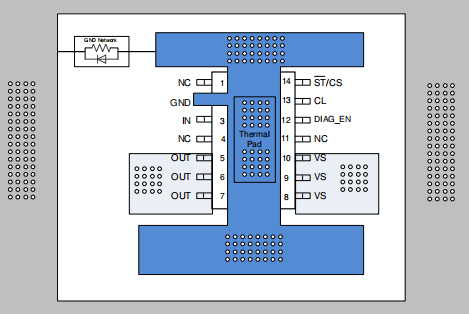
Without a GND Network

Without a GND network, tie the thermal pad directly to the board GND copper for better thermal performance.

Layout Without a GND Network


With a GND Network

With a GND network, tie the thermal pad with a single trace through the GND network to the board GND copper.

Layout With a GND Network


TPS1H100AQPWPRQ1 Applications

• High-side power switch for sub-module

• Power switch for low-wattage lamp

• High-side relays and solenoids

• PLC Digital output power switch

• General resistive, inductive, and capacitive loads

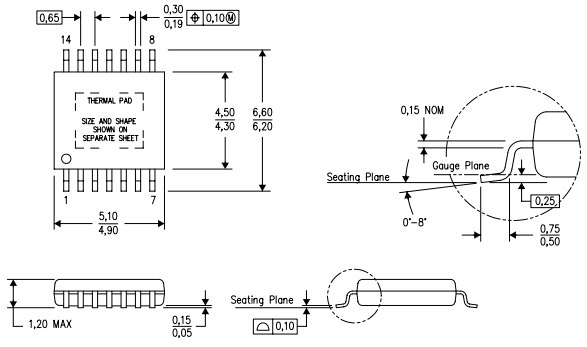
TPS1H100AQPWPRQ1 Package

The TPS1H100AQPWPRQ1 Package is shown as follows.

Package

TPS1H100AQPWPRQ1 Manufacturer

Texas Instruments Incorporated (TI) is an American technology corporation based in Dallas, Texas, that creates and manufactures semiconductors and integrated circuits for electronic designers and manufacturers around the world. Based on sales volume, it is one of the top ten semiconductor businesses in the world. Analog chips and embedded processors, which account for more than 80% of the company's revenue, are the company's main focus.

Datasheet PDF

TPS1H100AQPWPRQ1 Documents

Download datasheets and manufacturer documentation for TPS1H100AQPWPRQ1

Frequently Asked Questions

What is the TPS1H100AQPWPRQ1 equipped with?
NMOS power FET and charge pump.
What features does the TPS1H100AQPWPRQ1 stand out from competition?
Accurate current sense and programmable current limit capabilities.
What channel does the TPS1H100AQPWPRQ1 have?
Single-channel.
What are the advantages of the TPS1H100AQPWPRQ1?
Full diagnostics and high-accuracy current-sense features.
What improves the reliability of the TPS1H100AQPWPRQ1?
A programmable current-limit function.
When can both versions of the TPS1H100AQPWPRQ1 be set to the high-impedance state?
When diagnostics are removed.
What is used for version A of the digital status report?
Open-drain structure.
What is required to match the microcontroller supply level?
3.3- or 5-V external pull-up.
What enables for a stronger real-time monitoring effect and more accurate diagnostics without the need for additional calibration?
High-accuracy current sensing.
What is crucial for smart high-side power-switch devices?
Short-circuit reliability.
What is the purpose of the AEC-Q100-012 standard?
To verify the devices reliability when operating in a continuous short-circuit scenario.
What is the highest grade of the TPS1H100AQPWPRQ1?
Grade A.
FAQ
What is the TPS1H100AQPWPRQ1 equipped with?
NMOS power FET and charge pump.
What features does the TPS1H100AQPWPRQ1 stand out from competition?
Accurate current sense and programmable current limit capabilities.
What channel does the TPS1H100AQPWPRQ1 have?
Single-channel.
What are the advantages of the TPS1H100AQPWPRQ1?
Full diagnostics and high-accuracy current-sense features.
What improves the reliability of the TPS1H100AQPWPRQ1?
A programmable current-limit function.
When can both versions of the TPS1H100AQPWPRQ1 be set to the high-impedance state?
When diagnostics are removed.
What is used for version A of the digital status report?
Open-drain structure.
What is required to match the microcontroller supply level?
3.3- or 5-V external pull-up.
What enables for a stronger real-time monitoring effect and more accurate diagnostics without the need for additional calibration?
High-accuracy current sensing.
What is crucial for smart high-side power-switch devices?
Short-circuit reliability.
What is the purpose of the AEC-Q100-012 standard?
To verify the devices reliability when operating in a continuous short-circuit scenario.
What is the highest grade of the TPS1H100AQPWPRQ1?
Grade A.

TAGS

Share