ATTENTION: Due to increased demand and order volume, processing time may take an additional 1-3 business days.
HomeCommunitySubjectTS5V330D Video Switch: Pinout, Features and Specification

TS5V330D Video Switch: Pinout, Features and Specification

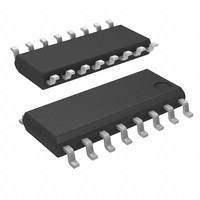
TEXAS INSTRUMENTS TS5V330D VIDEO SWITCH QUAD SPDT, SMD, 5V330 The TS5V330D is a Texas Instruments’ video switch IC. It is a 4-bit 1-of-2 multiplexer/demultiplexer.

195

May 31, 2021

Deborah

TEXAS INSTRUMENTS TS5V330D VIDEO SWITCH QUAD SPDT, SMD, 5V330

The TS5V330D is a Texas Instruments’ video switch IC. It is a 4-bit 1-of-2 multiplexer/demultiplexer. This blog mainly introduces pinout, equivalents, features, and other detailed information about TS5V330D.

TS5V330D

134In Stock
Min.: 1 Mult.: 1
Quantity Unit Price Ext. Price
1+ $0.67662$0.68
10+ $0.63832$6.38
100+ $0.60219$60.22
500+ $0.5681$284.05
1000+ $0.53595$535.95
Unit Price:$0.67662
Subtotal: $0.68
Looking for a better price? Want a lower wholesale price? Please send an RFQ, and we will respond immediately.
Quick Links

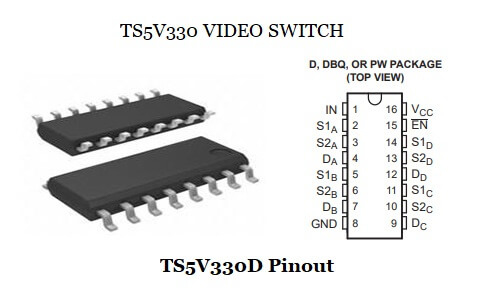
Pinout

CAD Model

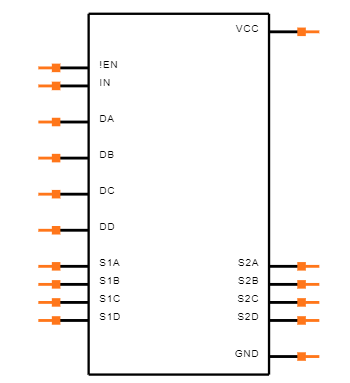
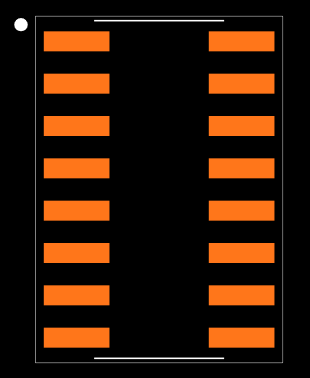
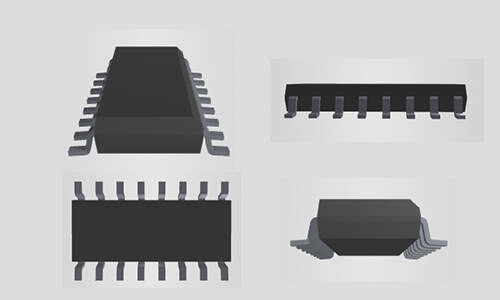
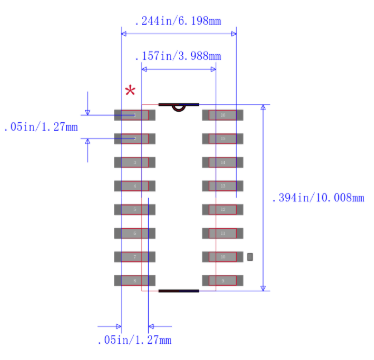
TS5V330D SymbolTS5V330D FootprintTS5V330D 3D model

Features

• Low Differential Gain and Phase (DG = 0.64%, DP = 0.1 Degrees Typ)

• Wide Bandwidth (BW = 300 MHz Min)

• Low Crosstalk (XTALK = –63 dB Typ)

• Low Power Consumption (ICC = 3 µA Max)

• Bidirectional Data Flow With Near-Zero Propagation Delay

• Low ON-State Resistance (ron = 3 Ω Typ)

• VCC Operating Range From 4.5 V to 5.5 V

• Ioff Supports Partial-Power-Down ModeOperation

• Data and Control Inputs Provide Undershoot Clamp Diode

• Control Inputs Can Be Driven by TTL or 5-V/3.3-V CMOS Outputs

• Latch-Up Performance Exceeds 100 mA Per JESD 78, Class II

• ESD Performance Tested Per JESD 22– 1000-V Charged-Device Model (C101)

• Suitable for Both RGB and Composite-Video Switching

Advantage

The TS5V330 is an ideal solution for video graphics cards.

  • Low RON, CON (3 Ω, 14 pF typ.): Maintains good signal quality at frequencies up to 300 MHz;

  • High off-isolation (–60 dB typ.): Excellent isolation at high frequencies when video switch is open;

  • Low crosstalk (–63 dB typ.): Excellent isolation between channels to prevent unwanted interference;

  • Low differential gain, phase (0.64%, 0.1º typ.): Very low signal distortion;

  • Space-saving, QFN package: Smallest PCB footprint.


Specifications

Texas Instruments TS5V330D technical specifications, attributes, parameters and parts with similar specifications to Texas Instruments TS5V330D.

TS5V330D Tech Specifications

Texas Instruments TS5V330D technical specifications, attributes, parameters and parts with similar specifications to Texas Instruments TS5V330D.

Product Attribute Attribute Value
Lifecycle StatusACTIVE (Last Updated: 6 days ago)
Factory Lead Time6 Weeks
MountSurface Mount
Mounting TypeSurface Mount
Package / Case16-SOIC (0.154, 3.90mm Width)
Number of Pins16Pins
Weight141.690917mg
Turn Off Delay Time6 ns
Operating Temperature-40°C~85°C TA
PackagingTube
JESD-609 Codee4
Pbfree Codeyes
Part StatusActive
Moisture Sensitivity Level (MSL)1 (Unlimited)
Number of Terminations16Terminations
Resistance10Ohm
Terminal FinishNickel/Palladium/Gold (Ni/Pd/Au)
ApplicationsVideo
Terminal PositionDUAL
Product Attribute Attribute Value
Terminal FormGULL WING
Peak Reflow Temperature (Cel)260
Number of Functions4Functions
Supply Voltage5V
Terminal Pitch1.27mm
Frequency300MHz
Base Part NumberTS5V330
Pin Count16
Number of Outputs8Outputs
Operating Supply Voltage5V
Power Supplies5V
Number of Channels4Channels
Max Supply Voltage5.5V
Min Supply Voltage4V
Operating Supply Current3μA
Nominal Supply Current3μA
Propagation Delay5 ns
Turn On Delay Time6 ns
Number of Inputs4Inputs
Product Attribute Attribute Value
Supply TypeSingle
Supply Current-Max (Isup)0.003mA
-3db Bandwidth300MHz Min
On-State Resistance (Max)10Ohm
Multiplexer/Demultiplexer Circuit2:1
Off-state Isolation-Nom60 dB
Switch CircuitSPDT
SwitchingBREAK-BEFORE-MAKE
Voltage - Supply, Single (V+)4V~5.5V
Normal PositionNO
FeaturesBi-Directional, RGB
Height1.75mm
Length9.9mm
Width3.91mm
Thickness1.58mm
REACH SVHCNo SVHC
Radiation HardeningNo
RoHS StatusROHS3 Compliant
Lead FreeLead Free
0 Products View Similar

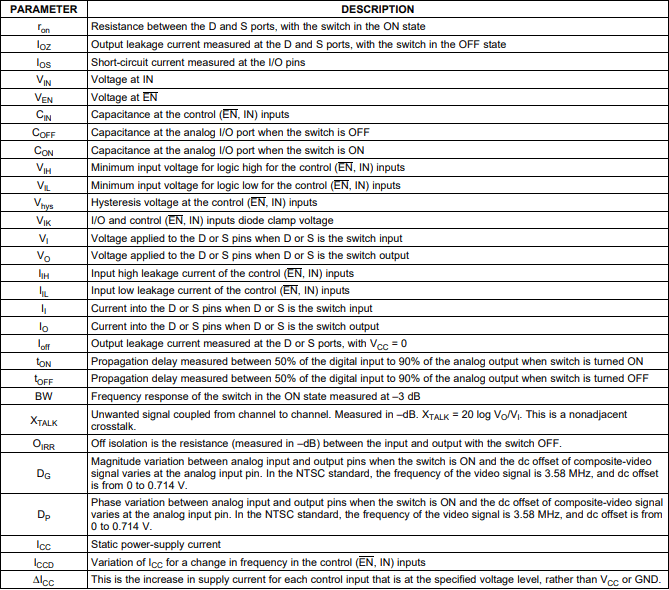
Parameter

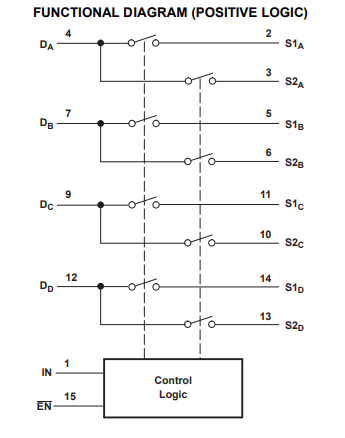
Functional Block Diagram

Alternative/Equivalent

  • TS5V330DBQR

  • TS5V330DR

  • TS5V330PW

  • TS5V330PWR

  • TS5V330RGYR

  • TS5V330DBQRE4

  • TS5V330DBQRG4

  • TS5V330RGYRG4

Application

1. Video Projectors

2. HDTV Monitors/Receivers

3. Notebook Computers

4. Digital HDTV Switch Boxes/Tuners

5. Multimedia Audio/Video Switchers

6. Servers/Routers with DVI Interfaces

The TS5V330 video switch is a 4-bit 1-of-2 multiplexer/demultiplexer with a single switch-enable (EN) input.

When EN is low, the switch is enabled and the D port is connected to the S port. When EN is high, the switch is disabled and the high-impedance state exists between the D and S ports. The select (IN) input controls the data path of the multiplexer/demultiplexer.

Low differential gain and phase make this switch ideal for composite and RGB video applications. This device has wide bandwidth and low crosstalk, making it suitable for high-frequency applications as well.

This device is fully specified for partial-power-down applications using Ioff. The Ioff feature ensures that damaging current will not backflow through the device when it is powered down. This switch maintains isolation during power off.

Package

TS5V330 package information

Manufacturer

As a global semiconductor company operating in 35 countries, Texas Instruments (TI) is first and foremost a reflection of its people. From the TIer who unveiled the first working integrated circuit in 1958 to the more than 30,000 TIers around the world today who design, manufacture, and sell analog and embedded processing chips, we are problem-solvers collaborating to change the world through technology.

Datasheet PDF

Download datasheets and manufacturer documentation for Texas Instruments TS5V330D.

TS5V330D Documents

Download datasheets and manufacturer documentation for TS5V330D

Frequently Asked Questions

1.Why is a Video Switch Needed?
With today’s growing demand for feature-rich applications, an original equipment manufacturer (OEM) can gain an edge on its competition by providing a high-performance, cost-effective solution to a recurring trend in video applications—multiplexing video signals. Texas Instruments (TI) now offers the quad SPDT (1:2 MUX/DEMUX) TS5V330 video switch in its specialty switches portfolio to address these applications.
2.How do video switches work?
Video switches work by taking analogue signals and switching them to different types of outputs such as HDMI. An example of this would be being able to output your laptop device via HDMI to an external monitor.
3.What is a analogue switch?
The analogue (or PETR) switch, also called the bilateral switch, is an electronic component that behaves in a similar way to a relay, but has no moving parts.
4.How does an analog switch work?
An analog switch acts like a solid-state relay (i.e., with no moving parts). Analog switches can also isolate devices at their terminals when the analog switch is OFF. When ON, they conduct both analog and digital signals, regardless of the direction in which the signal is traveling.
FAQ
1.Why is a Video Switch Needed?
With today’s growing demand for feature-rich applications, an original equipment manufacturer (OEM) can gain an edge on its competition by providing a high-performance, cost-effective solution to a recurring trend in video applications—multiplexing video signals. Texas Instruments (TI) now offers the quad SPDT (1:2 MUX/DEMUX) TS5V330 video switch in its specialty switches portfolio to address these applications.
2.How do video switches work?
Video switches work by taking analogue signals and switching them to different types of outputs such as HDMI. An example of this would be being able to output your laptop device via HDMI to an external monitor.
3.What is a analogue switch?
The analogue (or PETR) switch, also called the bilateral switch, is an electronic component that behaves in a similar way to a relay, but has no moving parts.
4.How does an analog switch work?
An analog switch acts like a solid-state relay (i.e., with no moving parts). Analog switches can also isolate devices at their terminals when the analog switch is OFF. When ON, they conduct both analog and digital signals, regardless of the direction in which the signal is traveling.

TAGS

Share