
Large thermal power plants have traditionally produced electricity, and centralized, top-down transmission and distribution networks have distributed it to consumers. The conventional electrical systems were also centralized in terms of control and supervision. Through high-voltage transmission and medium- and low-voltage distribution systems, power travels from power plants to consumers. The marketing, energy management, unit commitment, power flow, monitoring, and protection planning for conventional power systems are all managed centrally. Therefore, to meet the system demand with the desired level of reliability, powerful and sufficient transmission facilities are needed.
Emergence of Modern Power System
Both global warming and the depletion of fossil fuels have accelerated paradigm shifts away from thermal power plants and toward clean energy resources in the production of electric power. As a result, distribution systems now incorporate small-scale renewable energy sources like photovoltaic and wind systems.
The Idea of Distribution Generation
The use of renewable energy sources to generate electricity has altered the players in the power and energy markets, ultimately resulting in the deregulation of the power systems. Since then, the idea of distribution generation (DG) has drawn more and more attention as the structure of power systems is being developed. Additionally, the transmission and medium-voltage distribution systems have been integrated with large-scale renewable facilities like photovoltaic parks and wind farms. The direction of the power flow has changed as a result of the active networks created.
Importance of Energy Storage Systems
Additionally, as the use of renewable energy sources with intermittent output power increases, energy storage systems must be used to handle generation-consumption mismatches as well as smooth out power and voltage fluctuations. Additionally, if we are moving toward entirely renewable energies, using utility-scale energy storage is necessary. New technologies like electric vehicles (EVs) and DC transmission systems are important parts of future modern power systems in addition to renewable energy sources.
Role of Electric Vehicles
Growing electric vehicle technology will have an impact on how power systems are planned and operated. A suitable infrastructure that can supply the batteries in a timely manner may be needed to increase the penetration of electric vehicles in the market. Furthermore, electric vehicles might need bidirectional power flow to support the grid. Wireless charging stations can improve transportation services for modes of public transportation like electric buses. Moreover, for power grids with high electric vehicle penetration, intelligent control strategies should be applied.
DC Transmission System
The DC transmission devices also aid in the modernization of the grid. It is necessary to connect power networks to reach 100% renewable energy, and high voltage DC (HVDC) transmission systems can do this most affordably. Also, modern distribution systems will be powered up to meet demand locally. Connecting the medium-voltage distribution systems could make it possible for these systems to work reliably. Medium-voltage DC (MVDC) transmission systems can help with this integration because they are more stable and cost-effective than AC systems.
Structure of Future Power System
Real-time control and tracking systems, which can be distributed or decentralized, are required for the optimal operation of new power system technologies, including electric vehicles, energy storage systems, microgrids, and renewable resources. So, as shown in Figure 1, the overall framework for future cyber-physical power systems can be divided into three layers: physical, communication and coupling, and decision.
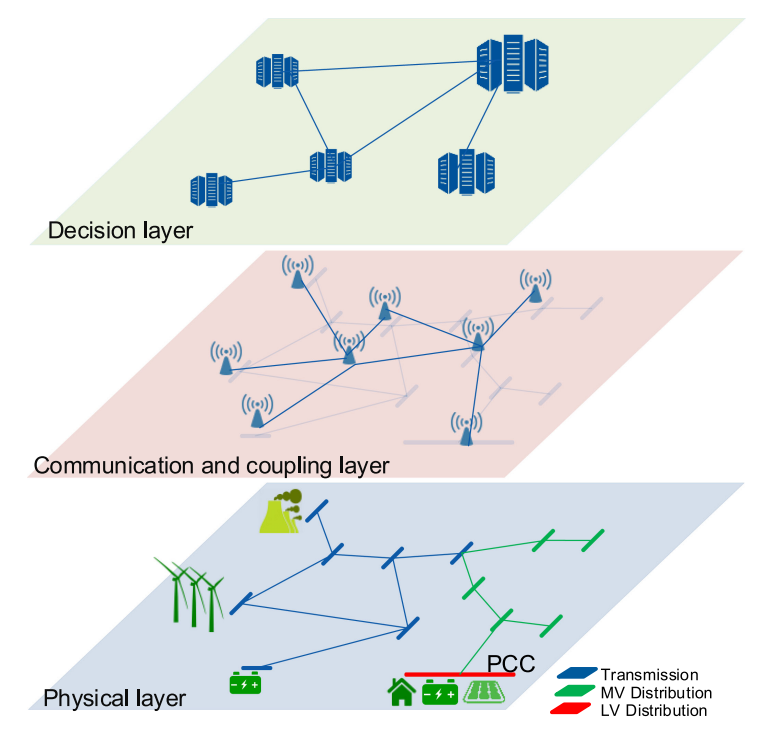
Fig. 1: Cyber-physical structure of modern power systems with three layers of operation Source: IEEE Open Journal of Power Electronics
The future physical layer will consist of hybrid AC-DC grids, taking into account the integration of new technologies into the power systems, as shown in Figure 2. In contrast to conventional power systems, large-scale renewable energy facilities and utility-scale energy storage systems are connected to the transmission system. Additionally, medium voltage DC transmission systems are used to connect high voltage DC and distribution systems, as well as medium voltage distribution systems.
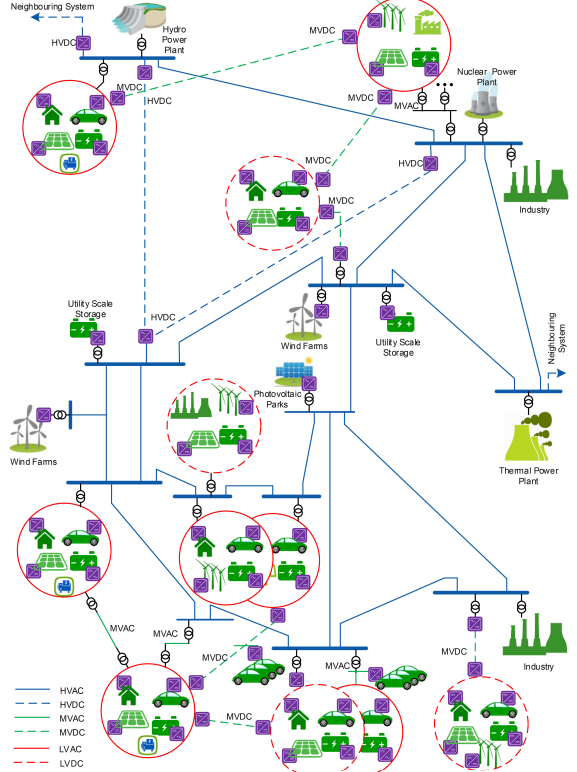
Fig. 2: Typical structure of modern power systems with hybrid AC and DC sub-grids. Source: IEEE Open Journal of Power Electronics
Microgrid
Additionally, energizing distribution networks as active distribution systems has advantages from the perspectives of energy efficiency, stability, security, availability, and resilience. Microgrid technology helps active distribution networks operate in the event of any contingency that might prevent the delivery of energy. To support its critical loads in the absence of a utility, the microgrid is an active power grid with enough energy sources, including power supply and energy storage.
Classification of Microgrid
According to the microgrid's location and size, the microgrid structures can be categorized. It is classified as a single-customer microgrid, partial feeder microgrid, full feeder microgrid, or substation microgrid based on its location on a distribution feeder. Additionally, microgrids can be classified as pico-, nano-, micro-, milli-, and inter-grids depending on their size.
Both classifications conceptually suggest a dynamic structure for future distribution networks, where an island zone or feeder can operate as a separate sub-grid. The micro-grids are therefore the dynamically decoupled pillars of the upcoming power systems. Depending on the primary energy source, the microgrids can be either direct current (DC) or alternative current (AC), as well as hybrid AC/DC microgrids.
Advantages
Since each microgrid essentially consists of a small grid connected to nearby feeders or grids, it must ensure adequate and secure operation. In reality, each microgrid has a backup in the utility or a nearby grid. Therefore, appropriate monitoring and control of any contingency or failure occurrence can achieve proper separation of the microgrids to operate in island mode. Recent information and communication advancements make the control and monitoring of power systems simpler. The smart grid introduces communication systems to the active distribution networks.
Strong communication infrastructures, central control, and decision-making systems are needed for the operation of such a complex grid with active networks and communication systems when using a top-down control strategy similar to that used in conventional power systems.
As a result, local communication networks and distributed power and energy management strategies can support the reliable operation of modern power systems. Therefore, both the structure and control levels of power systems will be as distributed as possible. The efficiency and stability of the structure will be improved as it becomes more distributed, and the control system will become more resilient to unpredictability and cyberattacks as it becomes more distributed.
Summarizing the Key Points
- Renewable energy sources can improve energy security in traditional centralized power systems. Integrating renewable energy sources into power grids requires intelligent control strategies to handle generation-consumption mismatches and voltage fluctuations.
- Energy storage systems are necessary to smooth out power and voltage fluctuations caused by intermittent output from renewable energy sources. Utility-scale energy storage is essential for moving towards entirely renewable energies.
- The future power system will likely feature a hybrid AC and DC sub-grid structure, with active distribution systems and energy storage systems playing a critical role.
- A microgrid is a small-scale power grid that can operate independently or in conjunction with the main power grid. It typically includes distributed energy resources such as solar panels, wind turbines, and energy storage systems.
References
Peyghami, S., Palensky, P., & Blaabjerg, F. (2020). An Overview on the Reliability of Modern Power Electronic Based Power Systems. IEEE Open Journal of Power Electronics, 1, 34–50. https://doi.org/10.1109/ojpel.2020.2973926