
The global electronics supply chain is entering a severe structural shortage of Multilayer Ceramic Capacitors (MLCCs) in 2026. Unlike previous cyclical consumer electronics shortages, this deficit is driven by a permanent paradigm shift: the explosive growth of AI data servers and 800V electric vehicle (EV) platforms. As top-tier manufacturers like Samsung Electro-Mechanics reallocate production lines to chase high-margin, high-reliability components, the market is experiencing a cascading deficit that is rapidly wiping out channel inventory for mid-tier specifications like 10μF, 22μF, and 47μF. Compounded by surging raw material costs for silver and copper, procurement managers and hardware engineers must abandon just-in-time (JIT) models and adopt aggressive buffering and strategic sourcing strategies to protect their Bill of Materials (BOM).
The AI and 800V EV Demand Shock
The primary catalyst for the 2026 MLCC shortage is the architectural evolution of power delivery in high-performance computing and automotive sectors.
In the AI sector, cloud service providers are rapidly deploying custom ASICs and advanced GPUs, a boom that TrendForce reports is actively reshaping capacitor demand. These processors operate at sub-1V levels but experience massive, instantaneous transient current swings of tens to hundreds of amperes. To prevent voltage droop and stabilize the power delivery network, engineers must place high-capacitance MLCCs as close to the GPU power pins as possible. Furthermore, AI server racks are upgrading from legacy 12V systems to 48V and even 800V power architectures. This transition requires components that can handle higher voltages while maintaining low Equivalent Series Resistance (ESR) and Equivalent Series Inductance (ESL).
.jpg)
The BOM impact is staggering. During the validation of the AMD MI450 platform, designers replaced traditional aluminum electrolytic capacitors with MLCCs, resulting in a 632% surge in the usage of 47μF/2.5V X6S 0402 MLCCs—totaling 10,544 units per board. Similarly, a single GB200 NVL72 AI server rack now consumes up to 440,000 MLCCs. When engineers take advantage of ceramic capacitors to boost power density and conversion efficiency, the sheer volume of components required scales exponentially.
Simultaneously, the automotive industry's shift to 800V EV platforms has increased MLCC usage per vehicle by over 50%. Automotive-grade (AEC-Q200) MLCCs represent a rigid, non-substitutable demand segment that is consuming a massive share of global manufacturing capacity.
The Raw Material Squeeze: Silver and Copper Price Transmission
Beyond demand-side pressure, the manufacturing cost of MLCCs is skyrocketing due to raw material constraints. Visual demonstrations of MLCC internal architectures reveal an interleaved structure of alternating ceramic dielectric layers and metal electrodes, finished with multi-layer metal terminations.
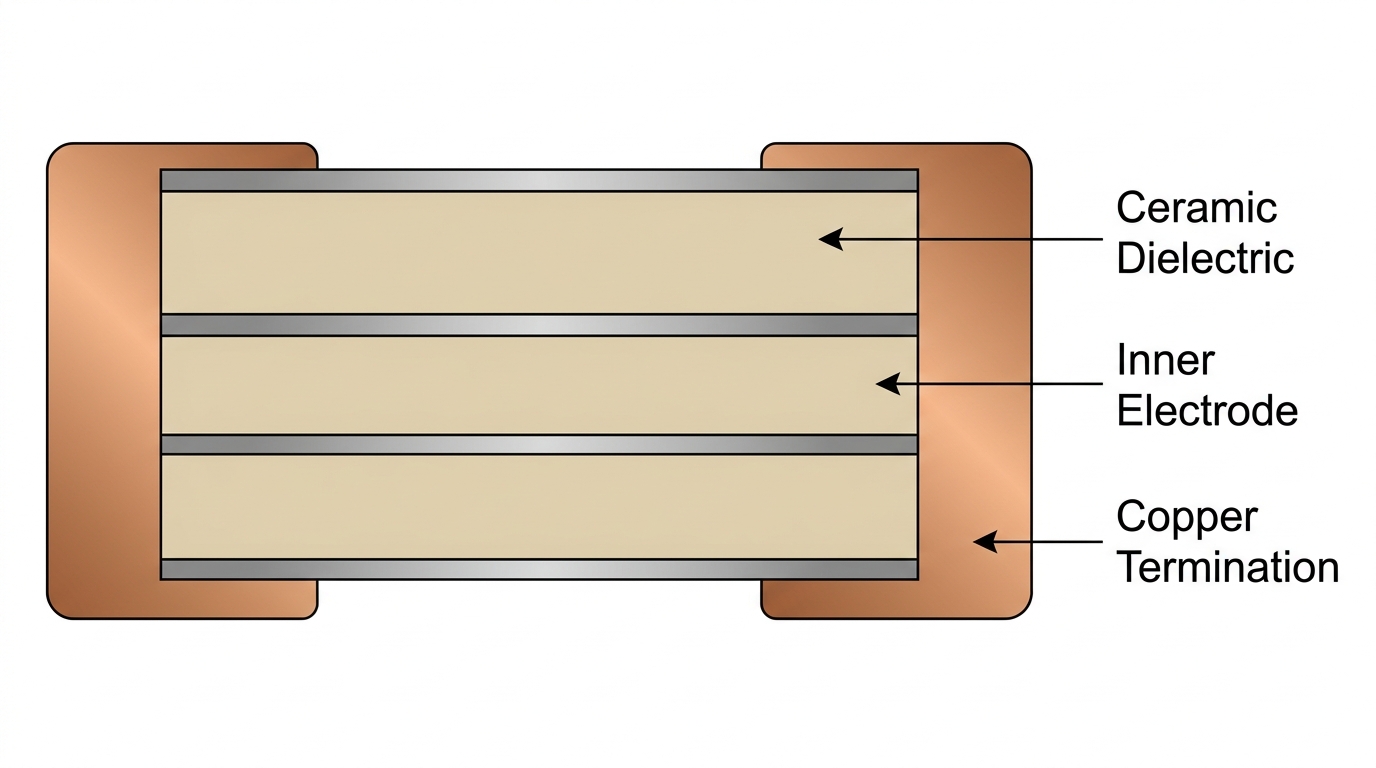
In 2026, the metals required for these inner electrodes and terminations are experiencing severe price inflation. Silver, which accounts for 42% to 58% of the production cost for certain MLCCs, has seen spot prices surge past $76 per ounce. Copper prices have risen by 27%, and nickel by 19%.
This creates a direct "price transmission" effect. Manufacturers are forced to pass these raw material costs down the supply chain, resulting in a 15% to 35% price hike for high-end MLCCs. This inflationary pressure is not isolated to capacitors; similar raw material constraints are forcing procurement teams to rethink their automotive-grade resistors 2026 price surge stocking strategy as well.
The Cascading Deficit: Why 10μF, 22μF, and 47μF Are Disappearing
A critical misunderstanding of the 2026 crisis is the belief that it is a "total shortage." In reality, it is a structural shortage.
Major manufacturers in Japan and South Korea are actively abandoning low-end, low-margin consumer orders to allocate their limited capacity to AI and automotive sectors. However, manufacturing ultra-high-end MLCCs requires thinner dielectric layers, higher layer counts, and finer ceramic particles. The yield rates for these AI-specific MLCCs currently hover between 45% and 65%.
Because manufacturers are dedicating disproportionate machine time to overcome these low yield rates, production lines for mid-tier specifications are being starved. This has triggered a severe cascading deficit. The intense demand for high-capacitance AI components has directly squeezed the capacity for 10μF, 22μF, and 47μF MLCCs—specifications that are ubiquitous in standard PCs, industrial controls, and networking equipment. Channel inventory for these high-capacitance models has dropped to a dangerously low 1 to 1.5 months, and lead times have stretched to 16–20 weeks.
Engineering Nuance: Avoiding Design Traps in a Shortage
When primary MLCC choices face 20-week lead times, engineers are often forced to source alternative components. However, improper substitution can lead to catastrophic circuit failures. Understanding capacitor basics and capacitor types is critical when navigating a shortage.
📺 All about MLCC (MultiLayer Ceramic Capacitors)
- The DC Bias Trap: High-voltage applications inherently reduce the effective capacitance of an MLCC due to the DC bias effect. If a 10μF capacitor is operated near its maximum voltage rating, its actual capacitance may drop by over 50%. Engineers must aggressively derate the voltage—selecting an MLCC rated for significantly higher than the operating voltage—to prevent failure.
- Mechanical Stress and Soft-Terminations: Standard MLCCs are highly prone to cracking under mechanical stress, such as PCB flex during assembly or extreme temperature fluctuations. For harsh automotive or industrial environments, buyers must source "Soft-Termination" MLCCs. These feature a distinct polymer layer between the metal termination and the ceramic body that absorbs mechanical stress.
- The Y5V Dielectric Danger: In a desperate search for high capacitance, buyers might be tempted by Class II Y5V dielectrics. However, engineering tests show that Y5V capacitors are incredibly unstable, losing up to 82% of their capacitance at extreme temperatures. They are entirely unsuitable for precision or critical power applications.
Procurement Strategies to Protect Your BOM
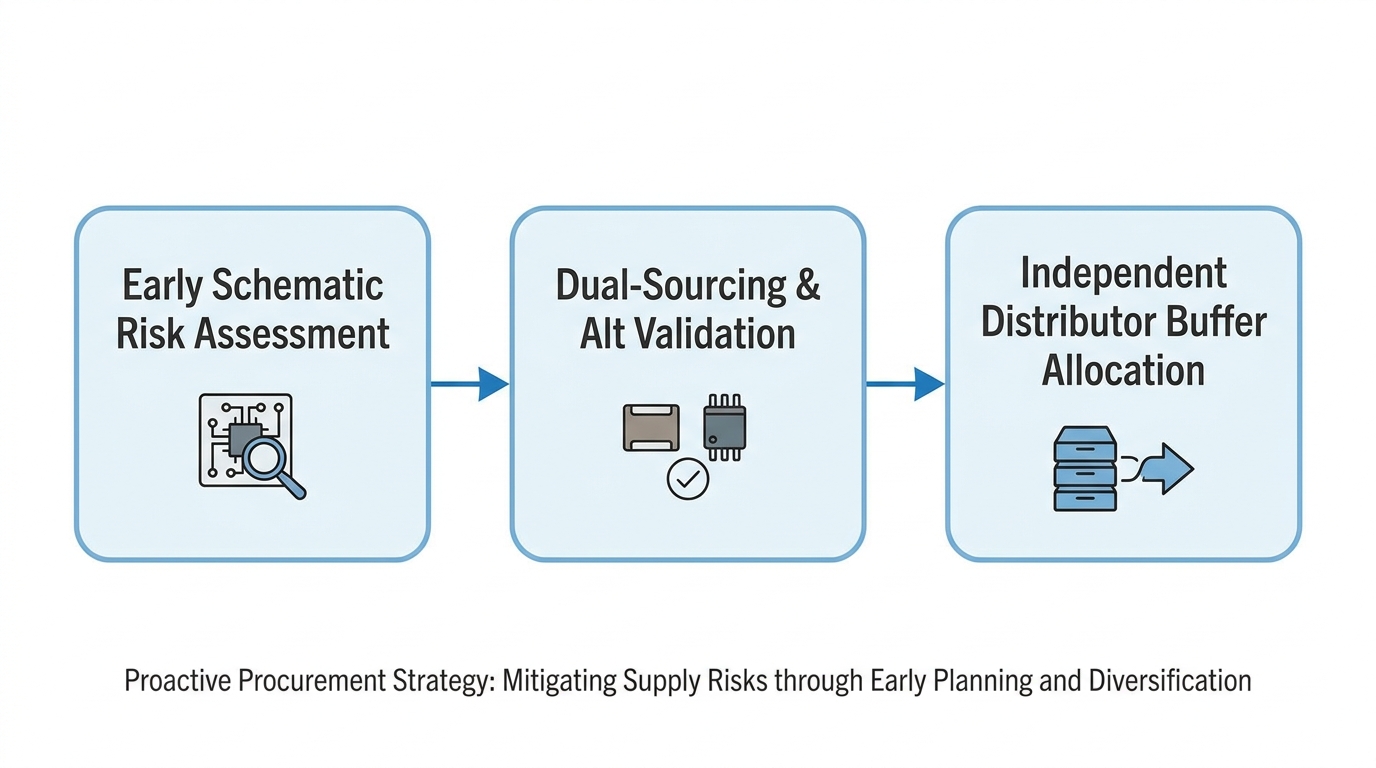
To survive the 2026 MLCC shortage, OEM and EMS buyers must shift from reactive purchasing to proactive supply chain stabilization.
- Assess Lead-Time Risk at BOM Creation: Do not wait for the final design review to check component availability. Hardware engineering leads and procurement managers must collaborate during the initial schematic phase to identify high-risk MLCCs (particularly 47μF and high-voltage automotive specs) and design in multiple approved alternatives.
- Avoid the Tantalum Trap: Historically, engineers mitigated MLCC shortages by swapping to tantalum capacitors. In 2026, this is a flawed strategy. Tantalum capacitors are facing their own 15% to 30% price hikes and distinct supply chain constraints tied to raw ore availability.
- Partner for Deep Inventory Access: Relying solely on franchised distribution allocations will leave production lines stalled. Companies must partner with trusted independent distributors to secure buffer stock. JAK Electronics offers deep inventory access to original, high-performance automotive and industrial-grade Multilayer Ceramic Capacitors (MLCCs) and chip inductors from leading global manufacturers, helping companies secure stable supply chains amid raw material price surges and allocation bottlenecks.
Decision Matrix: MLCC Sourcing and Substitution
| Component Profile | Primary 2026 Risk Factor | Engineering Mitigation | Procurement Strategy |
|---|---|---|---|
| High-Capacitance (10μF - 47μF) | Cascading capacity deficit; lead times >16 weeks. | Use parallel pairing (e.g., smaller MLCCs in parallel) to achieve target capacitance if large values are unavailable. | Secure 3-6 month buffer stock immediately; expand Approved Vendor List (AVL). |
| High-Voltage / Automotive (AEC-Q200) | Rigid demand from 800V EVs; low manufacturer yield rates. | Ensure strict DC bias derating; mandate Soft-Termination for mechanical reliability. | Do not substitute with commercial grade. Source original automotive-grade passives through deep-inventory partners. |
| Low-Capacitance / Consumer Grade | Price inflation driven by silver/copper costs, not absolute scarcity. | Avoid Y5V dielectrics; account for aging effects in X5R/X7R. | Monitor spot market pricing; leverage distributor networks to bypass localized price gouging. |
What to Ignore
- "There is a total shortage across all capacitor types." Ignore this panic narrative. The shortage is highly structural. Low-end, small-case-size consumer MLCCs are relatively available, though they are more expensive due to raw material costs. The true bottleneck is in high-capacitance, high-voltage, and automotive-grade specs.
- "Tantalum is a safe drop-in replacement." Ignore advice suggesting a wholesale shift to tantalum capacitors. Tantalum supply chains are equally constrained, and their ESR characteristics differ significantly from MLCCs, potentially destabilizing high-frequency AI power circuits.
- "Domestic substitution will solve the gap immediately." While emerging manufacturers are growing, their yield rates for ultra-high-end, high-reliability MLCCs required for AI and 800V EVs are not yet sufficient to replace top-tier Japanese and Korean components in critical applications.
Frequently Asked Questions (FAQs)
Why are 47μF MLCCs specifically so hard to find right now?
The 47μF specification is the exact sweet spot for current buffering in new AI accelerator platforms (like the AMD MI450). Because AI servers require tens of thousands of these specific capacitors per board, global capacity has been instantly absorbed, leaving standard industrial and PC manufacturers without supply.
How much do raw materials actually impact MLCC pricing?
Significantly. Silver makes up 42% to 58% of the production cost for certain MLCCs, primarily used in the inner electrodes and terminations. With silver and copper prices surging in 2026, manufacturers are passing these baseline cost increases directly to buyers.
Can I use standard MLCCs in an automotive application if AEC-Q200 parts are out of stock?
No. Standard MLCCs lack the mechanical durability required for automotive environments. They are highly susceptible to cracking under PCB flex and thermal shock. Automotive applications require Soft-Termination MLCCs to prevent catastrophic short circuits.
How long is the current MLCC shortage expected to last?
Industry analysts project the structural shortage for high-capacitance and high-voltage MLCCs will persist into 2027 or 2028. This extended timeline is due to severe bottlenecks in the delivery of high-end manufacturing equipment, which currently has lead times of 1 to 1.5 years.
What is the best way to handle DC bias in high-voltage circuits?
Always select an MLCC with a voltage rating significantly higher than your circuit's actual operating voltage. Because DC bias inherently reduces effective capacitance, aggressive derating ensures the capacitor maintains enough capacitance to function correctly under load.
References
- MLCC: The Key Component for Power, Computing, Network and the New Era of AI Servers — Samsung Electro-Mechanics
- TrendForce: CSP in-house AI ASIC Boom Reshapes Capacitor Demand — TrendForce