
Formula for dBm to watts conversion
dBm and W are two different power units, and the conversion relationship between them is relatively simple. dBm is a relative power unit, which represents the power value relative to 1 milliwatt, while W is an absolute power unit, which represents the actual power value.
1 milliwatt = 0.001 watts
1 watt = 1,000 milliwatts
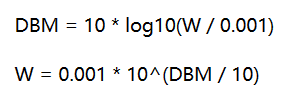
According to this conversion relationship, we can get the following conversion formula for dBm and W:
dBm to watts conversion example
Suppose you have a signal with a power of 2 watts and want to convert it to dBm, according to the formula, you get:

Therefore, the power value of this 2-watt signal is about 30dBm
Suppose you have a signal with a power of 40dBm and want to convert it to watts, according to the formula, you get:

Therefore, the power value of this 40dBm signal is about 10 watts
Note: The conversion relationship between dBm and W only applies to signals of the same frequency, and to convert signals of different frequencies, factors such as their frequency response and antenna gain need to be taken into account. In addition, the dBm and W conversion relationship is only applicable to a single signal, if there are multiple signals at the same time, you need to perform power addition operations.
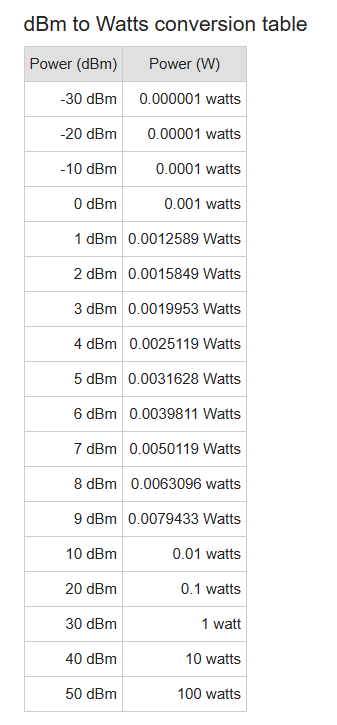
dBm to watts Conversion Chart
Power unit
The power unit is used to measure the amplitude of the transmission and the amplitude of the reception. In other words, a power unit measures absolute power. The relative unit is usually used to calculate the loss and gain after adding a cable or antenna. The relative unit is also used to calculate the power difference from point A to point B, that is, the relative unit is used to measure the power change.
|
Absolute units |
relative units |
|
W |
dB |
|
mW |
dBi |
|
dBm |
dBd |
What is W
W is the basic unit of power, and 1W is equivalent to 1 ampere of current at 1 volt

What is mW
mW is also a unit of power, 1mW=0.001W
What is dB and dBm?
dB (decibel) is a relative unit, not an absolute unit of power, so it is used to describe the difference between two values, in other words, dB is a relative expression that represents an indicator of the change in power. dBm (decibel-milliwatt) is a unit of power measurement that expresses power levels in decibels relative to one milliwatt (1 mW). It is commonly used in telecommunications, radio frequency, and electronics to quantify power levels in a more manageable and logarithmic scale.
In dBm, 0 dBm is equal to 1 milliwatt (mW) of power. Positive dBm values indicate power levels greater than 1 mW, while negative dBm values indicate power levels less than 1 mW. For example, 10 dBm represents 10 milliwatts, and -10 dBm represents 0.1 milliwatts.
So the difference between dB and dBm is that dB is the relative unit of the comparison of power levels, while dBm is the absolute unit of the direct measurement of power levels, the unit is milliwatts.