
Wire Size
In every building, the installation of wires and cables is necessary to meet electrical requirements. Choosing high-quality wiring is crucial for ensuring safe electrical connections. One of the standards to consider when selecting wires is wire gauge, also known as wire size. Different wire gauges can be used for various application needs.
Wire gauge sizes indicate the thickness of the wire, with a specific number representing the wire size. Higher numbers correspond to thinner wires. The American Wire Gauge (AWG) method is commonly used in industries to measure wire thickness, established as a standard in the United States.
Common Wire Size Measurement Systems
American Wire Gauge (AWG)
AWG (American Wire Gauge), also known as Brown & Sharpe wire gauge, is a standard for distinguishing wire diameters. This standardized wire gauge system was first introduced in the United States in 1857. The numerical value preceding AWG (e.g., 24AWG, 26AWG) represents the number of times the wire must pass through a hole to achieve the final diameter. The higher the number, the more times the wire passes through the hole, resulting in a smaller wire diameter.
Millimeters (mm)
- Metric system measurement for wire diameter.
- Provides precise and accurate wire sizing.
- Commonly used in international standards.
Inches
- Imperial system measurement for wire sizes.
- Used in some industries and applications.
- Conversion to metric units may be required for consistency.
Cross-sectional area
- Measurement of the area of a wire's cross-section.
- Indicates the amount of conductor material in the wire.
- Helps determine wire capacity and current-carrying capability.
Wire Gauge Conversion Chart
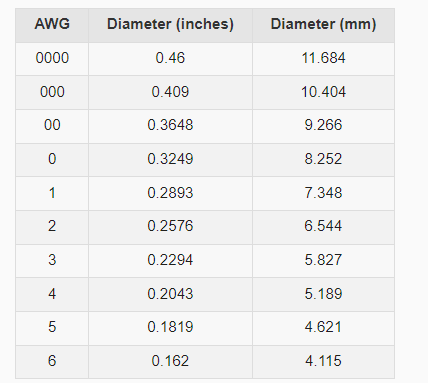
How to Calculate Wire Size
To calculate the size of a wire, factors such as the rated current of the wire, conductor cross-sectional area, wire material, conductor length, and other considerations need to be taken into account. Generally, as the current increases, the cross-sectional area of the wire needs to be larger to carry more current. Therefore, it is necessary to calculate the appropriate wire gauge based on the electrical design requirements.
The specific calculation method is as follows:
1. Calculate the rated current of the wire based on the current value that needs to be transmitted. Typically, the sum of the transmission current and the load current equals the rated current.
2. Calculate the cross-sectional area of the conductor based on the rated current of the wire and the required voltage value. Generally, the larger the cross-sectional area of the conductor, the higher the current-carrying capacity. Therefore, calculate the power passing through the wire based on the current and voltage, and then determine the required conductor cross-sectional area considering material parameters.
3. Determine the type and specification of the wire based on factors such as the material and length of the conductor. Different conductor materials and cross-sectional areas have different resistivity and transmission capabilities. Therefore, material factors need to be considered when selecting the appropriate wire.
4. Verify the selected wire gauge based on additional factors such as wire length and operating environment. If the wire length is long or the operating environment is harsh, a wire with a larger conductor cross-section needs to be chosen.
How to Calculate Wire Cross-Sectional Area
The relationship between diameter and radius is that the radius is equal to half the diameter, i.e., r = d/2, where r is the radius and d is the diameter.
Based on the above formula, the calculation steps for determining the conductor cross-sectional area are as follows:
1. Determine the diameter or radius of the conductor.
2. If the diameter is known, divide the diameter by 2 to obtain the radius.
3. Substitute the radius value into the formula π*r² to calculate the conductor's cross-sectional area.
Example Calculation of Wire Cross-Sectional Area
Assuming the diameter of the conductor is 10mm, we first need to convert the diameter to radius. Therefore, the radius of the conductor is 10mm/2 = 5mm. Next, by substituting the radius value into the formula, we get 3.14*5² = 78.54mm².
Using the calculation method described above, we have determined the conductor's cross-sectional area to be 78.54mm².
ALSO SEE