
What Is Volume
Volume is a measurement of the amount of space occupied by a three-dimensional object or substance. It is typically expressed in cubic units such as cubic centimeters (cm³), cubic meters (m³), liters (L), or gallons. Volume is a fundamental concept in mathematics and physics, and it is used to quantify the capacity, size, or amount of a substance or object. In everyday life, volume is commonly used to measure liquids, solids, and gases.
Metric system and Imperial system of measurement
Metric system:The Metric system is an internationally recognized decimal system of measurement that is based on units of 10. It provides a standardized and coherent method of quantifying physical quantities such as length, weight, volume, and temperature. The key features of the Metric system include:
1. Base Units: The Metric system has base units for fundamental physical quantities, such as the meter for length, gram for mass, liter for volume, and Celsius for temperature.
2. Prefixes: The Metric system uses prefixes to denote multiples or fractions of the base units. For example, "kilo-" represents a thousand times the base unit, while "milli-" represents a thousandth of the base unit.
3. Consistency: The Metric system is consistent and systematic, with conversions between units based on powers of 10. This makes it easy to convert between different units within the system.
4. International Adoption: The Metric system is widely adopted around the world and is the preferred system of measurement in most countries, including scientific and industrial applications.
5. Simplicity: The Metric system is known for its simplicity and ease of use, making it straightforward to perform calculations and measurements with its standardized units.
Overall, the Metric system provides a unified and user-friendly approach to measurement, promoting consistency and accuracy in scientific, industrial, and everyday applications.
Imperial system:The Imperial system, also known as the British Imperial system, is a system of measurement historically used in the United Kingdom and its former colonies, including the United States. While many countries have transitioned to the metric system, some aspects of the Imperial system are still in use in the United States and a few other countries. Key features of the Imperial system include:
1. Units of Measurement: The Imperial system uses units such as feet, inches, pounds, and gallons to measure length, weight, volume, and other quantities. These units have historical origins and are not based on a consistent decimal system like the metric system.
2. Complexity: The Imperial system can be more complex and less standardized than the metric system. For example, there are different units for volume (fluid ounces, pints, quarts, gallons) and weight (ounces, pounds, stones).
3. Customary Usage: In the United States, the Imperial system is often referred to as the US customary system. It is still used for certain applications, such as road signs, construction, and some industries, leading to a dual system of measurement in the country.
4. Less Precision: The Imperial system may be less precise than the metric system due to its varied units and conversion factors. This can lead to challenges in conversions and calculations.
5. Resistance to Change: Despite the global shift towards the metric system, the Imperial system remains in use in some countries due to historical traditions, cultural preferences, and the costs associated with transitioning to a new system.
Overall, while the Imperial system has historical significance and cultural relevance in certain regions, the metric system is more standardized, coherent, and widely accepted on a global scale for its simplicity and ease of use in scientific, industrial, and everyday applications.
Units of Volume
1. Milliliter (mL): A metric unit equal to one-thousandth of a liter.
2. Liter (L): A metric unit equal to 1000 milliliters or one cubic decimeter.
3. Cubic centimeter (cm³): A metric unit representing the volume of a cube with side lengths of 1 centimeter.
4. Cubic meter (m³): A metric unit equal to 1000 liters or one million cubic centimeters.
5. Gallon: A unit of volume used in the imperial and US customary systems, with different values in each system.
6. Fluid ounce (fl oz): A unit of volume commonly used for measuring liquids in the US customary system.
How to Convert Units of Volume
1. Metric Volume Units:
- 1 L = 1000 mL
- 1 L = 1000 cm³
- 1 L = 0.001 m³
- 1 KL = 1,000 L
- 1 m³ = 1000 L
- 1 m³ = 1,000,000 cm³
- 1 m³ = 1000 kL
2. Imperial Volume Units:
- 1 gallon = 128 fluid ounces (fl oz)
- 1 gallon ≈ 3.78541 liters
- 1 liter ≈ 0.264172 gallons
Example
Convert 300L to m³ and ㎝³
1L=0.001m³
1m³=1,000,000cm³
300L=0.3m³=300,000㎝³
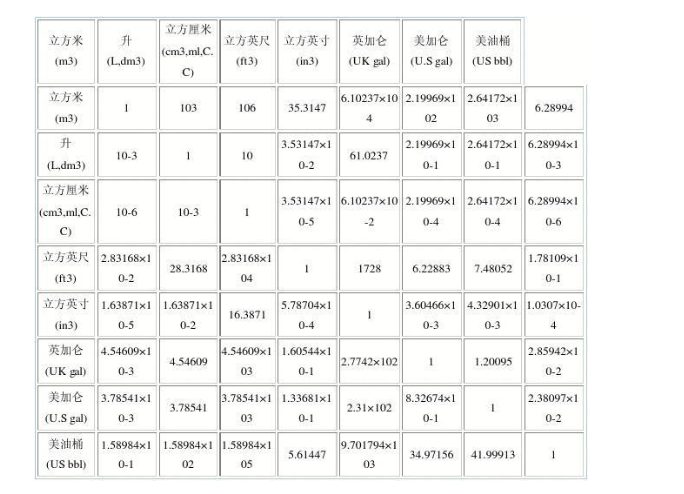
Volume Conversion Chart
ALSO SEE:
6 Band Resistor Color Code Calculator - The 6 Band Resistor Color Code Calculator can be used to calculate the resistance value of a 6 band resistor.
Energy Conversion - Energy conversion refers to the process of transforming one form of energy into another form.
Temperature Conversion - Temperature conversion refers to the process of converting a temperature value from one unit of measurement to another.