
Overview: EV charging has gained popularity recently, but the coordinated charging of several EVs is still a challenge. This article will describe how smart charging can help address this critical challenge.
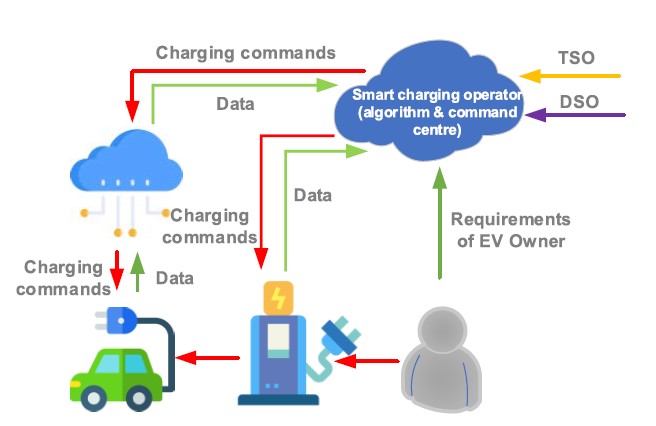
Fig. 1. A schematic of smart charging infrastructure. Source: S. Tirunagari et al.
Smart charging provides advantages to both EV owners and power utilities by allowing EVs to charge at the most convenient times of the day. This is especially true during low-demand periods when the cost of energy is also low. Smart charging calls for supplementary infrastructure, including chargers equipped for the technology, a communications layer, and a processing backbone. As illustrated in Fig. 1, the smart charging operator gathers information about the EV (via the Original Equipment Manufacturer (OEM) cloud), the EV owner, and the network operators (e.g., distribution system operator (DSO), transmission system operator (TSO)) in order to formulate smart charging commands (such as charging start/stop times and charging rates) for the EVs. As a result, it is the preferred charging method for reducing the impact of EV charging on the power system network. Optimizing electricity demand with smart charging helps to avoid network constraints like grid congestion.
In addition, smart charging helps maintain grid stability by balancing electricity generation with load demand; electric vehicles, for instance, can contribute to the network's power supply when renewable energy sources are in short supply, and they can charge when there is an abundance of renewable energy sources available. Uncoordinated EV charging has the potential to significantly impact network capacity by increasing peak demand and, consequently, increasing network congestion. Smart charging, on the other hand, with an optimal EV charging schedule (EVCS), can allocate the charging load to avoid power peaks but at an infrastructure cost.
In order to mitigate the negative effects of EV load charging on peak demand and feeder voltages in the system. Two strategies were proposed by Dubey et al., one based on classical quadratic programming (QP) and the other on market-based multi-agent system (MAS) coordination, considering a residential area with 63 households to shift the charging load over time and control the rate of charging. The first approach uses time-of-use (TOU) pricing to allow utilities to indirectly regulate EV charging, lowering peak load demand and easing transformer overheating and overloading concerns. The second approach is for utilities to use smart charging algorithms to reduce the total electricity cost in a real-time electricity market by directly controlling the charging rates and the start time of EV charging.
Benefits Of V2G
When an electric vehicle is connected to the power grid via vehicle-to-grid (V2G), energy flows back and forth between the vehicle's battery and the grid. Power connection to the grid, control communication between vehicles and the grid operator, and on-board/off-board intelligent metering are the three components necessary for successful V2G operation. The smartest V2G strategy appears to be the most efficient and beneficial for grid operators and EV owners alike. To achieve the highest possible net return from the V2G schemes, cooperation between the grid operator and vehicle owners or aggregators is crucial. The efficiency, stability, and dependability of the power grid are all areas that V2G has the potential to boost.
However, there are many obstacles that V2G must overcome before it can be widely implemented. These include things like premature battery degradation, spending money on communication infrastructure to allow EVs to talk to the grid, impacts on grid equipment, changes to other infrastructure, and more. Even though V2G operation may shorten the life of EV batteries, it is expected to provide financial benefits to EV owners and grid operators.
Economic, Social, and Environmental Benefits of Smart Charging
Smart charging may maximize the use of available green energy sources, minimize energy losses, increase the grid load factor, and maximize fully charged EVs, in addition to the various advantages it provides to power systems. Additionally, smart charging helps meet financial goals like decreasing generation costs, operating costs, and benefits maximization for aggregators as well as socio-environmental goals like lowering CO2 and greenhouse gas (GHG) emissions.
Investment in transmission and distribution network assets, including power lines and transformers, might be postponed or completely avoided with the use of EV charge and discharge management. In other words, if EV consumers use a smart charger rather than an uncoordinated charger, large savings can be gained in terms of both investment and operation costs. By using renewable energy to charge EVs and releasing it during times of high demand, smart V2G can help increase the penetration of renewable energy. Smart charging can help lower the cost of charging.
Houbbadi et al. suggest a multi-objective optimization framework for EV fleet charging. To get the best charging power profile with the lowest charging cost and battery aging cost, the study used nonlinear programming while taking into account all operating constraints, charging station restrictions, and power grid constraints. The simulation study has demonstrated that both objectives may be fulfilled using a multi-objective Pareto strategy, resulting in a 20% yearly decrease in electricity costs and a 48% annual reduction in battery aging costs.
Review of Smart Charging Algorithms
The negative impacts of EV charging load on the distribution grid can be mitigated via charging algorithms that establish optimal charging schedules, and this can also maximize the use of renewable and intermittent energy sources.
Centralized, decentralized and hierarchical models of coordinating EV charging are broadly distinguishable from one another. Charge times, charging durations, and charging rates for all participating EVs are directly managed by a central controller in a centralized controlled charging strategy. By contrast, under a decentralized coordination technique, individual EVs calculate their own charging events, preventing the overloading of the power grid that would result from charging a large number of EVs at once. In a pricing system based on prices, hierarchical coordination necessitates the participation of an aggregator.
By charging EVs during peak PV production times, the minimum operational demand limitation can be relaxed thanks to smart chargers that schedule charging based on demand, price, and other network constraints. Smart charging takes into account factors such as daily mileage, charging start time, vehicle battery capacity, system on chip (SoC), and vehicle count to develop a charge model or charging profile.
Summarizing with key points:
Some of the takeaways from the article are as follows:
- Energy is transferred both ways between the vehicle's battery and the power grid when an electric vehicle is connected to the grid using V2G technology.
- Financial goals, such as reducing generation costs, operating costs, and benefits maximization for aggregators, and social and environmental goals, such as reducing CO2 and greenhouse gas (GHG) emissions, are all aided by the implementation of smart charging.
- The use of a smart charger by EV owners as opposed to a standard, uncoordinated charger results in significant savings for both upfront capital and ongoing operational expenses.
- Smart V2G can increase the penetration of renewable energy by charging electric vehicles with that energy and then releasing it when demand is highest.
- Taking a Look at some innovative pricing methods charging algorithms that establish optimal charging schedules for EVs can reduce the strain on the distribution grid caused by recharging while also maximizing the use of renewable and intermittent energy sources.
- Smart chargers that schedule charging based on demand, price, and other network constraints allow the minimum operational demand limitation to be loosened by charging EVs during peak PV production times.
This blog post is part of a full research article that has been published on IEEE Access.