
Enterprise IT sourcing managers face an unprecedented hardware budget crisis in 2026 as structural shifts in semiconductor manufacturing drive memory procurement costs to record highs. A comprehensive Memory chip market analysis reveals that global "memflation" is fundamentally altering the economics of IT infrastructure. Understanding DRAM price trends 2026 and NAND Flash pricing is critical for survival. According to an April 8, 2026 forecast by Gartner, worldwide DRAM annual prices will increase by 125%, while NAND flash prices will surge by 234% year-over-year. The historical commodity cycle is dead. Procurement teams must stop waiting for a market dip and immediately execute 2026 and 2027 orders, while meticulously avoiding Long-Term Agreements (LTAs) with price floors that lock them into inflated rates through 2028.
This guide breaks down the hard 2026 contract data, the physical wafer mathematics causing the shortage, and aggressive procurement strategies to insulate Bill of Materials (BOM) estimates against extreme market volatility.
Memory Chip Market Analysis: Why Prices Are Rising When Consumer Demand Is Down
Memory prices are rising because fabricators have permanently reallocated cleanroom space to high-margin enterprise components, physically starving standard client memory of production capacity regardless of weak consumer PC and smartphone sales.
Wafer Capacity Reallocation and High-Bandwidth Memory
The root technical cause of the 2026 shortage is physical wafer mathematics. High-Bandwidth Memory (HBM) requires a strict 3-to-1 trade ratio with standard DDR5. According to December 2025 and February 2026 industry reports from TrendForce and Micron, every single HBM wafer produced physically displaces three standard DDR5 wafers from the production line.
With HBM projected to account for roughly 25% of total DRAM wafer production in 2026, standard client memory is physically starved of fab space. Consequently, consumer market weakness does not result in a price drop for standard DRAM or NAND. Legacy memory now behaves like a scarce asset with sticky, elevated pricing.
Cloud Service Provider Capacity Dominance
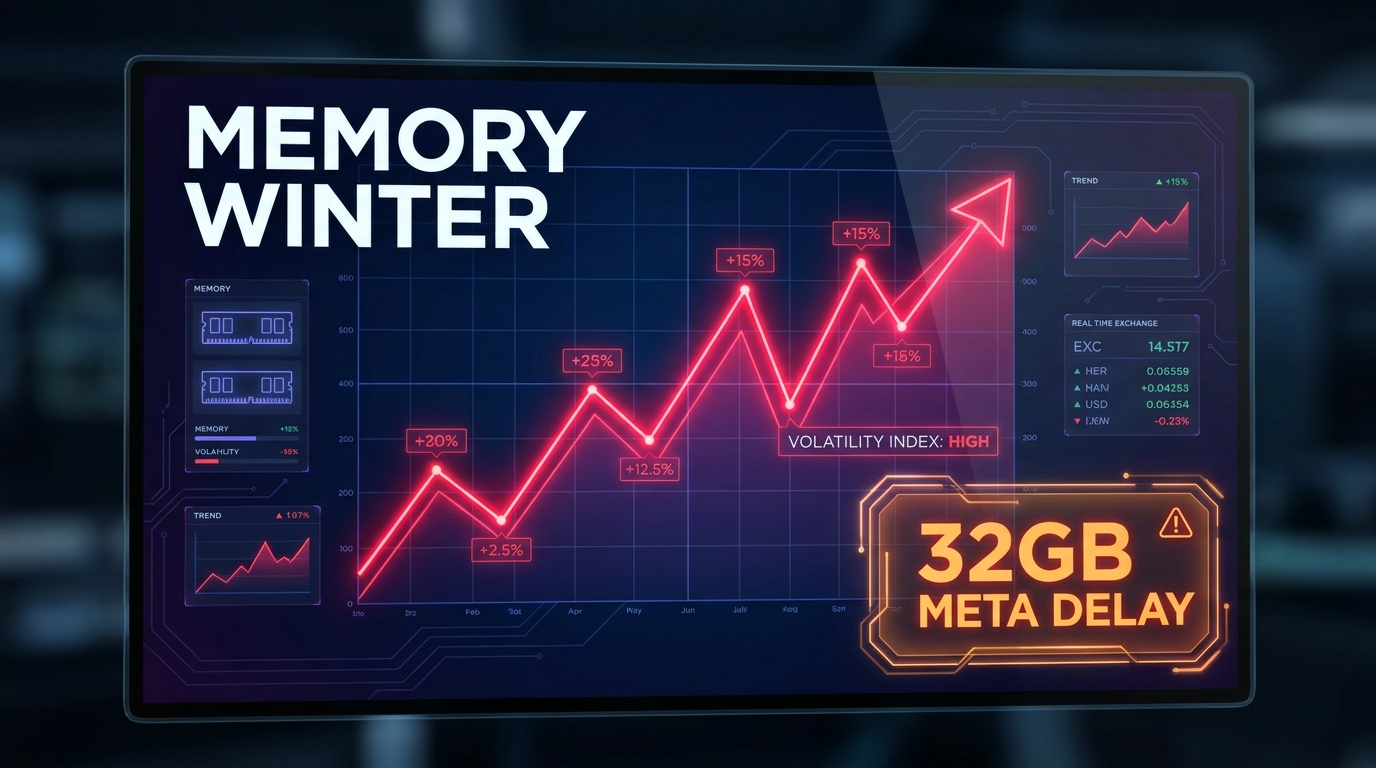
Hyperscalers—specifically Cloud Service Providers (CSPs) like Meta, Google, and Microsoft—have already bought out future wafer capacity via multi-year contracts. This dynamic forces mid-market and enterprise IT buyers to pay what the industry calls the "AI Tax," effectively subsidizing hyperscaler AI ambitions through inflated costs for standard enterprise hardware.
Users on community forums and system builders frequently refer to this era as the "Memory Winter." A common consensus among enthusiasts is the reality of the "32GB Meta Delay," where PC builders and enterprise workstation deployers are forced to stick to 32GB builds instead of upgrading to 64GB due to prohibitive RAM costs.
Extreme Spot Market Volatility and Hourly Pricing
The supply-demand imbalance has broken traditional procurement workflows. Suppliers are increasingly suspending standard 30-day quoting and forcing buyers into an "hourly pricing model." In this state of extreme volatility, spot market pricing fluctuates daily or hourly, making traditional quarterly budget approvals nearly impossible to execute without massive buffer margins.
DRAM Price Trends 2026 and NAND Flash Pricing Forecast Data
Contract prices for conventional DRAM and NAND Flash are compounding sequentially each quarter in 2026, driven by AI server demand and structural supply constraints.
Annual Price Surges
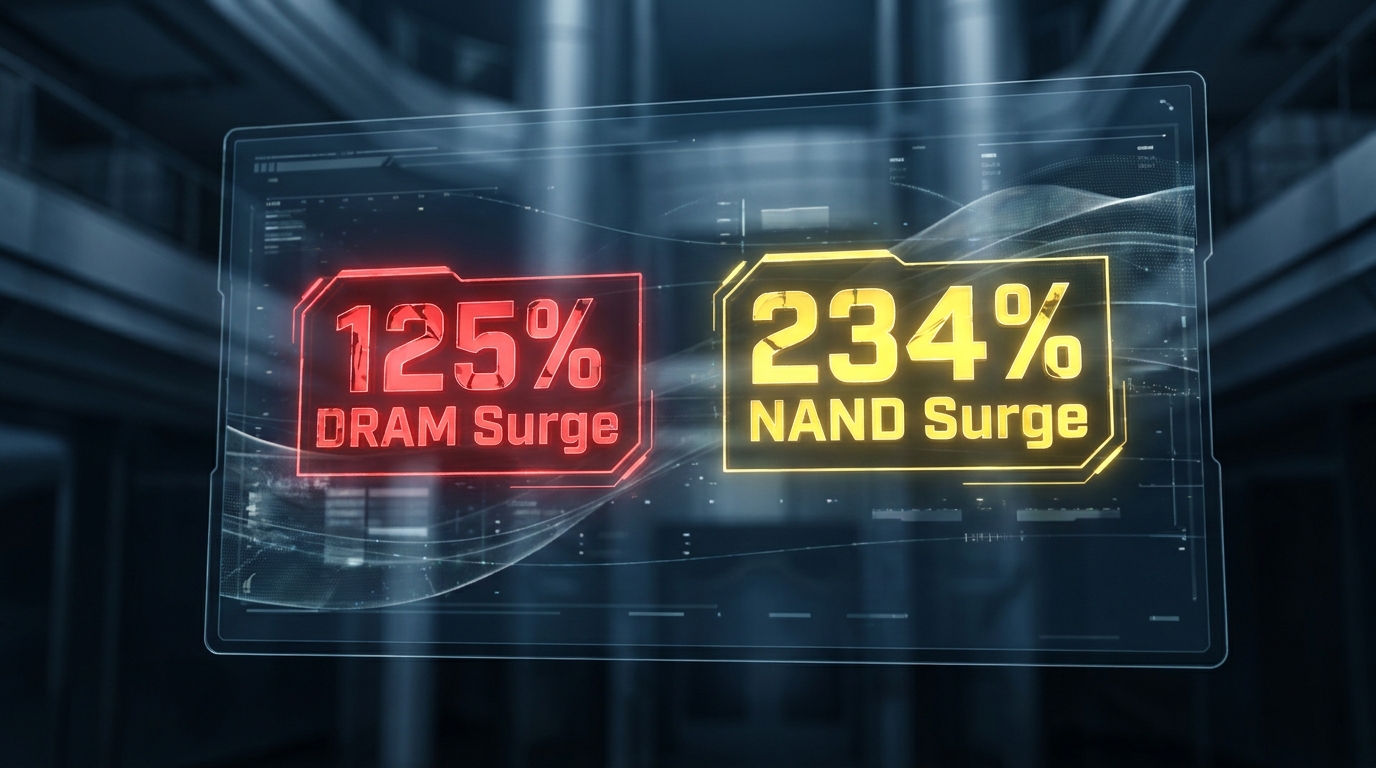
Gartner's official forecast confirms the severity of the budget destruction sourcing managers face. The projected 125% increase in DRAM and 234% surge in NAND flash prices year-over-year represents a structural market shift. This "memflation" means that a storage array or server cluster quoted in Q4 2025 will cost more than double to provision by the end of 2026. For a standard 100-seat Virtual Desktop Infrastructure (VDI) deployment, this translates to tens of thousands of dollars in unbudgeted hardware costs if procurement is delayed.
Sequential Contract Spikes
Quarter-over-quarter (QoQ) data illustrates the immediate danger of delaying procurement. According to a March 31, 2026 report by TrendForce, Q1 2026 DRAM contract prices surged by a record 90–95% QoQ. For Q2 2026, conventional DRAM contract prices are projected to rise another 58–63% QoQ, while NAND Flash contract prices will jump 70–75% QoQ.
Pro Tip: While many guides suggest waiting for a Q3 dip based on historical consumer cycles, the sequential quarter-over-quarter data proves that prices are compounding rapidly. Delaying orders under the assumption of a cyclical correction will cost enterprise buyers millions in lost purchasing power.
Evaluating Long-Term Agreements for Memory Procurement
Sourcing managers should lock in aggressive Long-Term Agreements (LTAs) for immediate 2026 and early 2027 needs, but explicitly reject contracts with minimum price floors extending into late 2028.
Supplier Price-Floor Risks in Long-Term Agreements
Fabricators, including Samsung, SK Hynix, and Micron, are currently pushing multi-year LTAs with minimum price floors. Suppliers are leveraging the current panic to lock enterprise buyers into artificially high rates for the next three years. Signing a flat-rate LTA today guarantees supply, but it also guarantees maximum expenditure just before new fabrication plants come online.
Strategic Timing: 2026 vs. 2028 Timelines
Meaningful supply relief will not arrive until late 2027 and 2028. This timeline aligns precisely with the operational dates of new fabrication facilities:
- May 2027: SK Hynix's Yongin mega fab begins operations.
- Late 2027: Samsung's fast-tracked P5 line comes online.
- Second Half of 2028: Micron's new Singapore and New York fabs become operational.
According to February 2026 TrendForce data and January 2026 Micron announcements, these facilities will finally introduce genuine physical capacity to the market. Therefore, buyers must explicitly reject supplier LTAs with price floors extending into 2028, as that is exactly when new physical capacity will crash the inflated market prices.
Defensive Procurement Strategies for 2026 Bill of Materials Management
To survive the 2026 memory market, procurement teams must front-load purchasing, restructure budget buffer margins, and shift to hybrid storage architectures to reduce reliance on local NVMe storage.
Front-Loading Early 2026 Purchasing
Because prices are compounding by 50% to 70% per quarter, procurement teams must execute 2026 and early 2027 hardware refreshes immediately. The strategy of spreading capital expenditure evenly across four quarters is mathematically flawed in a hyper-inflationary component market. Front-loading purchases in Q1 and Q2 secures inventory before the Q3/Q4 contract spikes take effect.
Restructuring Bill of Materials Estimates
The traditional 30-day quote validity period is obsolete. Sourcing managers must restructure BOM estimates to include a 40% to 60% volatility buffer if the approval process takes longer than two weeks. Furthermore, IT departments must decouple memory and storage procurement from bare-metal server purchases. Buying unpopulated servers and sourcing RAM/NAND directly from the spot market—when timed correctly—can bypass the massive markups applied by Original Equipment Manufacturers (OEMs).
Architectural Shifts to Mitigate NAND Volatility
Engineering and IT teams must alter device architectures to insulate against NAND volatility. Relying on massive local NVMe storage for every endpoint or edge server is no longer cost-effective.
📺 Enterprise Explained: Should I Make the Switch to NVMe?
For heavy compute workloads requiring maximum local IOPS, high-density local NVMe remains the standard, and is an excellent choice for users who need zero-latency data processing. However, for enterprise deployments prioritizing cost-efficiency, shifting to hybrid storage architectures—where endpoints utilize minimal local flash (e.g., 256GB) and rely heavily on centralized, tiered cloud or NAS storage—offers a more cost-effective path. This reduces the total volume of NAND required per user, directly mitigating the impact of the 234% price surge.
Structured Decision Aid: 2026 Memory Procurement Action Matrix
To navigate the complexities of the 2026 market, procurement teams can use the following framework to align their purchasing strategies with the projected fab timelines.
| Procurement Strategy | Ideal Use Case | Primary Risk Factor | Recommended Action Window |
|---|---|---|---|
| Spot Market Purchasing | Immediate, low-volume hardware refreshes (under 50 units). | Hourly price volatility; zero supply guarantees. | Q1 - Q2 2026 (Execute immediately). |
| Short-Term LTA (12-18 Months) | Enterprise server deployments planned for 2026 and early 2027. | Locking in at peak "memflation" rates. | Negotiate now; cap duration at Q3 2027. |
| Long-Term LTA (36 Months) | Hyperscalers requiring guaranteed wafer capacity for AI clusters. | Paying 2026 peak prices in 2028 when new fabs open. | Avoid. Reject price floors extending past mid-2028. |
| Decoupled BOM Sourcing | Large-scale workstation or VDI rollouts. | Increased internal IT labor for assembly and validation. | Ongoing through 2026. |
Conclusion and Next Steps
The 2026 memory market requires a fundamental shift in how IT departments forecast and execute hardware budgets. The historical commodity cycle has been replaced by a demand-driven structural shortage, heavily skewed by the 3-to-1 wafer capacity drain of High-Bandwidth Memory. With DRAM prices surging 125% and NAND flash increasing by 234%, passive procurement strategies will result in severe budget overruns.
"Memory Winter" is a mathematical reality through at least late 2027. To protect organizational purchasing power, sourcing managers must transition from reactive quoting to proactive defense.
Immediate Next Steps for Procurement Teams:
- Audit Pending Quotes: Immediately review any open hardware quotes from Q4 2025 or Q1 2026. Assume a minimum 50% price increase if the quote has expired.
- Renegotiate LTAs: Review all proposed Long-Term Agreements. Strike any clauses that enforce minimum price floors beyond May 2027 (the opening of SK Hynix's Yongin fab).
- Consult Engineering: Initiate a meeting with IT architects to evaluate hybrid storage models, reducing the baseline NAND requirement for upcoming endpoint refreshes.