What is Decimal
The decimal number system (also known as Arabic) has 10 characters, including (0, 1, 2, 3, 4, 5, 6, 7, 8, 9), and it is the most used number system in our daily lives.
What is Fraction
The number above the black line is the numerator, and the number below the black line is the denominator. Although both the numerator and denominator are natural numbers, the values they themselves represent sometimes cannot be represented as natural numbers.
How to Convert a Negative Decimal to a Fraction
Negative decimals, like positive decimals, can be converted into fractions as long as they are not infinite and do not cycle. For example -π, π is an irrational number, and irrational numbers are not fractions.
When negative decimalizing fractions:
1, first according to the method of decimalizing the fraction conversion;
2, and then add a negative sign in front of the generated fraction.
For example: -0.5=-1/2 -0.3333333...=-1/3
How to Convert a Decimal to a Fraction
How to convert decimals into component numbers needs to be divided into two cases, one is finite decimals and the other isrepeating decimals.
If it is a finite decimal, follow these steps:
1 Write down the finite decimal first, such as 0.325
2 Confirm how many places are behind the decimal point, and convert the decimal into component number form. In the case of 0.325, there are three digits after the decimal point, and the conversion component number is added to the 1 by three zeros, that is, 0.325=325/1000. And so on, 0.3=3/10.
3 Find the greatest common factor (GCF) of the numerator and denominator of this new fraction, then divide the numerator and denominator by the greatest common factor to simplify the fraction. In the example of 325/1000, the maximum GCF divisible by 325 and 1000 is 25, i.e. 25/325=13,25/1000=40, that is 325/1000=13/40, so 0.325=13/40
If it is a repeating decimal, follow these steps:
Method 1: Take the repeating decimal x, multiply it by 10 raised to the power of n to get y, then subtract x from y and divide the result by 10 raised to the power of n minus 1 to simplify and obtain the fraction.
For example, for the repeating decimal 0.3333..., multiply it by 10 to get 3.3333..., then subtract 0.3333... from 3.3333... to get 3, and finally divide 3 by 9 (which is 10^1 - 1) to get 1/3.
Method 2: Take the repeating decimal x, multiply it by 10 raised to the power of n to get y, then divide y by 10 raised to the power of n to get z. Next, subtract z from y, multiply the result by 10 raised to the power of n to get w, then subtract x from w and divide the result by 10 raised to the power of 2n minus 1 to simplify and obtain the fraction.
For example, for the repeating decimal 0.1666..., multiply it by 10 to get 1.6666..., then divide 1.6666... by 10 to get 0.1666..., subtract 0.1666... from 1.6666... to get 1.5, multiply 1.5 by 10 to get 15, subtract 0.1666... from 15 to get 13.3333..., and finally divide 13.3333... by 10 raised to the power of 4 minus 1 to get 13/78.
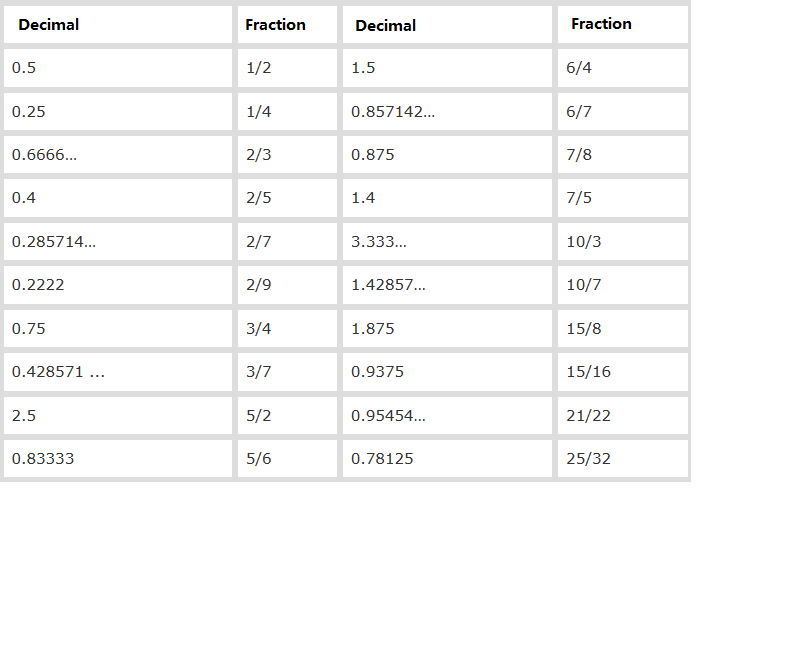
Decimal to Fraction Conversion Table