
Introduction
Definition
Force is one of the fundamental concepts in mechanics, it is an external factor that causes an object to change its motion state or shape. In dynamics, it is equal to the product of an object's mass and acceleration. Force is the interaction between objects and cannot exist independently apart from objects, but forces can also act between two non-contacting objects, and the action of forces is mutual.
In the International System of Units (SI), the unit of measurement for force is the Newton, symbol N (in SI units: kgm/s²).
Force units
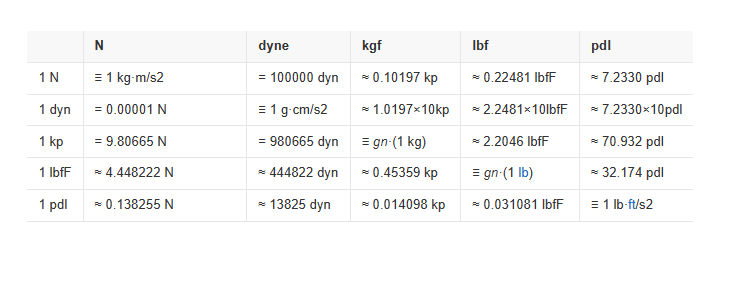
The international unit of force is the Newton (N). In addition, there are other units of force such as the kilogram-force (kgf, 1 kgf = 9.80665 N), the ton-force (tf, 1 tf = 9806.65 N), the dyne (dyn, 1 dyn = 0.00001 N), the poundal (pdl, 1 pdl = 0.138255 N), and the libraforce (lbf, 1 lbf = 4.44822 N).
Types of Force Conversions
dyn: Dyn is a unit in the International System of Units, defined as the force required to accelerate a mass of 1 gram at a rate of 1 centimeter per second squared.
N: Newton is a unit in the International System of Units, defined as the force required to accelerate a mass of 1 kilogram at a rate of 1 meter per second squared.
kgf: Kilogram-force is a unit of force outside of the International System of Units (SI). Although not an international standard unit, kgf is widely used in some regions of Asia, especially in the field of engineering.
pdl: Poundal is a unit of force defined in the British Gravitational System of units. It is the force required to accelerate a mass of one pound at a rate of one foot per second squared.
Formulae for Force Conversion
1. To convert between lbf and N, you can use the following conversion relationship:
1 N = 0.22481 lbf
1 lbf = 4.44822 N
For example: If you want to convert 10 lbf to N, you can use the following formula:
10 lbf × 4.44822 = 44.4822 N
If you want to convert 20 N to lbf, you can use the following formula:
20 N × 0.22481 = 4.4962 lbf
2. To convert between dyn and N, you can use the following conversion relationship:
1 N = 100,000 dyn
1 dyn = 0.00001 N
For example: If you want to convert 75,000 dyn to N, you can use the following formula:
75,000 dyn × 0.00001 = 0.75 N
For example: If you want to convert 500 N to dyn, you can use the following formula:
500 N ×100,000 = 50, 000, 000 dyn
3.To convert between kgf and N, you can use the following conversion relationship:
1 N = 0.102kgf
1 kgf = 9.81 N
For example: If you want to convert 75 kgf to N, you can use the following formula:
75 kgf×9.81= 736.5N
If you want to convert 500 N to kgf, you can use the following formula:
500N×0.102=51kgf
Force unit conversion table
ALSO SEE:
Temperature Conversion - Temperature conversion refers to the process of converting a temperature value from one unit of measurement to another.
Pressure Conversion - Pressure conversion refers to the process of converting a given pressure measurement from one unit of measurement to another.
Force Conversion - A force conversion calculator is a tool that allows you to convert force measurements from one unit to another.